• Fri frakt över 249 kr
  • •
  • Snabba leveranser
  • •
  • Billiga böcker
Kundservice

Du är på sajten för privatpersoner.

Företag, bibliotek eller offentlig verksamhet?

Du handlar på classic.bokus.com, där alla dina funktioner finns intakta.
Till classic.bokus.com
Bokus logotyp. Gå till startsidan.
  • Erbjudanden
  • Nyheter
  • Student
  • Topplistor
  • Barn & ungdom
  • Bokus Play
  • E-böcker
  • Pocketböcker
  • Spel & pussel

10% rabatt på allt med kod: NYSTART10 →

Sidfot

Mina sidor

    Hjälp

    • Kundservice
    • Vanliga frågor och svar
    • Frakt och leverans
    • Retur vid ångerrätt
    • Reklamera vara
    • Betalning
    • Köpvillkor
    • Allmänna villkor
    • Information om webbplatsens tillgänglighet

    Om Bokus

    • Om oss
    • Pressrum
    • För studenter
    • För företag
    • För bibliotek och offentlig verksamhet
    • För leverantörer
    • Hållbarhet

    Populärt

    • Aktuella erbjudanden
    • Presentkort
    • Studentlitteratur
    • Nya böcker
    • Topplistor
    • Signerade böcker
    • Engelska böcker

    Inspiration

    • Boktips
    • BookTok
    • Populära bokserier
    • Barnbokskaraktärer
    • Populära författare
    Logotyp för Bokus
    Följ oss på Facebook (extern länk)Följ oss på Instagram (extern länk)Följ oss på YouTube (extern länk)Följ oss på TikTok (extern länk)
    bokus @ CookiesAnpassa cookiesIntegritetspolicyKöpvillkor
    Till Citymail hemsida (extern länk)Till Budbee hemsida (extern länk)Till Postnord hemsida (extern länk)Till Schenker hemsida (extern länk)Till Early Bird hemsida (extern länk)Till Walleys hemsida (extern länk)
    1. Naturvetenskap och teknik
    2. Matematik och naturvetenskap
    3. Kemi
    4. Analytisk kemi

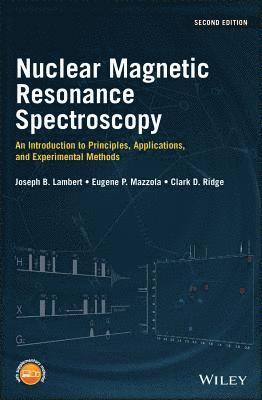
    Nuclear Magnetic Resonance Spectroscopy

    An Introduction to Principles, Applications, and Experimental Methods

    AvJoseph B. Lambert,Eugene P. Mazzola

    Inbunden, Engelska, 2018

    1 020 kr

    Beställningsvara. Skickas inom 5-8 vardagar. Fri frakt över 249 kr.

    Beskrivning

    Combines clear and concise discussions of key NMR concepts with succinct and illustrative examplesDesigned to cover a full course in Nuclear Magnetic Resonance (NMR) Spectroscopy, this text offers complete coverage of classic (one-dimensional) NMR as well as up-to-date coverage of two-dimensional NMR and other modern methods. It contains practical advice, theory, illustrated applications, and classroom-tested problems; looks at such important ideas as relaxation, NOEs, phase cycling, and processing parameters; and provides brief, yet fully comprehensible, examples. It also uniquely lists all of the general parameters for many experiments including mixing times, number of scans, relaxation times, and more.Nuclear Magnetic Resonance Spectroscopy: An Introduction to Principles, Applications, and Experimental Methods, 2nd Edition begins by introducing readers to NMR spectroscopy - an analytical technique used in modern chemistry, biochemistry, and biology that allows identification and characterization of organic, and some inorganic, compounds. It offers chapters covering: Experimental Methods; The Chemical Shift; The Coupling Constant; Further Topics in One-Dimensional NMR Spectroscopy; Two-Dimensional NMR Spectroscopy; Advanced Experimental Methods; and Structural Elucidation. Features classical analysis of chemical shifts and coupling constants for both protons and other nuclei, as well as modern multi‐pulse and multi-dimensional methodsContains experimental procedures and practical advice relative to the execution of NMR experimentsIncludes a chapter-long, worked-out problem that illustrates the application of nearly all current methodsOffers appendices containing the theoretical basis of NMR, including the most modern approach that uses product operators and coherence-level diagramsBy offering a balance between volumes aimed at NMR specialists and the structure-determination-only books that focus on synthetic organic chemists, Nuclear Magnetic Resonance Spectroscopy: An Introduction to Principles, Applications, and Experimental Methods, 2nd Edition is an excellent text for students and post-graduate students working in analytical and bio-sciences, as well as scientists who use NMR spectroscopy as a primary tool in their work.

    Produktinformation

    • Utgivningsdatum:2018-12-21
    • Mått:168 x 246 x 25 mm
    • Vikt:1 066 g
    • Format:Inbunden
    • Språk:Engelska
    • Antal sidor:480
    • Upplaga:2
    • Förlag:John Wiley & Sons Inc
    • ISBN:9781119295235

    Utforska kategorier

    • Analytisk kemi inom Naturvetenskap och teknik

    Mer om författaren

    Joseph B. Lambert, Ph.D., is Research Professor of Chemistry at Trinity University.Eugene P. Mazzola, Ph.D., is an adjunct professor of chemistry at the University of Maryland as well as a researcher at the UMD‐FDA Joint Institute for Food Safety and Applied Nutrition.Clark D. Ridge, Ph.D., is an NMR spectroscopist based at the Health and Human Sciences division of the FDA at College Park, Maryland.

    Innehållsförteckning

    • Preface to First EditionPreface to Second EditionSymbolsAbbreviations1. Introduction1.1. Magnetic Properties of Nuclei1.2. The Chemical Shift1.3. Excitation and Relaxation1.4. Pulsed Experiments1.5. The Coupling Constant1.6. Quantitation and Complex Splitting1.7. Commonly Studied Nuclides1.8. Dynamic Effects1.9. Spectra of SolidsProblemsTips on Solving NMR ProblemsBibliography2. Introductory Experimental Methods2.1. The Spectrometer2.2. Sample Preparation2.3. Optimizing the Signal2.3a. Sample Tube Placement2.3b. Probe Tuning2.3c. Field/Frequency Locking2.3d. Spectrometer Shimming2.4. Determination of NMR Spectra-Acquisition Parameters2.4a. Number of Data Points2.4b. Spectral Width2.4c. Filter Bandwidth2.4d. Acquisition Time2.4e. Transmitter Offset2.4f. Flip Angle2.4g. Receiver Gain2.4h. Number of Scans2.4i. Steady-State Scans2.4j. Oversampling and Digital Filtration2.4k. Decoupling for X Nuclei2.4l. Typical NMR Experiments2.5. Determination of NMR Spectral-Processing Parameters2.5a. Exponential Weighting2.5b. Zero Filling2.5c. FID Truncation and Spectral Artifacts2.5d. Resolution2.6. Determination of NMR Spectra:  Spectral Presentation2.6a. Signal Phasing and Baseline Correction2.6b. Zero Referencing2.6c. Determination of Certain NMR Parameters2.7. Calibrations2.7a. Pulse Width (Flip Angle)2.8b. Decoupler Field StrengthProblemsBibliography3. The Chemical Shift3.1. Factors That Influence Proton Shifts3.2. Proton Chemical Shifts and Structure3.2a. Saturated Aliphatics3.2b. Unsaturated Aliphatics3.2c. Aromatics3.2d. Protons on Oxygen and Nitrogen3.2e. Programs for Empirical Calculations3.3. Medium and Isotope Effects3.4. Factors That Influence Carbon Shifts3.5. Carbon Chemical Shifts and Structure3.5a. Saturated Aliphatics3.5b. Unsaturated Compounds3.5c. Carbonyl Groups3.5d. Programs for Empirical Calculation3.6. Tables of Chemical ShiftsProblemsFurther Tips on Solving NMR ProblemsBibliography4. The Coupling Constant4.1. First- and Second-Order Effects4.2. Chemical and Magnetic Equivalence4.3. Signs and Mechanisms of Coupling4.4. Couplings over One Bond4.5. Geminal Couplings4.6. Vicinal Couplings4.7. Long-Range Couplings4.8. Spectral Analysis4.9. Tables of Coupling ConstantsProblemsBibliography5. Further Topics in One-Dimensional NMR Spectroscopy5.1. Spin-Lattice and Spin-Spin Relaxation5.2. Reactions on the NMR Time Scale5.3. Multiple Resonance5.4. The Nuclear Overhauser Effect5.5. Spectral Editing5.6. Sensitivity Enhancement5.7. Carbon Connectivity5.8. Phase Cycling, Composite Pulses, and Shaped PulsesProblemsBibliography6. Two-Dimensional NMR Spectroscopy6.1. Proton-Proton Correlation Through J Coupling6.2. Proton-Heteronucleus Correlation6.3. Proton-Proton Correlation Through Space or Chemical Exchange6.4. Carbon-Carbon Correlation6.5. Higher Dimensions6.6. Pulsed Field Gradients6.7. Diffusion-Ordered Spectroscopy6.7. Summary of Two-Dimensional MethodsProblemsBibliography7. Advanced Experimental MethodsPart A. One-Dimensional Techniques7.1. T1 Measurements7.2. 13C Spectral Editing Experiments7.2a. The APT Experiment7.2b. The DEPT Experiment7.3. NOE Experiments7.3a. The NOE Difference Experiment7.3b. The Double-Pulse, Field-Gradient, Spin-Echo NOE ExperimentPart B. Two-Dimensional Techniques7.4. Two-Dimensional NMR Data-Acquisition Parameters7.4a. Number of Data Points7.4b. Number of Time Increments7.4c. Spectral Widths7.4d. Acquisition Time7.4e. Transmitter Offset7.4f. Flip Angle7.4g. Relaxation Delay7.4h. Receiver Gain7.4i. Number of Scans per Time Increment7.4j. Steady-State Scans7.5. Two-Dimensional NMR Data-Processing Parameters7.5a. Weighting Functions7.5b. Zero Filling7.5c. Digital Resolution7.5d. Linear Prediction7.6. Two-Dimensional NMR Data Display7.6a. Phasing and Zero Referencing7.6b. Symmetrization7.6c. Use of Cross Sections in AnalysisPart C. Two-Dimensional Techniques:  The Experiments7.7. Homonuclear Chemical-Shift Correlation Experiments via Scalar Coupling7.7a. The COSY Family:  COSY-90°, COSY-45°, Long-Range COSY, and DQF-COSY7.7b. The TOCSY Experiment7.8. Direct Heteronuclear Chemical-Shift Correlation via Scalar Coupling7.8a. The HMQC Experiment7.8b. The HSQC Experiment7.8c. The HETCOR Experiment7.9. Indirect Heteronuclear Chemical-Shift Correlation via Scalar Coupling7.9a. The HMBC Experiment7.9b. The FLOCK Experiment7.9c. The HSQC-TOCSY Experiment7.10. Homonuclear Chemical-Shift Correlation via Dipolar Coupling7.10a. The NOESY Experiment7.10b. The ROESY Experiment7.11. 1D and Advanced 2D Experiments7.11a. The 1D TOCSY Experiment7.11b. The 1D NOESY and ROESY Experiments7.11c. The Multiplicity-Edited HSQC Experiment7.11d. The H2BC Experiment7.11e. Nonuniform Sampling7.11f. Pure Shift NMR7.11g. Covariance NMR7.12. Pure Shift-Covariance NMRBibliography8. Structural Elucidation:  An ExamplePart A. Spectral Analysis8.1. 1H NMR Data8.2. 13C NMR Data8.3. The DEPT Experiment8.4. The HSQC Experiment8.5. The COSY Experiment8.6. The HMBC Experiment8.7. General Molecular Assembly Strategy8.8. A Specific Molecular Assembly Procedure8.9. The NOESY ExperimentPart B Computer-Assisted Structure Elucidation8.10. CASE Procedures8.11. T-2 ToxinAppendix 1 Derivation of the NMR EquationAppendix 2 The Bloch EquationsAppendix 3 Quantum Mechanical Treatment of the Two-Spin SystemAppendix 4 Analysis of Second-Order, Three- and Four-Spin Systems by InspectionAppendix 5 RelaxationAppendix 6 Product-Operator Formalism and Coherence-Level DiagramsBibliographyAppendix 7 Stereochemical ConsiderationsA7.1. Homotopic GroupsA7.2. Enantiotopic GroupsA7.3. Diastereotopic GroupsBibliographyIndex