• Fri frakt över 249 kr
  • •
  • Snabba leveranser
  • •
  • Billiga böcker
Kundservice

Du är på sajten för privatpersoner.

Företag, bibliotek eller offentlig verksamhet?

Du handlar på classic.bokus.com, där alla dina funktioner finns intakta.
Till classic.bokus.com
Bokus logotyp. Gå till startsidan.
  • Erbjudanden
  • Nyheter
  • Student
  • Topplistor
  • Barn & ungdom
  • Bokus Play
  • E-böcker
  • Pocketböcker
  • Spel & pussel

10% rabatt på allt med kod NYSTART10 →

Sidfot

Mina sidor

    Hjälp

    • Kundservice
    • Vanliga frågor och svar
    • Frakt och leverans
    • Retur vid ångerrätt
    • Reklamera vara
    • Betalning
    • Köpvillkor
    • Allmänna villkor
    • Information om webbplatsens tillgänglighet

    Om Bokus

    • Om oss
    • Pressrum
    • För studenter
    • För företag
    • För bibliotek och offentlig verksamhet
    • För leverantörer
    • Hållbarhet

    Populärt

    • Aktuella erbjudanden
    • Presentkort
    • Studentlitteratur
    • Nya böcker
    • Topplistor
    • Signerade böcker
    • Engelska böcker

    Inspiration

    • Boktips
    • BookTok
    • Populära bokserier
    • Barnbokskaraktärer
    • Populära författare
    Logotyp för Bokus
    Följ oss på Facebook (extern länk)Följ oss på Instagram (extern länk)Följ oss på YouTube (extern länk)Följ oss på TikTok (extern länk)
    bokus @ CookiesAnpassa cookiesIntegritetspolicyKöpvillkor
    Till Citymail hemsida (extern länk)Till Budbee hemsida (extern länk)Till Postnord hemsida (extern länk)Till Schenker hemsida (extern länk)Till Early Bird hemsida (extern länk)Till Walleys hemsida (extern länk)
    1. Naturvetenskap och teknik
    2. Teknik och industri
    3. Elektronik och kommunikationer

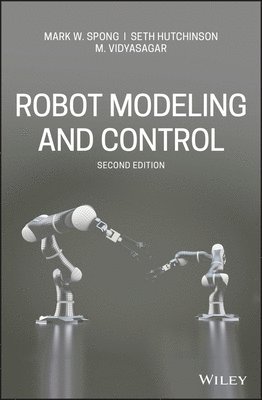
    Robot Modeling and Control

    AvMark W. Spong,Seth Hutchinson

    Inbunden, Engelska, 2020

    1 729 kr

    Beställningsvara. Skickas inom 5-8 vardagar. Fri frakt över 249 kr.

    Beskrivning

    A New Edition Featuring Case Studies and Examples of the Fundamentals of Robot Kinematics, Dynamics, and ControlIn the 2nd Edition of Robot Modeling and Control, students will cover the theoretical fundamentals and the latest technological advances in robot kinematics. With so much advancement in technology, from robotics to motion planning, society can implement more powerful and dynamic algorithms than ever before. This in-depth reference guide educates readers in four distinct parts; the first two serve as a guide to the fundamentals of robotics and motion control, while the last two dive more in-depth into control theory and nonlinear system analysis.With the new edition, readers gain access to new case studies and thoroughly researched information covering topics such as: ●      Motion-planning, collision avoidance, trajectory optimization, and control of robots●      Popular topics within the robotics industry and how they apply to various technologies●      An expanded set of examples, simulations, problems, and case studies●      Open-ended suggestions for students to apply the knowledge to real-life situationsA four-part reference essential for both undergraduate and graduate students, Robot Modeling and Control serves as a foundation for a solid education in robotics and motion planning.

    Produktinformation

    • Utgivningsdatum:2020-02-27
    • Mått:170 x 249 x 38 mm
    • Vikt:1 203 g
    • Format:Inbunden
    • Språk:Engelska
    • Antal sidor:608
    • Upplaga:2
    • Förlag:John Wiley & Sons Inc
    • ISBN:9781119523994

    Utforska kategorier

    • Elektronik och kommunikationer inom Naturvetenskap och teknik

    Mer om författaren

    MARK W. SPONG has been researching and teaching robotics for over 35 years. He currently serves as a Professor, Excellence in Education Chair, in the Department of Systems Engineering at the University of Texas at Dallas. He has been recognized for outstanding achievements including the John R. Ragazzini Award for Control Education and the IEEE RAS Pioneer in Robotics Award. He is currently a Fellow of both IEEE and IFAC. SETH HUTCHINSON received his Ph.D. from Purdue University in 1988, and is currently Professor and KUKA Chair for Robotics in the School of Interactive Computing at the Georgia Institute of Technology, where he also serves as Executive Director of the Institute for Robotics and Intelligent Machines. He was the Founding Editor-in-Chief of the IEEE Robotics and Automation Society's Conference Editorial Board, Editor-in-Chief of the IEEE Transactions on Robotics, and is a Fellow of the IEEE. His research in robotics spans the areas of planning, sensing, and control. MATHUKUMALLI VIDYASAGAR received his Ph.D. in electrical engineering in 1969 from the University of Wisconsin in Madison. During his fifty-year career, he has worked in control theory, machine learning, robotics and cancer biology. Among the many honors he has received are Fellowship in The Royal Society and the IEEE Control Systems Award. At present he is a Distinguished Professor at the Indian Institute of Technology Hyderabad.

    Innehållsförteckning

    • Preface v1 Introduction 11.1 Mathematical Modeling of Robots 51.2 Robots as Mechanical Devices 71.3 Common Kinematic Arrangements 131.4 Outline of the Text 18Problems 27Notes and References 29I The Geometry of Robots 332 Rigid Motions 352.1 Representing Positions 362.2 Representing Rotations 382.3 Rotational Transformations 442.4 Composition of Rotations 482.5 Parameterizations of Rotations 522.6 Rigid Motions 612.7 Chapter Summary 65Problems 67Notes and References 733 Forward Kinematics 753.1 Kinematic Chains 753.2 The Denavit-Hartenberg Convention 783.3 Examples 873.4 Chapter Summary 96Problems 96Notes and References 994 Velocity Kinematics 1014.1 Angular Velocity: The Fixed Axis Case 1024.2 Skew-Symmetric Matrices 1034.3 Angular Velocity: The General Case 1074.4 Addition of Angular Velocities 1084.5 Linear Velocity of a Point Attached to a Moving Frame 1104.6 Derivation of the Jacobian 1114.7 The Tool Velocity 1194.8 The Analytical Jacobian 1214.9 Singularities 1224.10 Static Force/Torque Relationships 1294.11 Inverse Velocity and Acceleration 1314.12 Manipulability 1334.13 Chapter Summary 136Problems 138Notes and References 1405 Inverse Kinematics 1415.1 The General Inverse Kinematics Problem 1415.2 Kinematic Decoupling 1435.3 Inverse Position: A Geometric Approach 1455.4 Inverse Orientation 1515.5 Numerical Inverse Kinematics 1565.6 Chapter Summary 158Problems 160Notes and References 162II Dynamics and Motion Planning 1636 Dynamics 1656.1 The Euler-Lagrange Equations 1666.2 Kinetic and Potential Energy 1776.3 Equations of Motion 1816.4 Some Common Configurations 1846.5 Properties of Robot Dynamic Equations 1946.6 Newton-Euler Formulation 1986.7 Chapter Summary 209Problems 211Notes and References 2147 Path and Trajectory Planning 2157.1 The Configuration Space 2167.2 Path Planning for Q = ℝ2 2217.3 Artificial Potential Fields 2297.4 Sampling-Based Methods 2457.5 Trajectory Planning 2527.6 Chapter Summary 263Problems 265Notes and References 267III Control of Manipulators 2698 Independent Joint Control 2718.1 Introduction 2718.2 Actuator Dynamics 2738.3 Load Dynamics 2768.4 Independent Joint Model 2788.5 PID Control 2818.6 Feedforward Control 2888.7 Drive-Train Dynamics 2928.8 State Space Design 2978.9 Chapter Summary 304Problems 307Notes and References 3099 Nonlinear and Multivariable Control 3119.1 Introduction 3119.2 PD Control Revisited 3139.3 Inverse Dynamics 3179.4 Passivity-Based Control 3299.5 Torque Optimization 3339.6 Chapter Summary 337Problems 341Notes and References 34310 Force Control 34510.1 Coordinate Frames and Constraints 34710.2 Network Models and Impedance 35110.3 Task Space Dynamics and Control 35510.4 Chapter Summary 361Problems 362Notes and References 36411 Vision-Based Control 36511.1 Design Considerations 36611.2 Computer Vision for Vision-Based Control 36811.3 Camera Motion and the Interaction Matrix 37811.4 The Interaction Matrix for Point Features 37911.5 Image-Based Control Laws 38611.6 End Effector and Camera Motions 39311.7 Partitioned Approaches 39411.8 Motion Perceptibility 39711.9 Summary 399Problems 401Notes and References 40512 Feedback Linearization 40912.1 Background 41012.2 Feedback Linearization 41712.3 Single-Input Systems 41912.4 Multi-Input Systems 42912.5 Chapter Summary 433Problems 433Notes and References 435IV Control of Underactuated Systems 43713 Underactuated Robots 43913.1 Introduction 43913.2 Modeling 44013.3 Examples of Underactuated Robots 44313.4 Equilibria and Linear Controllability 44813.5 Partial Feedback Linearization 45613.6 Output Feedback Linearization 46113.7 Passivity-Based Control 46613.8 Chapter Summary 474Problems 476Notes and References 47714 Mobile Robots 47914.1 Nonholonomic Constraints 48014.2 Involutivity and Holonomy 48414.3 Examples of Nonholonomic Systems 48714.4 Dynamic Extension 49314.5 Controllability of Driftless Systems 49514.6 Motion Planning 49914.7 Feedback Control of Driftless Systems 50914.8 Chapter Summary 519Problems 520Notes and References 521A Trigonometry 523A.1 The Two-Argument Arctangent Function 523A.2 Useful Trigonometric Formulas 523B Linear Algebra 525B.1 Vectors 525B.2 Inner Product Spaces 526B.3 Matrices 528B.4 Eigenvalues and Eigenvectors 530B.5 Differentiation of Vectors 533B.6 The Matrix Exponential 534B.7 Lie Groups and Lie Algebras 534B.8 Matrix Pseudoinverse 536B.9 Schur Complement 536B.10 Singular Value Decomposition (SVD) 537C Lyapunov Stability 539C.1 Continuity and Differentiability 539C.2 Vector Fields and Equilibria 541C.3 Lyapunov Functions 545C.4 Stability Criteria 545C.5 Global and Exponential Stability 546C.6 Stability of Linear Systems 547C.7 LaSalle's Theorem 548C.8 Barbalat's Lemma 549D Optimization 551D.1 Unconstrained Optimization 551D.2 Constrained Optimization 552E Camera Calibration 555E.1 The Image Plane and the Sensor Array 555E.2 Extrinsic Camera Parameters 556E.3 Intrinsic Camera Parameters 557E.4 Determining the Camera Parameters 557Bibliography 561Index 576