• Fri frakt över 249 kr
  • •
  • Snabba leveranser
  • •
  • Billiga böcker
Kundservice

Du är på sajten för privatpersoner.

Företag, bibliotek eller offentlig verksamhet?

Du handlar på classic.bokus.com, där alla dina funktioner finns intakta.
Till classic.bokus.com
Bokus logotyp. Gå till startsidan.
  • Erbjudanden
  • Nyheter
  • Student
  • Topplistor
  • Barn & ungdom
  • Bokus Play
  • E-böcker
  • Pocketböcker
  • Spel & pussel

10% rabatt på allt med kod: NYSTART10 →

Sidfot

Mina sidor

    Hjälp

    • Kundservice
    • Vanliga frågor och svar
    • Frakt och leverans
    • Retur vid ångerrätt
    • Reklamera vara
    • Betalning
    • Köpvillkor
    • Allmänna villkor
    • Information om webbplatsens tillgänglighet

    Om Bokus

    • Om oss
    • Pressrum
    • För studenter
    • För företag
    • För bibliotek och offentlig verksamhet
    • För leverantörer
    • Hållbarhet

    Populärt

    • Aktuella erbjudanden
    • Presentkort
    • Studentlitteratur
    • Nya böcker
    • Topplistor
    • Signerade böcker
    • Engelska böcker

    Inspiration

    • Boktips
    • BookTok
    • Populära bokserier
    • Barnbokskaraktärer
    • Populära författare
    Logotyp för Bokus
    Följ oss på Facebook (extern länk)Följ oss på Instagram (extern länk)Följ oss på YouTube (extern länk)Följ oss på TikTok (extern länk)
    bokus @ CookiesAnpassa cookiesIntegritetspolicyKöpvillkor
    Till Citymail hemsida (extern länk)Till Budbee hemsida (extern länk)Till Postnord hemsida (extern länk)Till Schenker hemsida (extern länk)Till Early Bird hemsida (extern länk)Till Walleys hemsida (extern länk)
    1. Samhälle och politik
    2. Politik och statsskick

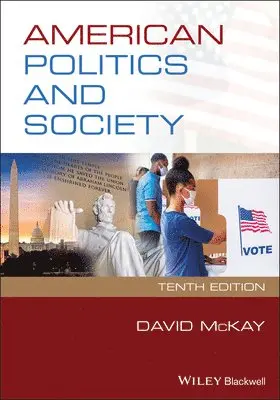
    American Politics and Society

    AvDavid McKay

    Häftad, Engelska, 2021

    451 kr

    Beställningsvara. Skickas inom 5-8 vardagar. Fri frakt över 249 kr.

    Fler format och utgåvor

    E-bok

    536 kr

    E-bok

    538 kr

    E-bok

    568 kr

    E-bok

    568 kr

    Beskrivning

    Provides an up-to-date introduction and analysis of the US political scene written from a comparative perspective, newly revised and updated throughoutAmerican Politics and Society in an accessible introduction to the main institutions of the US federal government, discussing the most recent developments in broader economic, social, and comparative contexts. Now in its tenth edition, this popular textbook applies an international perspective to the relevance of historical trends, research findings in political science, and present-day governmental procedures, structures, and debates. Acclaimed author David McKay guides students through the complexities of the American political system while encouraging them to evaluate the widening ideological divide that now defines American political life and public discourse.Since the publication of the previous edition, America has undergone some of the most dramatic events in its history—from the COVID-19 pandemic, to the widespread protests against racial and economic injustice, to the aggressive populist rhetoric of Donald Trump, to the bitterly contested 2020 presidential election that culminated in the violent assault on the US Capitol. In this edition, the author addresses the escalating ideological conflict, the rise of extremism in the Republican Party, arguments over the proper role of government, the public’s expectations of politicians and political processes, and more. Offering valuable insights into both the social-political past and present of America, this classic textbook: Examines the policy process in such areas as civil rights, social policy, economic policy, the environment, and foreign policyEvaluates the performance of US government over the last decade and audits the broader American political systemEncourages students to critically assess the US government in areas of democratic responsiveness and public accountabilityCompares international social-political perspectives to those that are uniquely AmericanDiscusses of the role of beliefs and values in American politics and how they influence broader society and economyThanks to its clear and engaging narrative and its wealth of pedagogical features, American Politics and Society, Tenth Edition remains the ideal introductory textbook for courses exploring the institutions and processes of the US government and the most important events in the current American social and political landscape.

    Produktinformation

    • Utgivningsdatum:2021-11-18
    • Mått:175 x 252 x 31 mm
    • Vikt:1 066 g
    • Format:Häftad
    • Språk:Engelska
    • Antal sidor:512
    • Upplaga:10
    • Förlag:John Wiley and Sons Ltd
    • ISBN:9781119578369

    Utforska kategorier

    • Politik och statsskick inom Samhälle och politik

    Mer om författaren

    David McKay, Emeritus Professor of Government at the University of Essex, UK, is the author of numerous books and articles on American and comparative politics, including Designing Europe: Comparative Lessons from the Federal Experience, which won the Political Studies Association W. J. M. MacKenzie prize in 2001. He is also co-author of Controversies in American Politics (Wiley Blackwell, 2002).

    Innehållsförteckning

    • List of Plates xiiList of Figures xivList of Tables xviiPreface to the Tenth Edition xviii1 Governing in a Polarized Society 1Chapters to Come 5Glossary 52 Beliefs, Values and American Society 6The Nature of American Beliefs and Values 7Values and American Society 17Controversy 2.1. Immigration: The Changing Nature of the Debate 23Controversy 2.2. How Classless is American Society? 26Controversy 2.3. Americans’ Ambivalent View of Government and Taxes 27Social Structure 27Summary 38Questions for Discussion 38Glossary 38Notes 39Further Reading 403 Constitutional Government 41Origins 42The American Constitution 46Biographies. Hamilton and Madison 52Ratification 52The Adaptive Constitution 54Controversy 3.1. How Democratic is the Constitution? 58Assessing the Constitution 59Summary 60Questions for Discussion 61Glossary 61Notes 62Further Reading 624 Federalism: Cooperation and Conflict 63Federalism in Theory and Practice 64The Evolution of American Federalism 68The Changing Federal Role 70Controversy 4.1. Federal versus State Power 72Briefing 4.1. US Federalism in Comparative Perspective 75A Changing Court Role? 80The Future of American Federalism 82Summary 84Questions for Discussion 84Glossary 84Notes 86Further Reading 865 American Political Parties: Polarization and Conflict 87The Functions of Parties 88Briefing 5.1. Why Only Two Parties in the US? 93Crisis and Change in the American Party System 94The Decline and Rise of Political Parties 100Biographies: Lee Atwater and Karl Rove – Republican Party ‘Heavies’ 102Changing Party Ideology: 1970–2021 102Explaining Party Change 105Briefing 5.2. Populism and American Political Parties 106Stronger but More Polarized Parties 107Briefing 5.3. The Tea Party Movement and its Legacy 108Summary 109Questions for Discussion 109Glossary 109Notes 110Further Reading 1116 Elections and Political Participation 112Patterns of American Electoral Behaviour 114The ‘American Voter’ Model and the New Deal Coalition 122The Decline of the New Deal Coalition and the Rise of a Divided Electorate 124Controversy 6.1. Non-voting: Does it Matter? 127Controversy 6.2. Are American Elections Corrupt? 128Controversy 6.3. Does the Decline in Social Capital Matter? 133Non-Electoral Political Participation 134Summary 139Questions for Discussion 139Glossary 139Notes 140Further Reading 1417 The Media and American Politics 142Media Structure and Organization 143Organization and Ownership 144How Biased? The Media and the Political Agenda 146Biography. The Rise and Fall of Roger Ailes Creator of the Fox News Network 150Controversy 7.1. Legitimizing the Conservative Right? The Role of Real Clear Politics 152Controversy 7.2. How Biased Are Television, Radio and the Electronic Media? 152Controlling the Media 153The Media and American Democracy 154Summary 155Questions for Discussion 156Glossary 156Notes 156Further Reading 1578 Congress I: The People’s Branch? 158Representation and Congress 160Briefing 8.1. Forms of Representation 162Congressional Elections 163Legislators as Rational Actors 170Biography. Jim Jordan: Freedom Caucus Firebrand 172The Work of Members of Congress 175Conclusions 177Summary 178Questions for Discussion 178Glossary 179Notes 179Further Reading 1809 Congress II: Functions and Powers – The Broken Branch? 181The Functions of Congress 182The Structure of Power in Congress 183Congress Under Fire 191Biography. Jack Abramoff: Master Lobbyist and Convicted Felon 201Controversy 9.1. Divided Government: For and Against 201Biography. Alexandra Ocasio-Cortez (AOC) and the ‘Squad’ 202Reform and Change in Congress 202Is Congress the ‘Broken Branch’? 207Summary 208Questions for Discussion 208Glossary 209Notes 210Further Reading 21010 The Presidency I: Powers and Selection 211Formal Sources of Power 212Briefing 10.1. The American Presidency: A Unitary Institution 214Informal Powers 215Presidential Selection 217Controversy 10.1. Primaries: For and Against 220Briefing 10.2. The Role of Money 222Presidential Selection: Faults and Foibles 228Summary 230Questions for Discussion 230Glossary 230Notes 231Further Reading 23111 The Presidency II: The President as Chief Executive 232The Presidency in a Changing America 233Presidential Abuse of Power and the Congressional Response 238Presidential Resources 241Biography. Steve Bannon: Political Strategist and Crisis Junkie 244Briefing 11.1. Organizing the White House 245Assessing the Presidency: Presidential Power at Home and Abroad 253Summary 255Questions for Discussion 255Glossary 255Notes 256Further Reading 25612 Bureaucratic Power: Federal Departments and Agencies 258The Federal Bureaucracy: Organization and Function 260Controversy 12.1. Privatization: For and Against 265The Bureaucracy: How Uncontrollable? 266The Inherent Power of Bureaucracy 266The Bureaucratic Hydra: A Uniquely American Phenomenon? 268Reform Attempts 271Concluding Remarks 275Summary 276Questions for Discussion 276Glossary 277Notes 278Further Reading 27813 The Security State 279The Rise of the Security State 2809/11, the Patriot Act and the Department of Homeland Security 282Briefing 13.1. The Department of Homeland Security and the Culture of Threat 284Threats to Civil Liberties 285Trump and the Security State 287The Security State and American Values 289Summary 291Questions for Discussion 291Glossary 291Notes 292Further Reading 29214 Organized Interests: The Real Power? 293Interests, Groups and Lobbyists 295Economic Groups 297Briefing 14.1. The Enron Collapse and Crony Capitalism 298Controversy 14.1. Do the Bankruptcy Laws Damage Workers’ Rights? 299Professional Groups 303Promotional Groups 305Political Action Committees 307The Washington Lobby 309Interest Groups: For and Against 309Summary 313Questions for Discussion 313Glossary 313Notes 314Further Reading 31515 The Supreme Court and Judicial Politics 316The American Legal System 318The Supreme Court: Decision Making 321The Supreme Court and Political Power 326Controversy 15.1. The Supreme Court: An Active or a Passive Role? 333Briefing 15.1. The Supreme Court and the Guantánamo Bay Detainees 338The Polarized Rehnquist and Roberts Courts 339Conclusions: The Court and American Democracy 343Summary 344Questions for Discussion 344Glossary 345Notes 346Further Reading 34616 Regulating Morality: Civil Rights, Liberties and the Conscience Issues 347Introduction 348Regulating Public Morality 348Civil Liberties 349Controversy 16.1. What’s So Wrong with Gun Control? 356Briefing 16.1. Abortion and American Politics 357Equality and Civil Rights 358Briefing 16.2. Federalism and Same-Sex Marriage 364Conclusions 364Summary 365Questions for Discussion 365Glossary 366Note 367Further Reading 36717 Social Policy in America: Self-Reliance and State Dependence 368The Federal Government and Social Welfare in America: The Reluctant Provider 369Federalism 371Social Security, Medicare and the Electoral Connection 372The Continuing Importance of Self-reliance 374Briefing 17.1. Why was Health Care So Hard to Reform? 374Health-care Reforms 375The Federal Government and Education 377Conclusions 378Summary 379Questions for Discussion 379Glossary 380Further Reading 38018 Managing Economic Change 381State and Economy in the United States 382Ideology and Economic Policy 384Controversy 18.1. Foreign Economic Policy and Trumps America First Policy 387Institutions and Economic Policy 388Briefing 18.1. Institutional Sclerosis and the Budget, 2011–2013 391Briefing 18.2. The Great Housing Crash, 2007–2012 397Conclusions: Economic Policy in an Age of Uncertainty 398Summary 399Questions for Discussion 399Glossary 399Further Reading 40019 Environmental Politics 401Background 402The Emerging Environmental Agenda 402Controversy 19.1. International Cooperation on Climate Change:The Kyoto Protocol and the Paris Treaty on Climate Change 405Policy Actors and Institution 406Chronology 411Political Parties and the Environment 413Conclusions: The Future of Environmental Politics 413Summary 414Questions for Discussion 414Glossary 414Notes 415Further Reading 41520 The American World Role 416The Institutional Context 418American Foreign Policy in the Post-9/11 World 421Briefing 20.1. The Rise and Fall of Neoconservatism 426Conclusions: Bound to Lead or Bound to Fail? 426Summary 428Questions for Discussion 428Glossary 429Notes 429Further Reading 43021 The American Political System in a Divided Society 431Assessing the American Polity 432Reform and Renewal 436Questions for Discussion 438Glossary 438Notes 438Further Reading 438Websites 439Glossary 443Appendix: The Constitution of the United States 455Index 474