• Fri frakt över 249 kr
  • •
  • Snabba leveranser
  • •
  • Billiga böcker
Kundservice

Du är på sajten för privatpersoner.

Företag, bibliotek eller offentlig verksamhet?

Du handlar på classic.bokus.com, där alla dina funktioner finns intakta.
Till classic.bokus.com
Bokus logotyp. Gå till startsidan.
  • Erbjudanden
  • Nyheter
  • Student
  • Topplistor
  • Barn & ungdom
  • Bokus Play
  • E-böcker
  • Pocketböcker
  • Spel & pussel

10% rabatt på allt med kod: NYSTART10 →

Sidfot

Mina sidor

    Hjälp

    • Kundservice
    • Vanliga frågor och svar
    • Frakt och leverans
    • Retur vid ångerrätt
    • Reklamera vara
    • Betalning
    • Köpvillkor
    • Allmänna villkor
    • Information om webbplatsens tillgänglighet

    Om Bokus

    • Om oss
    • Pressrum
    • För studenter
    • För företag
    • För bibliotek och offentlig verksamhet
    • För leverantörer
    • Hållbarhet

    Populärt

    • Aktuella erbjudanden
    • Presentkort
    • Studentlitteratur
    • Nya böcker
    • Topplistor
    • Signerade böcker
    • Engelska böcker

    Inspiration

    • Boktips
    • BookTok
    • Populära bokserier
    • Barnbokskaraktärer
    • Populära författare
    Logotyp för Bokus
    Följ oss på Facebook (extern länk)Följ oss på Instagram (extern länk)Följ oss på YouTube (extern länk)Följ oss på TikTok (extern länk)
    bokus @ CookiesAnpassa cookiesIntegritetspolicyKöpvillkor
    Till Citymail hemsida (extern länk)Till Budbee hemsida (extern länk)Till Postnord hemsida (extern länk)Till Schenker hemsida (extern länk)Till Early Bird hemsida (extern länk)Till Walleys hemsida (extern länk)
    1. Naturvetenskap och teknik
    2. Geovetenskap
    3. Geografi

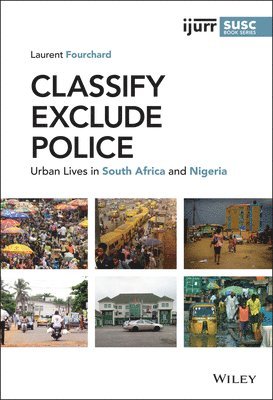
    Classify, Exclude, Police

    Urban Lives in South Africa and Nigeria

    AvLaurent Fourchard

    Inbunden, Engelska, 2021

    Del i serien IJURR Studies in Urban and Social Change Book Series

    828 kr

    Beställningsvara. Skickas inom 5-8 vardagar. Fri frakt över 249 kr.

    Fler format och utgåvor

    Häftad

    281 kr

    E-bok

    317 kr

    E-bok

    947 kr

    Beskrivning

    >CLASSIFY, EXCLUDE, POLICE ‘Laurent Fourchard’s deep, first-hand knowledge of the history and contemporary politics of Nigeria and South Africa forms the basis of an insightful and compelling analysis of how states produce invidious distinctions among their people and at the same time how political linkages are forged between state and society, elites and subalterns, bureaucratic structures and personal relations.’Frederick Cooper, Professor of History, New York University, USA ‘Violence, control, police and political order are essential dimensions of metropolis. In this exceptional book, Laurent Fourchard compares decentralised exercises of authority in providing vivid analysis of exclusion of youth and migrants, policing and riots, politics of “Big men” and fine-grained blurring between bureaucracy and society. A masterpiece of urban politics.’Patrick Le Galès, Dean of Urban School, Sciences Po Paris, France ‘This book is a major contribution to rethinking urban politics from the experiences of African cities. Based on detailed historical analysis of South Africa and Nigeria, Fourchard recalibrates the actors, stakes and terms of urban politics around African-centred concerns.’ Jennifer Robinson, Professor of Geography, University College London, UK The cities of South Africa and Nigeria are reputed to be dangerous, teeming with slums, and dominated by the informal economy but we know little about how people are divided up, categorised and policed. Colonial governments assigned rights and punishments, banned categories considered problematic (delinquents, migrants, single women, street vendors) and give non-state organisations the power to police low-income neighbourhoods. Within this enduring legacy, a tangle of petty arrangements has developed to circumvent exclusion to public places and government offices. In this unpredictable urban reality ??? which has eluded all planning ??? individuals and social groups have changed areas of public action through exclusion, violence and negotiation. In combining historical and ethnographic methods, Classify, Exclude, Police explores the effects and limits of public action, and questions the possibility of comparison between cities often perceived as incommensurable. Focusing on state formation, urbanization, and daily lives, Laurent Fourchard addresses debates and controversies in comparative urban studies, history, political science, and urban anthropology. The book provides a systematic, comparative approach to the practices, processes, arrangements used to create boundaries, direct violence, and produce social, racial, gender, and`generational differences.

    Produktinformation

    • Utgivningsdatum:2021-05-06
    • Mått:152 x 229 x 22 mm
    • Vikt:567 g
    • Format:Inbunden
    • Språk:Engelska
    • Serie:IJURR Studies in Urban and Social Change Book Series
    • Antal sidor:304
    • Förlag:John Wiley & Sons Inc
    • ISBN:9781119582625

    Utforska kategorier

    • Geografi inom Naturvetenskap och teknik
    • Politik och statsskick inom Samhälle och politik

    Mer om författaren

    Laurent Fourchard is Research Professor at the Centre for International Studies (CERI) and at the Urban School of Sciences Po, Paris, France. His research is located at the intersection of comparative urban studies, African history, and African politics. He combines historical and ethnographic methods and privileges a comparative analysis through a description of everyday practices in Nigerian and South African cities. His interests focus on security practices, apparatus of exclusion, colonial and postcolonial governments and negotiation and conflicts in urban public places.

    Innehållsförteckning

    • Series Editors’ Preface viiiAcknowledgements ixClassify, Exclude, Police 1Part I Governing Colonial Urban Space 211 Classifying and Excluding Migrants 25Race and Urban Space 28Differentiating Urbans from Migrants in South Africa 33Stabilisation Policies and Urban Residential Rights 34Reinterpreting the Riots in Sharpeville and Langa 38Differentiating Natives from Non‐Natives in Nigeria 45The Birth of Territorial Enclaves: Non‐Native Neighbourhoods 46Regionalism and Decolonisation 49The Kano Riots 52Conclusion 54Notes 582 The Making of a Delinquent 63Rise of Urban Poverty and Delinquency Issues 66Between Psychometric Expertise and Penal Reform in South Africa 68The Empire’s First Social Services in Lagos 71Race, Gender and Welfare 73From Preference to Racial Differentiation in South Africa 74Juvenile Prostitution and the Construction of a Moral Space in Nigeria 77A Coercive Incomplete Welfare State 81From Financial Indigence to Flogging in Urban Nigeria 83Violent Socialisation of Urban Youth in South African Institutions 85Conclusion 88Notes 90Part II Policing the Neighbourhood 953 Vigilantism and Violence Under Colonialism and Apartheid 103Policing in a Colonial Situation: Historiographical Detours 104Violence and Vigilantism in South African Townships 107Violence and the Making of Township Communities in the Cape Flats 111Violence and Vigilantism in South‐West Nigeria 117Honour and Violence in the Centre of Ibadan 120Conclusion 123Notes 1254 Commodification, Politicisation and Uneven Pacification of Contemporary Vigilantism 129State Regulation and Commodification in Nigeria 133Commodifying Protection and Regulating Vigilante Violence in Ibadan 135Return to Democracy and Uneven Pacification of Vigilantism 139Politicisation, Bureaucratisation and Feminisation of Vigilantism in the Cape Flats 142Politicisation of Security Initiatives 145Limited Pacification and Bureaucratisation of Vigilantism 147Feminisation of Vigilantism 153Conclusion 157Notes 159Part III Politics of the Street, Politics in the Office 1655 Patronage, Taxation and the Politicisation of Urban Space 171Patronage and Urban Projects 174The Amala Politics in Ibadan 176The Metropolitan Project in Lagos 180Revenues, Violence and Politicisation in Motor Parks 184Extorting Money or Levying Taxes? 186Governing Transport Between Patronage and Bureaucracy 190Violence, Loyalty and Politicisation in Motor Parks 194Conclusion 198Notes 2006 Bureaucrats, Indigenes and a New Urban Politics of Exclusion 203Institutionalising Exclusion, Manufacturing New Urban Belonging 207Producing Certificates, Identifying Urban Ancestry 215Indigeneity, Segregation and Patronage 223Conclusion 229Notes 230Conclusion: The Urban Legacy of Exclusion, Policing and Violence 233References 243Appendix 1: Dictionary 273Index 279