• Fri frakt över 249 kr
  • •
  • Snabba leveranser
  • •
  • Billiga böcker
Kundservice

Du är på sajten för privatpersoner.

Företag, bibliotek eller offentlig verksamhet?

Du handlar på classic.bokus.com, där alla dina funktioner finns intakta.
Till classic.bokus.com
Bokus logotyp. Gå till startsidan.
  • Erbjudanden
  • Nyheter
  • Student
  • Topplistor
  • Barn & ungdom
  • Bokus Play
  • E-böcker
  • Pocketböcker
  • Spel & pussel

10% rabatt på allt med kod NYSTART10 →

Sidfot

Mina sidor

    Hjälp

    • Kundservice
    • Vanliga frågor och svar
    • Frakt och leverans
    • Retur vid ångerrätt
    • Reklamera vara
    • Betalning
    • Köpvillkor
    • Allmänna villkor
    • Information om webbplatsens tillgänglighet

    Om Bokus

    • Om oss
    • Pressrum
    • För studenter
    • För företag
    • För bibliotek och offentlig verksamhet
    • För leverantörer
    • Hållbarhet

    Populärt

    • Aktuella erbjudanden
    • Presentkort
    • Studentlitteratur
    • Nya böcker
    • Topplistor
    • Signerade böcker
    • Engelska böcker

    Inspiration

    • Boktips
    • BookTok
    • Populära bokserier
    • Barnbokskaraktärer
    • Populära författare
    Logotyp för Bokus
    Följ oss på Facebook (extern länk)Följ oss på Instagram (extern länk)Följ oss på YouTube (extern länk)Följ oss på TikTok (extern länk)
    bokus @ CookiesAnpassa cookiesIntegritetspolicyKöpvillkor
    Till Citymail hemsida (extern länk)Till Budbee hemsida (extern länk)Till Postnord hemsida (extern länk)Till Schenker hemsida (extern länk)Till Early Bird hemsida (extern länk)Till Walleys hemsida (extern länk)
    1. Naturvetenskap och teknik
    2. Teknik och industri
    3. Elektronik och kommunikationer

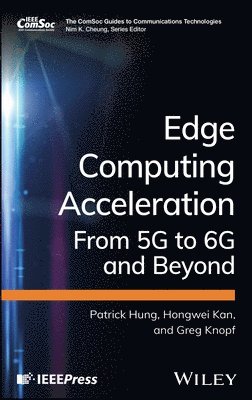
    Edge Computing Acceleration

    From 5G to 6G and Beyond

    AvPatrick Hung,Hongwei Kan

    Inbunden, Engelska, 2024

    Del i serien ComSoc Guides to Communications Technologies

    1 408 kr

    Beställningsvara. Skickas inom 5-8 vardagar. Fri frakt över 249 kr.

    Beskrivning

    Discover the latest advances in computer architecture and software at the dawn of the 5G/6G era In Edge Computing Acceleration: From 5G to 6G and Beyond, distinguished researchers Dr. Patrick Hung, Hongwei Kan, and Greg Knopf deliver a comprehensive overview of personal computer architecture and software design usage in the upcoming 5G decade. The authors begin by introducing key components and exploring different hardware acceleration architectures. They move on to discuss 5G data security and data integrity and offer a survey of network virtualization technologies, including accelerated virtualization technologies. The book analyzes 5G/6G system performance, investigating key design considerations and trade-offs and introducing high-level synthesis flow. It concludes with chapters exploring design verification and validation flow, illustrations of 5G applications based on artificial intelligence and other emerging technologies and offering highlights of emerging 6G research and roadmaps. Readers will enjoy the combination of accessible descriptions of new technologies presented side-by-side as a step-by-step guide to designing effective 5G systems. The book also includes: A thorough introduction to key 5G/6G components, including new wireless communication protocols, edge and fog computing, acceleration technologies, IoE architectures, software-designed networks, network function virtualization, and data securityExplorations of various hardware acceleration architectures, like FPGA and GPU acceleration architecturesPractical discussions of 5G/6G data security, data integrity, and a survey of network virtualization technologiesIn-depth treatments of 5G/6G system performance, key design considerations, high-level synthesis flow, design verification, and validation flowPerfect for undergraduate and graduate students in programs related to communications technology, engineering, and computer science, Edge Computing Acceleration: From 5G to 6G and Beyond is a must-have resource for engineers, programmers, system architects, technical managers, communications business executives, telco operators, and government regulators who regularly interact with cutting-edge communications equipment.

    Produktinformation

    • Utgivningsdatum:2024-11-29
    • Mått:237 x 157 x 24 mm
    • Vikt:680 g
    • Format:Inbunden
    • Språk:Engelska
    • Serie:ComSoc Guides to Communications Technologies
    • Antal sidor:304
    • Förlag:John Wiley & Sons Inc
    • ISBN:9781119813842

    Utforska kategorier

    • Elektronik och kommunikationer inom Naturvetenskap och teknik

    Mer om författaren

    Patrick Hung, PhD, is a co-founder of Alta Sicuro Technology, and was Consulting Assistant Professor at Stanford University. He is currently Vice-Chairman of IEEE Hong Kong Section Computer Society Chapter and IEEE ESOC Technical Committee member. Dr. Hung was Taishan Scholar in China and CBI Overseas Scholar in UK. Hongwei Kan is Chief Expert & General Manager at the Institute of Pioneering Technologies (IPT) at Tsinghua Unigroup, responsible for designing and development its next-generation computer architecture. Mr. Kan is a Visiting Professor at Beijing University of Posts and Telecommunications and the China University of Mining and Technology. Greg Knopf is Senior Director of Server Customer Engineering at Advanced Micro Devices (AMD). Through his engineering leadership roles at AMD and Intel, Mr. Knopf contributed to the development of more than ten generations of flagship server CPUs.

    Innehållsförteckning

    • About the Authors xiForeword (professor Ray Cheung) xiiiForeword (Raghu Nambiar) xvPreface xviiAcknowledgment (Patrick Hung) xixAcknowledgment (Greg Knopf) xxiPart I Introduction 11 Introduction 31.1 Introducing 5G and Internet of Everything 41.2 Edge Computing Architecture 81.2.1 Edge Versus Cloud Computing 101.2.2 Edge Design Options 111.2.3 Key Benefits of Edge Computing 121.3 Custom Computing 141.3.1 Introduction to Custom Computing 141.3.2 5G/6G Security Concerns 151.3.3 Custom Edge Computing Cards 171.4 Deployment Considerations 181.4.1 5G/6G Cell Architecture 191.4.2 5G/6G Private Network 211.4.3 Infrastructure Sharing 23References 262 Overview of 5G and 6G 312.1 5G Timeline 312.2 5G Spectrum 322.3 Characteristics of 5G 342.4 5G New Radio 342.4.1 Orthogonal Frequency-Division Multiplexing 342.4.2 Massive MIMO 362.4.3 Beamforming 372.4.4 Multiuser MIMO 382.5 Data Plane and Control Plane Separation 382.6 5G Applications 402.7 Smooth Transition to 6G 422.8 6G Expected Timeline, Spectrum, and Characteristics 462.9 6G Potential Applications 482.10 Edge, Fog, and Cloud Computing in Relation to 5G and 6G 502.10.1 Edge Computing in Relation to 5G and 6G 512.10.2 Fog Computing in Relation to 5G and 6G 532.10.3 Cloud Computing in Relation to 5G and 6G 55References 57Part II Theory 633 High-Level Synthesis (HLS) 653.1 Why Use High-Level Synthesis? 673.1.1 Hardware Acceleration with High-Level Synthesis 683.2 Common HLS Languages and Platforms 693.2.1 Compute Unified Device Architecture (CUDA) 703.2.1.1 CUDA and HLS for Hardware Acceleration 703.2.1.2 Advantage of Using CUDA and HLS for Hardware Acceleration 713.2.2 OpenCL 723.2.2.1 OpenCL and HLS for Hardware Acceleration 733.2.2.2 Advantages of Using OpenCL with HLS Tools for Hardware Acceleration 743.2.3 Maxeler MaxJ 753.2.3.1 Using Maxeler MaxJ with HLS for Hardware Acceleration 763.2.3.2 Advantages of Using Maxeler MaxJ with HLS for Hardware Acceleration 773.3 Limitations and Challenges of HLS 793.4 Using HLS in 5G Edge Computing 803.4.1 User (Data) Plane Acceleration 813.4.2 Control Plane Acceleration 823.4.3 Advantages of Using HLS for User Plane and Control Plane Acceleration 83References 854 Coding Design 894.1 Overview 894.2 Error Correction Codes (ECCs) 904.2.1 Turbo, Low-Density Parity-Check, and Polar Codes 924.2.1.1 Turbo Codes 934.2.1.2 LDPC Codes 944.2.1.3 Polar Codes 974.3 Security Codes 984.3.1 Public Key Infrastructure 994.3.2 Symmetric and Asymmetric Cryptography Concepts 1004.3.2.1 Symmetric Key Cryptography 1004.3.2.2 Asymmetric Key Cryptography 1014.3.3 Existing Algorithms and Standards 1034.3.3.1 Advanced Encryption Standard 1034.3.3.2 RSA Algorithm 1034.3.3.3 Elliptic Curve Cryptography 1044.4 Emerging 5G Security Design Acceleration 1054.4.1 Blockchain 1054.4.2 Lightweight Encryption Algorithms 1084.4.2.1 SIMON and SPECK Algorithms 1084.4.2.2 PRESENT Algorithm 1104.4.2.3 GIFT Algorithm 1124.4.3 Network Codes 1134.4.4 Post-Quantum Cryptography 1154.4.5 Homomorphic Encryption 1164.4.6 Zero-Knowledge Proof 118References 120Part III Architecture 1255 Hardware Architecture 1275.1 Development Timeline 1275.2 Operating Spectrum 1285.3 Core Requirements 1335.4 New Radio Access Technology 1355.4.1 Orthogonal Frequency-Division Multiplexing 1355.4.2 Massive MIMO (Multiple-Input Multiple-Output) 1375.4.3 Beamforming 1375.4.4 Multiuser MIMO 1385.5 Network Architecture 1385.5.1 Next Generation Radio Access Network 1395.5.2 5G Core 1405.5.2.1 Control and User Plane Separation (CUPS) 1405.5.2.2 Service-Based Architecture (SBA) 1405.6 Performance Improvement 1425.6.1 Computing and Network Convergence 1425.6.2 Related Works 1445.6.3 Smart_xPU Design Methodology 1485.6.3.1 Data Flow Optimization 1485.6.3.2 Distributed System Optimization 1515.6.3.3 Core Microarchitecture Optimization 1545.6.3.4 Software/Hardware Interface Optimization 1565.6.3.5 Analyzing the Smart_xPU Architecture 1595.6.4 Summary of the Smart_xPU Architecture 160References 1626 Software Architecture 1676.1 End-to-End Example of 5G System 1676.1.1 High-Level Description 1676.1.1.1 5G Radio Access Network 1686.1.1.2 Edge 1696.1.1.3 5G Core 1696.1.1.4 Application and Services 1716.1.2 Interfaces 1716.1.2.1 N1: Between 5G Core and User Equipment 1716.1.2.2 N2: Between 5G Core and Base Station 1716.1.2.3 N3: Between RAN and User Plane Function 1726.1.2.4 Other Interfaces Include the Following 1726.2 Network Slicing Architecture, Software-Defined Network, and Network Function Virtualization 1736.2.1 Network Slicing Architecture 1736.2.1.1 Software-Defined Network (SDN) 1746.2.1.2 Network Function Virtualization (NFV) 1766.3 Software Acceleration 1786.3.1 User Space Approach 1786.3.1.1 Data Plane Development Kit (DPDK) 1786.3.2 Other Approaches 1836.3.2.1 Remote Direct Memory Access (RDMA) 1836.3.2.2 Compute Express Link (CXL) 1866.3.2.3 Data Processing Unit (DPU) 188References 190Part IV Applications 1937 Killer Applications 1957.1 Metaverse and Its Trends 1957.2 Technologies Behind Metaverse 1977.2.1 Artificial Intelligence 1977.2.1.1 AI-Based Non-player Character 1997.2.1.2 Sensory Capabilities with AI 1997.2.2 Blockchain 2007.2.2.1 Power Consumption 2017.2.3 AR and VR 2027.2.4 Internet of Things 2037.3 Applications of Metaverse 2047.3.1 Gaming 2047.3.2 Education 2057.3.3 Commerce 2067.3.4 Social Networking 2077.3.5 Healthcare 2087.3.6 Industrial Use 2107.3.7 Entertainment 2117.4 Accelerating Killer Apps 2137.4.1 Edge Computing 2147.4.2 Acceleration by Specialized Hardware 215References 2168 From Concept to Production 2258.1 System Design Process 2258.2 Some Examples 2308.3 Standards Compliance 2338.4 Other Design Metrics 2348.5 Summary 237References 237Part V Future Roadmap 2419 The Road Ahead 2439.1 Spatial Computing and Networking 2459.2 Supporting 5G/6G Spatial Computing and Networking 2469.3 Migrating to 6G 2489.3.1 Cutting Edge 6G Research 2499.4 Enabling Technologies for 5G and Beyond 2519.4.1 Processing-in-Memory Architecture 2519.4.2 New Packaging Architecture 2539.4.3 New Memory Architecture 2559.4.4 Artificial Intelligence-Driven Architectures 2579.5 Some Final Thoughts 259References 259Index 263