• Fri frakt över 249 kr
  • •
  • Snabba leveranser
  • •
  • Billiga böcker
Kundservice

Du är på sajten för privatpersoner.

Företag, bibliotek eller offentlig verksamhet?

Du handlar på classic.bokus.com, där alla dina funktioner finns intakta.
Till classic.bokus.com
Bokus logotyp. Gå till startsidan.
  • Erbjudanden
  • Nyheter
  • Student
  • Topplistor
  • Barn & ungdom
  • Bokus Play
  • E-böcker
  • Pocketböcker
  • Spel & pussel

10% rabatt på allt med kod: NYSTART10 →

Sidfot

Mina sidor

    Hjälp

    • Kundservice
    • Vanliga frågor och svar
    • Frakt och leverans
    • Retur vid ångerrätt
    • Reklamera vara
    • Betalning
    • Köpvillkor
    • Allmänna villkor
    • Information om webbplatsens tillgänglighet

    Om Bokus

    • Om oss
    • Pressrum
    • För studenter
    • För företag
    • För bibliotek och offentlig verksamhet
    • För leverantörer
    • Hållbarhet

    Populärt

    • Aktuella erbjudanden
    • Presentkort
    • Studentlitteratur
    • Nya böcker
    • Topplistor
    • Signerade böcker
    • Engelska böcker

    Inspiration

    • Boktips
    • BookTok
    • Populära bokserier
    • Barnbokskaraktärer
    • Populära författare
    Logotyp för Bokus
    Följ oss på Facebook (extern länk)Följ oss på Instagram (extern länk)Följ oss på YouTube (extern länk)Följ oss på TikTok (extern länk)
    bokus @ CookiesAnpassa cookiesIntegritetspolicyKöpvillkor
    Till Citymail hemsida (extern länk)Till Budbee hemsida (extern länk)Till Postnord hemsida (extern länk)Till Schenker hemsida (extern länk)Till Early Bird hemsida (extern länk)Till Walleys hemsida (extern länk)
    1. Ekonomi och Ledarskap
    2. Företagsekonomi
    3. Redovisning och finansiering

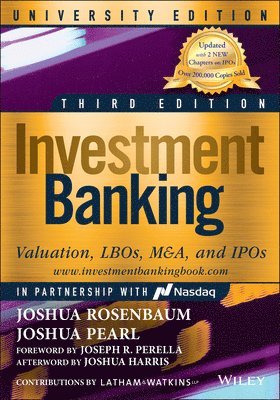
    Investment Banking

    Valuation, LBOs, M&A, and IPOs, University Edition

    AvJoshua Rosenbaum,Joshua Pearl

    Häftad, Engelska, 2021

    Del i serien Wiley Finance

    1 106 kr

    Beställningsvara. Skickas inom 5-8 vardagar. Fri frakt över 249 kr.

    Fler format och utgåvor

    Inbunden

    1 006 kr

    E-bok

    1 057 kr

    E-bok

    1 057 kr

    Inbunden

    1 371 kr

    Beskrivning

    Investment Banking Praise for Investment Banking, UNIVERSITY EDITION “This book will surely become an indispensable guide to the art of buyout and M&A valuation, for the experienced investment practitioner as well as for the non-professional seeking to learn the mysteries of valuation.”—David M. Rubenstein, Co-Founder and Co-Executive Chairman, The Carlyle Group Host, The David Rubenstein Show: Peer to Peer Conversations “The two Joshes present corporate finance in a broad, yet detailed framework for understanding valuation, balance sheets, and business combinations. As such, their book is an essential resource for understanding complex businesses and capital structures whether you are on the buy-side or sell-side.”—Mitchell R. Julis, Co-Chairman and Co-CEO, Canyon Partners, LLC “Investment Banking provides a highly practical and relevant guide to the valuation analysis at the core of investment banking, private equity, and corporate finance. Mastery of these essential skills is fundamental for any role in transaction-related finance. This book will become a fixture on every finance professional’s bookshelf.”—Thomas H. Lee, President, Lee Equity Partners, LLC Founder, Thomas H. Lee Capital Management, LLC “As a pioneer in public equities, Nasdaq is excited to be partnering with Rosenbaum and Pearl on Investment Banking as they break new ground on content related to IPOs, direct listings, and SPACs. We recommend the book for any shareholder and senior executive looking to take a company public, as well as their bankers and lawyers.”—Adena Friedman, President and CEO, Nasdaq “Investment Banking requires a skill set that combines both art and science. While numerous textbooks provide students with the core principles of financial economics, the rich institutional considerations that are essential on Wall Street are not well documented. This book represents an important step in filling this gap.”—Josh Lerner, Jacob H. Schiff Professor of Investment Banking, Harvard Business School Co-author, Venture Capital and Private Equity: A Casebook “Valuation is the key to any transaction. Investment Banking provides specific step-by-step valuation procedures for LBO and M&A transactions, with lots of diagrams and numerical examples.”—Roger G. Ibbotson, Professor in the Practice of Finance, Yale School of Management Chairman and CIO, Zebra Capital Management, LLC Founder, Ibbotson Associates “Investment Banking provides fresh insight and perspective to valuation analysis, the basis for every great trade and winning deal on Wall Street. The book is written from the perspective of practitioners, setting it apart from other texts.”—Gregory Zuckerman, Special Writer, The Wall Street Journal Author, The Greatest Trade Ever, The Frackers, and The Man Who Solved the Market Also available from the authors:Investment Banking WORKBOOKInvestment Banking FOCUS NOTESInvestment Banking ONLINE COURSEwww.efficientlearning.com/investment-banking

    Produktinformation

    • Utgivningsdatum:2021-08-16
    • Mått:178 x 252 x 31 mm
    • Vikt:1 157 g
    • Format:Häftad
    • Språk:Engelska
    • Serie:Wiley Finance
    • Antal sidor:576
    • Upplaga:3
    • Förlag:John Wiley & Sons Inc
    • ISBN:9781119823377

    Utforska kategorier

    • Redovisning och finansiering inom Ekonomi och Ledarskap

    Mer om författaren

    JOSHUA ROSENBAUM is a Managing Director and Head of the Industrials & Diversified Services Group at RBC Capital Markets. He originates, structures, and advises on M&A, corporate finance, and capital markets transactions. Previously, he worked at UBS Investment Bank and the International Finance Corporation, the direct investment division of the World Bank. He received his AB from Harvard and his MBA with Baker Scholar honors from Harvard Business School.JOSHUA PEARL has served as a Managing Director at Brahman Capital, a long/short equity asset manager. He focuses on public equity investments and special situations utilizing a fundamentals-based approach. Previously, he structured high yield financings, leveraged buyouts, and restructurings as a Director at UBS Investment Bank. Prior to UBS, he worked at Moelis & Company and Deutsche Bank. He received his BS in Business from Indiana University's Kelley School of Business.

    Innehållsförteckning

    • Instructor and Student Resources xvAbout the Authors xixAbout the Editors xxiForeword xxiiiAcknowledgments xxvDisclaimer xxxiiiIntroduction 1Structure of the Book 3Part One: Valuation (Chapters 1–3) 3Part Two: Leveraged Buyouts (Chapters 4 & 5) 5Part Three: Mergers & Acquisitions (Chapters 6 & 7) 6Part Four: Initial Public Offerings (Chapters 8 & 9) 8ValueCo Summary Financial Information 9Part One Valuation 11Chapter 1 Comparable Companies Analysis 13Summary of Comparable Companies Analysis Steps 14Step I. Select the Universe of Comparable Companies 17Study the Target 17Identify Key Characteristics of the Target for Comparison Purposes 18Screen for Comparable Companies 22Step II. Locate The Necessary Financial Information 23SEC Filings: 10-K, 10-Q, 8-K, and Proxy Statement 24Equity Research 25Press Releases and News Runs 26Financial Information Services 26Summary of Financial Data Primary Sources 27Step III. Spread Key Statistics, Ratios, and Trading Multiples 28Calculation of Key Financial Statistics and Ratios 28Supplemental Financial Concepts and Calculations 42Calculation of Key Trading Multiples 47Step IV. Benchmark the Comparable Companies 50Benchmark the Financial Statistics and Ratios 50Benchmark the Trading Multiples 50Step V. Determine Valuation 51Valuation Implied by EV/EBITDA 52Valuation Implied by P/E 52Key Pros and Cons 54Illustrative Comparable Companies Analysis for ValueCo 55Step I. Select the Universe of Comparable Companies 55Step II. Locate the Necessary Financial Information 57Step III. Spread Key Statistics, Ratios, and Trading Multiples 57Step IV. Benchmark the Comparable Companies 69Step V. Determine Valuation 74Chapter 1 Questions 75Chapter 2 Precedent Transactions Analysis 79Summary of Precedent Transactions Analysis Steps 80Step I. Select the Universe of Comparable Acquisitions 83Screen for Comparable Acquisitions 83Examine Other Considerations 84Step II. Locate the Necessary Deal-Related and Financial Information 86Public Targets 86Private Targets 89Summary of Primary SEC Filings in M&A Transactions 90Step III. Spread Key Statistics, Ratios, and Transaction Multiples 92Calculation of Key Financial Statistics and Ratios 92Calculation of Key Transaction Multiples 98Step IV. Benchmark the Comparable Acquisitions 102Step V. Determine Valuation 102Key Pros and Cons 103Illustrative Precedent Transaction Analysis for ValueCo 104Step I. Select the Universe of Comparable Acquisitions 104Step II. Locate the Necessary Deal-Related and Financial Information 105Step III. Spread Key Statistics, Ratios, and Transaction Multiples 107Step IV. Benchmark the Comparable Acquisitions 115Step V. Determine Valuation 117Chapter 2 Questions 118Chapter 3 Discounted Cash Flow Analysis 123Summary of Discounted Cash Flow Analysis Steps 124Step I. Study the Target and Determine Key Performance Drivers 128Study the Target 128Determine Key Performance Drivers 128Step II. Project Free Cash Flow 129Considerations for Projecting Free Cash Flow 129Projection of Sales, EBITDA, and EBIT 131Projection of Free Cash Flow 133Step III. Calculate Weighted Average Cost of Capital 139Step III(a): Determine Target Capital Structure 140Step III(b): Estimate Cost of Debt (r d) 141Step III(c): Estimate Cost of Equity (r e) 142Step III(d): Calculate WACC 146Step IV. Determine Terminal Value 146Exit Multiple Method 147Perpetuity Growth Method 147Step V. Calculate Present Value and Determine Valuation 149Calculate Present Value 149Determine Valuation 151Perform Sensitivity Analysis 153Key Pros and Cons 154Illustrative Discounted Cash Flow Analysis for ValueCo 155Step I. Study the Target and Determine Key Performance Drivers 155Step II. Project Free Cash Flow 155Projection of Sales, EBITDA, and EBIT 157Step III. Calculate Weighted Average Cost of Capital 162Step IV. Determine Terminal Value 167Step V. Calculate Present Value and Determine Valuation 169Chapter 3 Questions 174Part Two Leveraged Buyouts 179Chapter 4 Leveraged Buyouts 181Key Participants 183Financial Sponsors 183Investment Banks 184Bank and Institutional Lenders 186Bond Investors 187Private Credit Funds 188Target Management 188Characteristics of a Strong LBO Candidate 189Strong Cash Flow Generation 190Leading and Defensible Market Positions 190Growth Opportunities 190Efficiency Enhancement Opportunities 191Low Capex Requirements 191Strong Asset Base 192Proven Management Team 192Economics of LBOs 193Returns Analysis—Internal Rate of Return 193Returns Analysis—Cash Return 194How LBOs Generate Returns 194How Leverage Is Used to Enhance Returns 196Primary Exit/Monetization Strategies 199Sale of Business 199Initial Public Offering 200Dividends / Dividend Recapitalization 200Below Par Debt Repurchase 200LBO Financing: Structure 201LBO Financing: Primary Sources 204Secured Debt 204High Yield Bonds 208Mezzanine Debt 210Equity Contribution 211LBO Financing: Selected Key Terms 214Security 214Seniority 214Maturity 215Coupon 216Call Protection 217Covenants 218Term Sheets 221LBO Financing: Determining Financing Structure 224Chapter 4 Questions 229Chapter 5 LBO Analysis 233Financing Structure 233Valuation 234Step I. Locate and Analyze the Necessary Information 236Step II. Build the Pre-LBO Model 236Step II(a): Build Historical and Projected Income Statement through EBIT 237Step II(b): Input Opening Balance Sheet and Project Balance Sheet Items 240Step II(c): Build Cash Flow Statement through Investing Activities 242Operating Activities 242Step III. Input Transaction Structure 245Step III(a): Enter Purchase Price Assumptions 245Step III(b): Enter Financing Structure into Sources and Uses 247Step III(c): Link Sources and Uses to Balance Sheet Adjustments Columns 248Uses of Funds Links 251Step IV. Complete the Post-LBO Model 254Step IV(a): Build Debt Schedule 254Step IV(b): Complete Pro Forma Income Statement from EBIT to Net Income 263Step IV(c): Complete Pro Forma Balance Sheet 266Step IV(d): Complete Pro Forma Cash Flow Statement 268Step V. Perform LBO Analysis 270Step V(a): Analyze Financing Structure 270Step V(b): Perform Returns Analysis 272Step V(c): Determine Valuation 276Step V(d): Create Transaction Summary Page 277Illustrative LBO Analysis for ValueCo 278Chapter 5 Questions 288Part Three Mergers & Acquisitions 293Chapter 6 Sell-Side M&A 295Auctions 296Auction Structure 299Organization and Preparation 299Identify Seller Objectives and Determine Appropriate Sale Process 299Perform Sell-Side Advisor Due Diligence and Preliminary Valuation Analysis 301Select Buyer Universe 301Prepare Marketing Materials 302Prepare Confidentiality Agreement 305First Round 306Contact Prospective Buyers 306Negotiate and Execute Confidentiality Agreement with Interested Parties 306Distribute Confidential Information Memorandum and Initial Bid Procedures Letter 307Prepare Management Presentation 308Set Up Data Room 309Prepare Stapled Financing Package (if applicable) 311Receive Initial Bids and Select Buyers to Proceed to Second Round 311Second Round 313Conduct Management Presentations 313Facilitate Site Visits 314Provide Data Room Access and Respond to Diligence Requests 314Distribute Final Bid Procedures Letter and Draft Definitive Agreement 315Receive Final Bids 316Negotiations 320Evaluate Final Bids 320Negotiate with Preferred Buyer(s) 320Select Winning Bidder 320Render Fairness Opinion (if required) 321Receive Board/Owner Approval and Execute Definitive Agreement 321Closing 322Obtain Necessary Approvals 322Shareholder Approval 323Financing and Closing 325Negotiated Sale 326Chapter 6 Questions 328Chapter 7 Buy-Side M&A 331Buyer Motivation 332Synergies 333Cost Synergies 334Revenue Synergies 334Acquisition Strategies 335Horizontal Integration 335Vertical Integration 335Conglomeration 336Form of Financing 337Cash on Hand 338Debt Financing 338Equity Financing 339Debt vs. Equity Financing Summary—Acquirer Perspective 340Deal Structure 340Stock Sale 340Asset Sale 343Stock Sales Treated as Asset Sales for Tax Purposes 346Buy-Side Valuation 349Football Field 349Analysis at Various Prices 352Contribution Analysis 353Merger Consequences Analysis 355Purchase Price Assumptions 355Balance Sheet Effects 360Accretion/(Dilution) Analysis 365Acquisition Scenarios—I) 50% Stock/50% Cash; II) 100% Cash; and III) 100% Stock 368Illustrative Merger Consequences Analysis for the BuyerCo / ValueCo Transaction 373Chapter 7 Questions 394Part Four Initial Public Offerings 399Chapter 8 Initial Public Offerings 401Why Do Companies Go Public? 402Characteristics of a Strong IPO Candidate 404Attractive Industry 404Strong Competitive Position 404Growth Opportunities 405Moat & Barriers to Entry 406Healthy Financial Profile 406Disruptive & Differentiated Solutions 407Favorable Risk Profile 407Proven Management Team 408Key Participants 409Investment Banks 409Company Management 412Current Owners / Investors 413IPO Investors 413Lawyers 414Accountants 414Exchange Partner 415IPO Advisors 416Vendors 416Selected Key Terms 417Offering Size 418Primary / Secondary 419Overallotment Option, a.k.a. “Greenshoe” 420Syndicate Structure 421Lock-up Provision 422Listing Exchange 422Gross Spread 423Dual-Track Process 424Special Purpose Acquisition Companies (SPACs) 427Direct Listings 429Post-IPO Equity Offerings 432IPO Considerations 433Chapter 8 Questions 435Nasdaq Appendix 439Chapter 9 The IPO Process 443Organization and Preparation 445Select IPO Team, Exchange Partner, and Assign Responsibilities 445Manage Corporate Housekeeping 448c corp vs. Up-c Structure 453Determine IPO Timing 455Determine Offering Structure and Preliminary IPO Valuation 456Host Organizational Meeting 459Due Diligence, Drafting, and Filing 460Perform Underwriter Due Diligence 460Draft and File the Registration Statement 461Prepare Other Key Transaction and Corporate Governance Documents 466Coordinate with Equity Research 467Respond to SEC Comments and File Amended Registration Statement 467Marketing and Roadshow 468Prepare Marketing Materials 468Salesforce Teach-in 469Conduct Roadshow 470Build Order Book 473Pricing and Allocation 475Price the Offering 475Allocate Shares to Investors 477Closing 477Chapter 9 Questions 479Solutions to Selected Questions 485Afterword 513Bibliography and Recommended Reading 515Index 521