• Fri frakt över 249 kr
  • •
  • Snabba leveranser
  • •
  • Billiga böcker
Kundservice

Du är på sajten för privatpersoner.

Företag, bibliotek eller offentlig verksamhet?

Du handlar på classic.bokus.com, där alla dina funktioner finns intakta.
Till classic.bokus.com
Bokus logotyp. Gå till startsidan.
  • Erbjudanden
  • Nyheter
  • Student
  • Topplistor
  • Barn & ungdom
  • Bokus Play
  • E-böcker
  • Pocketböcker
  • Spel & pussel

10% rabatt på allt med kod: NYSTART10 →

Sidfot

Mina sidor

    Hjälp

    • Kundservice
    • Vanliga frågor och svar
    • Frakt och leverans
    • Retur vid ångerrätt
    • Reklamera vara
    • Betalning
    • Köpvillkor
    • Allmänna villkor
    • Information om webbplatsens tillgänglighet

    Om Bokus

    • Om oss
    • Pressrum
    • För studenter
    • För företag
    • För bibliotek och offentlig verksamhet
    • För leverantörer
    • Hållbarhet

    Populärt

    • Aktuella erbjudanden
    • Presentkort
    • Studentlitteratur
    • Nya böcker
    • Topplistor
    • Signerade böcker
    • Engelska böcker

    Inspiration

    • Boktips
    • BookTok
    • Populära bokserier
    • Barnbokskaraktärer
    • Populära författare
    Logotyp för Bokus
    Följ oss på Facebook (extern länk)Följ oss på Instagram (extern länk)Följ oss på YouTube (extern länk)Följ oss på TikTok (extern länk)
    bokus @ CookiesAnpassa cookiesIntegritetspolicyKöpvillkor
    Till Citymail hemsida (extern länk)Till Budbee hemsida (extern länk)Till Postnord hemsida (extern länk)Till Schenker hemsida (extern länk)Till Early Bird hemsida (extern länk)Till Walleys hemsida (extern länk)
    1. Naturvetenskap och teknik
    2. Matematik och naturvetenskap
    3. Kemi
    4. Organisk kemi

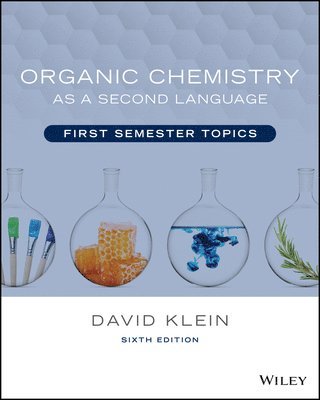
    Organic Chemistry as a Second Language

    First Semester Topics

    AvDavid R. Klein

    Häftad, Engelska, 2024

    1 070 kr

    Skickas . Fri frakt över 249 kr.

    Fler format och utgåvor

    E-bok

    569 kr

    E-bok

    489 kr

    Häftad

    724 kr

    E-bok

    490 kr

    Beskrivning

    Organic chemistry can be a challenging subject. Most students view organic chemistry as a subject requiring hours upon hours of memorization. Author David Klein's Second Language books prove this is not true—organic chemistry is one continuous story that makes sense if you pay attention. Offering a unique skill-building approach, these market-leading books teach students how to ask the right questions to solve problems, study more efficiently to avoid wasting time, and learn to speak the language of organic chemistry.Covering the initial half of the course, Organic Chemistry as a Second Language: First Semester Topics reviews critical principles and explains their relevance to the rest of the course. Each section provides hands-on exercises and step-by-step explanations to help students fully comprehend classroom lectures and textbook content. Now in the 6th edition, there are approximately 30 new end-of-chapter exercises in each chapter. These new exercises vary in difficulty, starting with exercises that focus on just one skill or concept (called Practice Problems), and continuing with exercises that focus on more than one skill or concept (called Integrated Problems), and concluding with advanced exercises (called Challenge Problems). There are also author-created, detailed solutions for all new exercises, and these detailed solutions appear in the back of the book.

    Produktinformation

    • Utgivningsdatum:2024-05-27
    • Mått:203 x 252 x 23 mm
    • Vikt:998 g
    • Format:Häftad
    • Språk:Engelska
    • Antal sidor:576
    • Upplaga:6
    • Förlag:John Wiley & Sons Inc
    • ISBN:9781119837091

    Utforska kategorier

    • Organisk kemi inom Naturvetenskap och teknik

    Mer om författaren

    David Klein is a lecturer at Johns Hopkins University where he teaches Organic and General Chemistry. He is a dynamic and creative teacher and uses analogy to help students grasp difficult topics. Klein's unique informal voice and manner of presentation help students truly master key topics in this course. He is also the author of Organic Chemistry as a Second Language; response to this book has been phenomenal.

    Innehållsförteckning

    • Chapter 1 Bond-line Drawings 11.1 How to Read Bond-Line Drawings 11.2 How to Draw Bond-Line Drawings 41.3 Mistakes to Avoid 61.4 More Exercises 61.5 Identifying Formal Charges 81.6 Finding Lone Pairs that Are Not Drawn 11End-of-Chapter Problems 15Chapter 2 Resonance 192.1 What Is Resonance? 192.2 Curved Arrows: The Tools for Drawing Resonance Structures 202.3 The Two Commandments 212.4 Drawing Good Arrows 242.5 Formal Charges in Resonance Structures 262.6 Drawing Resonance Structures—Step By Step 292.7 Drawing Resonance Structures—By Recognizing Patterns 332.8 Assessing the Relative Importance of Resonance Structures 40End-of-Chapter Problems 45Chapter 3 Acid–base Reactions 483.1 Factor 1—What Atom Is the Charge On? 483.2 Factor 2—Resonance 513.3 Factor 3—Induction 543.4 Factor 4—Orbitals 563.5 Ranking the Four Factors 573.6 Other Factors 603.7 Quantitative Measurement (pKa Values) 613.8 Predicting the Position of Equilibrium 613.9 Showing a Mechanism 62End-of-Chapter Problems 64Chapter 4 Geometry 684.1 Orbitals and Hybridization States 684.2 Geometry 714.3 Lone Pairs 73End-of-Chapter Problems 75Chapter 5 Nomenclature 775.1 Functional Group 785.2 Unsaturation 795.3 Naming the Parent Chain 805.4 Naming Substituents 835.5 Stereoisomerism 855.6 Numbering 875.7 Common Names 915.8 Going from a Name to a Structure 92End-of-Chapter Problems 92Chapter 6 Conformations 956.1 How to Draw a Newman Projection 956.2 Ranking the Stability of Newman Projections 996.3 Drawing Chair Conformations 1016.4 Placing Groups on the Chair 1056.5 Ring Flipping 1086.6 Comparing the stability of Chairs 1146.7 Don’t Be Confused by The Nomenclature 117End-of-Chapter Problems 117Chapter 7 Configurations 1217.1 Locating Chiral Centers 1217.2 Determining the Configuration of a Chiral Center 1247.3 Nomenclature 1317.4 Drawing Enantiomers 1347.5 Diastereomers 1387.6 MESO Compounds 1397.7 Drawing Fischer Projections 1417.8 Optical Activity 145End-of-Chapter Problems 146Chapter 8 Mechanisms 1498.1 Introduction to Mechanisms 1498.2 Nucleophiles and Electrophiles 1498.3 Basicity vs. Nucleophilicity 1518.4 Arrow-Pushing Patterns for Ionic Mechanisms 1538.5 Carbocation Rearrangements 1588.6 Information Contained in a Mechanism 162End-of-Chapter Problems 164Chapter 9 Substitution Reactions 1689.1 The Mechanisms 1689.2 Factor 1—The Electrophile (Substrate) 1709.3 Factor 2—The Nucleophile 1729.4 Factor 3—The Leaving Group 1749.5 Factor 4—The Solvent 1769.6 Using All Four Factors 1779.7 Drawing a Substitution Product and the Mechanism of Its Formation 178End-of-Chapter Problems 182Chapter 10 Elimination Reactions 18510.1 The E2 Mechanism 18510.2 The Regiochemical Outcome of an E2 Reaction 18610.3 The Stereochemical Outcome of an E2 Reaction 18710.4 The E1 Mechanism 19010.5 The Regiochemical Outcome of an E1 Reaction 19210.6 The Stereochemical Outcome of an E1 Reaction 19210.7 Substitution vs. Elimination 19310.8 Determining the Function of the Reagent 19310.9 Identifying the Mechanism(s) 19510.10 Predicting the Products 197End-of-Chapter Problems 200Chapter 11 Addition Reactions 20411.1 Terminology Describing Regiochemistry 20411.2 Terminology Describing Stereochemistry 20611.3 Adding H and H 21211.4 Adding H and X, Markovnikov 21511.5 Adding H and Br, Anti-Markovnikov 22011.6 Adding H and OH, Markovnikov 22411.7 Adding H and OH, Anti-Markovnikov 22611.8 Synthesis Techniques 23011.9 Adding Br and Br; Adding Br and OH 23611.10 Adding OH and OH, Anti 24111.11 Adding OH and OH, syn 24311.12 Oxidative Cleavage of an Alkene 245End-of-Chapter Problems 248Chapter 12 Alkynes 25312.1 Structure and Properties of Alkynes 25312.2 Preparation of Alkynes 25512.3 Alkylation of Terminal Alkynes 25612.4 Reduction of Alkynes 25812.5 Hydration of Alkynes 26112.6 Keto-Enol Tautomerization 26412.7 Ozonolysis of Alkynes 269End-of-Chapter Problems 270Chapter 13 Alcohols 27413.1 Naming and Designating Alcohols 27413.2 Predicting Solubility of Alcohols 27513.3 Predicting Relative Acidity of Alcohols 27613.4 Preparing Alcohols: A Review 27913.5 Preparing Alcohols via Reduction 28013.6 Preparing Alcohols via Grignard Reactions 28613.7 Summary of Methods for Preparing Alcohols 28913.8 Reactions of Alcohols: Substitution and Elimination 29013.9 Reactions of Alcohols: Oxidation 29413.10 Converting an Alcohol into an Ether 297End-of-Chapter Problems 298Chapter 14 Ethers and Epoxides 30014.1 Introduction to Ethers 30014.2 Preparation of Ethers 30214.3 Reactions of Ethers 30414.4 Preparation of Epoxides 30514.5 Ring-Opening Reactions of Epoxides 307End-of-Chapter Problems 313Chapter 15 Synthesis 31615.1 Functional Group Interconversion 31615.2 Changing the Carbon Skeleton 31715.3 Two Questions to Ask in Every Synthesis Problem 31815.4 Retrosynthetic Analysis 32015.5 Creating Your Own Problems 323End-of-Chapter Problems 324Detailed Solutions S-1Index I-1