• Fri frakt över 249 kr
  • •
  • Snabba leveranser
  • •
  • Billiga böcker
Kundservice

Du är på sajten för privatpersoner.

Företag, bibliotek eller offentlig verksamhet?

Du handlar på classic.bokus.com, där alla dina funktioner finns intakta.
Till classic.bokus.com
Bokus logotyp. Gå till startsidan.
  • Erbjudanden
  • Nyheter
  • Student
  • Topplistor
  • Barn & ungdom
  • Bokus Play
  • E-böcker
  • Pocketböcker
  • Spel & pussel

10% rabatt på allt med kod: NYSTART10 →

Sidfot

Mina sidor

    Hjälp

    • Kundservice
    • Vanliga frågor och svar
    • Frakt och leverans
    • Retur vid ångerrätt
    • Reklamera vara
    • Betalning
    • Köpvillkor
    • Allmänna villkor
    • Information om webbplatsens tillgänglighet

    Om Bokus

    • Om oss
    • Pressrum
    • För studenter
    • För företag
    • För bibliotek och offentlig verksamhet
    • För leverantörer
    • Hållbarhet

    Populärt

    • Aktuella erbjudanden
    • Presentkort
    • Studentlitteratur
    • Nya böcker
    • Topplistor
    • Signerade böcker
    • Engelska böcker

    Inspiration

    • Boktips
    • BookTok
    • Populära bokserier
    • Barnbokskaraktärer
    • Populära författare
    Logotyp för Bokus
    Följ oss på Facebook (extern länk)Följ oss på Instagram (extern länk)Följ oss på YouTube (extern länk)Följ oss på TikTok (extern länk)
    bokus @ CookiesAnpassa cookiesIntegritetspolicyKöpvillkor
    Till Citymail hemsida (extern länk)Till Budbee hemsida (extern länk)Till Postnord hemsida (extern länk)Till Schenker hemsida (extern länk)Till Early Bird hemsida (extern länk)Till Walleys hemsida (extern länk)
    1. Naturvetenskap och teknik
    2. Matematik och naturvetenskap
    3. Kemi
    4. Organisk kemi

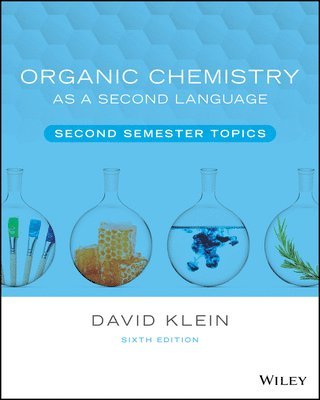
    Organic Chemistry as a Second Language

    Second Semester Topics

    AvDavid R. Klein

    Häftad, Engelska, 2024

    724 kr

    Skickas . Fri frakt över 249 kr.

    Fler format och utgåvor

    E-bok

    569 kr

    E-bok

    489 kr

    Häftad

    1 070 kr

    E-bok

    490 kr

    Beskrivning

    Organic chemistry is a challenging subject, with many students expecting it to require many hours of memorization. Author David Klein's Second Language books prove this is not true—organic chemistry is one continuous story that actually makes sense if you pay close attention. Klein’s books use a conversational tone making them more accessible and easier to read for students. Organic Chemistry as a Second Language: Second Semester Topics, 6e builds on the principles explored in the first half of the course, delving deeper into molecular mechanisms, reactions, and analytical techniques. Using Klein’s one-of-a-kind SkillBuilder approach, the book includes hands-on exercises and thoroughly explained solutions designed to further reinforce student comprehension of chemical concepts and organic principles. An indispensable supplement to the primary text, this resource covers aromatic compounds, infrared (IR) and nuclear magnetic resonance (NMR) spectroscopy, nucleophilic and electrophilic aromatic substitution, ketones and aldehydes, carboxylic acid derivatives, and much more. Organic Chemistry as a Second Language: Second Semester Topics, 6e teaches students how to ask the right questions to solve problems, study more efficiently, and learn to speak the language of organic chemistry. Like its first-semester companion title, it is an essential ‘guide on the side’ for any organic chemistry student no matter what textbook or instructor-provided lecture material is used. The inclusion of new end of chapter problems, providing both practice and challenge, will prepare students and build confidence come exam time, as well as outside the classroom.

    Produktinformation

    • Utgivningsdatum:2024-09-19
    • Mått:206 x 252 x 25 mm
    • Vikt:998 g
    • Format:Häftad
    • Språk:Engelska
    • Antal sidor:576
    • Upplaga:6
    • Förlag:John Wiley & Sons Inc
    • ISBN:9781119837053

    Utforska kategorier

    • Organisk kemi inom Naturvetenskap och teknik

    Mer om författaren

    David Klein is a lecturer at Johns Hopkins University where he teaches Organic and General Chemistry. He is a dynamic and creative teacher and uses analogy to help students grasp difficult topics. Klein's unique informal voice and manner of presentation help students truly master key topics in this course. He is also the author of Organic Chemistry as a Second Language; response to this book has been phenomenal.

    Innehållsförteckning

    • ContentsChapter 1 Aromaticity 11.1 Introduction to Aromatic Compounds 11.2 Nomenclature of Aromatic Compounds 21.3 Criteria for Aromaticity 61.4 Lone Pairs 9End-of-Chapter Problems 11Chapter 2 IR Spectroscopy 142.1 Vibrational Excitation 142.2 IR Spectra 162.3 Wavenumber 162.4 Signal Intensity 212.5 Signal Shape 222.6 Analyzing an IR Spectrum 29End-of-Chapter Problems 36Chapter 3 NMR Spectroscopy 393.1 Chemical Equivalence 393.2 Chemical Shift (Benchmark Values) 423.3 Integration 473.4 Multiplicity 503.5 Pattern Recognition 523.6 Complex Splitting 543.7 No Splitting 553.8 Hydrogen Deficiency Index (Degrees of Unsaturation) 563.9 Analyzing a Proton NMR Spectrum 593.10 13 C NMR Spectroscopy 63End-of-Chapter Problems 65Chapter 4 Electrophilic Aromatic Substitution 784.1 Halogenation and the Role of Lewis Acids 794.2 Nitration 834.3 Friedel–Crafts Alkylation and Acylation 854.4 Sulfonation 924.5 Activation and Deactivation 964.6 Directing Effects 984.7 Identifying Activators and Deactivators 1074.8 Predicting and Exploiting Steric Effects 1174.9 Synthesis Strategies 124End-of-Chapter Problems 129Chapter 5 Nucleophilic Aromatic Substitution 1345.1 Criteria for Nucleophilic Aromatic Substitution 1345.2 S N Ar Mechanism 1365.3 Elimination–Addition 1425.4 Mechanism Strategies 148End-of-Chapter Problems 151Chapter 6 Ketones and Aldehydes 1546.1 Preparation of Ketones and Aldehydes 1546.2 Stability and Reactivity of C===O Bonds 1576.3 H-Nucleophiles 1596.4 O-Nucleophiles 1646.5 S-Nucleophiles 1746.6 N-Nucleophiles 1766.7 C-Nucleophiles 1846.8 Exceptions to the Rule 1936.9 How to Approach Synthesis Problems 197End-of-Chapter Problems 203Chapter 7 Carboxylic Acid Derivatives 2077.1 Reactivity of Carboxylic Acid Derivatives 2077.2 General Rules 2087.3 Acid Halides 2127.4 Acid Anhydrides 2207.5 Esters 2227.6 Amides and Nitriles 2317.7 Synthesis Problems 240End-of-Chapter Problems 247Chapter 8 Enols and Enolates 2538.1 Alpha Protons 2538.2 Keto-Enol Tautomerism 2558.3 Reactions Involving Enols 2598.4 Making Enolates 2628.5 Haloform Reaction 2658.6 Alkylation of Enolates 2688.7 Aldol Reactions 2728.8 Claisen Condensation 2788.9 Decarboxylation 2858.10 Michael Reactions 292End-of-Chapter Problems 299Chapter 9 Amines 3039.1 Nucleophilicity and Basicity of Amines 3039.2 Preparation of Amines Through S N 2 Reactions 3059.3 Preparation of Amines Through Reductive Amination 3089.4 Acylation of Amines 3139.5 Reactions of Amines with Nitrous Acid 3169.6 Aromatic Diazonium Salts 319End-of-Chapter Problems 322Chapter 10 Diels-alder Reactions 32510.1 Introduction and Mechanism 32510.2 The Dienophile 32810.3 The Diene 32910.4 Other Pericyclic Reactions 335End-of-Chapter Problems 336Detailed Solutions S-1Index I-1