• Fri frakt över 249 kr
  • •
  • Snabba leveranser
  • •
  • Billiga böcker
Kundservice

Du är på sajten för privatpersoner.

Företag, bibliotek eller offentlig verksamhet?

Du handlar på classic.bokus.com, där alla dina funktioner finns intakta.
Till classic.bokus.com
Bokus logotyp. Gå till startsidan.
  • Erbjudanden
  • Nyheter
  • Student
  • Topplistor
  • Barn & ungdom
  • Bokus Play
  • E-böcker
  • Pocketböcker
  • Spel & pussel

10% rabatt på allt med kod: NYSTART10 →

Sidfot

Mina sidor

    Hjälp

    • Kundservice
    • Vanliga frågor och svar
    • Frakt och leverans
    • Retur vid ångerrätt
    • Reklamera vara
    • Betalning
    • Köpvillkor
    • Allmänna villkor
    • Information om webbplatsens tillgänglighet

    Om Bokus

    • Om oss
    • Pressrum
    • För studenter
    • För företag
    • För bibliotek och offentlig verksamhet
    • För leverantörer
    • Hållbarhet

    Populärt

    • Aktuella erbjudanden
    • Presentkort
    • Studentlitteratur
    • Nya böcker
    • Topplistor
    • Signerade böcker
    • Engelska böcker

    Inspiration

    • Boktips
    • BookTok
    • Populära bokserier
    • Barnbokskaraktärer
    • Populära författare
    Logotyp för Bokus
    Följ oss på Facebook (extern länk)Följ oss på Instagram (extern länk)Följ oss på YouTube (extern länk)Följ oss på TikTok (extern länk)
    bokus @ CookiesAnpassa cookiesIntegritetspolicyKöpvillkor
    Till Citymail hemsida (extern länk)Till Budbee hemsida (extern länk)Till Postnord hemsida (extern länk)Till Schenker hemsida (extern länk)Till Early Bird hemsida (extern länk)Till Walleys hemsida (extern länk)
    1. Naturvetenskap och teknik
    2. Matematik och naturvetenskap
    3. Kemi
    4. Organisk kemi

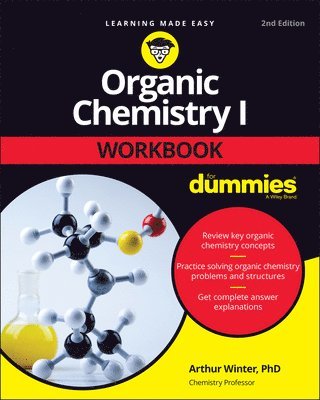
    Organic Chemistry I Workbook For Dummies

    AvArthur Winter

    Häftad, Engelska, 2022

    203 kr

    Beställningsvara. Skickas inom 5-8 vardagar. Fri frakt över 249 kr.

    Fler format och utgåvor

    E-bok

    363 kr

    E-bok

    341 kr

    Beskrivning

    Need help with organic chemistry? Get extra practice with this workbook If you’re looking for a little extra help with organic chemistry than your Organic Chemistry I class offers, Organic Chemistry I Workbook For Dummies is exactly what you need! It lets you take the theories you’re learning (and maybe struggling with) in class and practice them in the same format you’ll find on class exams and other licensing exams, like the MCAT. It offers tips and tricks to memorize difficult concepts and shortcuts to solving problems.  This reference guide and practice book explains the concepts of organic chemistry (such as functional groups, resonance, alkanes, and stereochemistry) in a concise, easy-to-understand format that helps you refine your skills. It also includes real practice with hundreds of exam questions to test your knowledge.  Walk through the answers and clearly identify where you went wrong (or right) with each problem Get practical advice on acing your exams Use organic chemistry in practical applications Organic Chemistry I Workbook For Dummies provides you with opportunities to review the material and practice solving problems based on the topics covered in a typical Organic Chemistry I course. With the help of this practical reference, you can face down your exam and pass on to Organic Chemistry II with confidence!

    Produktinformation

    • Utgivningsdatum:2022-02-25
    • Mått:203 x 249 x 25 mm
    • Vikt:635 g
    • Format:Häftad
    • Språk:Engelska
    • Antal sidor:400
    • Upplaga:2
    • Förlag:John Wiley & Sons Inc
    • ISBN:9781119855774

    Utforska kategorier

    • Organisk kemi inom Naturvetenskap och teknik

    Mer om författaren

    Arthur Winter, PhD, is the author of the popular Organic Chemistry Help! website chemhelper.com and Organic Chemistry I For Dummies. His professional focus is on the chemistry of magneto-organic materials.

    Innehållsförteckning

    • Introduction 1About This Book 1Foolish Assumptions 2Icons Used in This Book 3Beyond the Book 3Where to Go from Here 3Part 1: The Fundamentals of Organic Chemistry 5Chapter 1: Working with Models and Molecules 7Constructing Lewis Structures 7Predicting Bond Types 10Determining Bond Dipoles 12Determining Dipole Moments for Molecules 13Predicting Atom Hybridizations and Geometries 15Making Orbital Diagrams 17Answer Key 20Chapter 2: Speaking Organic Chemistry: Drawing and Abbreviating Lewis Structures 25Assigning Formal Charges 26Determining Lone Pairs on Atoms 29Abbreviating Lewis Structures with Condensed Structures 30Drawing Line-Bond Structures 33Determining Hydrogens on Line-Bond Structures 36Answer Key 38Chapter 3: Drawing Resonance Structures 45Seeing Cations Next to a Double Bond, Triple Bond, or Lone Pair 46Pushing Lone Pairs Next to a Double or Triple Bond 49Pushing Double or Triple Bonds Containing an Electronegative Atom 52Alternating Double Bonds around a Ring 53Drawing Multiple Resonance Structures 55Assigning Importance to Resonance Structures 57Answer Key 60Chapter 4: Working with Acids and Bases 67Defining Acids and Bases 68Bronsted-Lowry acids and bases 68Lewis acids and bases 70Comparing Acidities of Organic Molecules 71Contrasting atom electronegativity, size, and hybridization 71The effect of nearby atoms 73Resonance effects 75Predicting Acid-Base Equilibria Using pKa Values 77Answer Key 79Part 2: The Bones of Organic Molecules: The Hydrocarbons 85Chapter 5: Seeing Molecules in 3-D: Stereochemistry 87Identifying Chiral Centers and Assigning Substituent Priorities 88Assigning R & S Configurations to Chiral Centers 92Working with Fischer Projections 95Comparing Relationships between Stereoisomers and Meso Compounds 99Answer Key 103Chapter 6: The Skeletons of Organic Molecules: The Alkanes 113Understanding How to Name Alkanes 114Drawing a Structure from a Name 118Answer Key 121Chapter 7: Shaping Up with Bond Calisthenics and Conformation 127Setting Your Sights on Newman Projections 128Comparing Conformational Stability 131Choosing Sides: The Cis-Trans Stereochemistry of Cycloalkanes 134Getting a Ringside Seat with Cyclohexane Chair Conformations 135Predicting Cyclohexane Chair Stabilities 137Answer Key 140Chapter 8: Doubling Down: The Alkenes 147Giving Alkenes a Good Name 148Markovnikov Mixers: Adding Hydrohalic Acids to Alkenes 152Adding Halogens and Hydrogen to Alkenes 155Just Add Water: Adding H2O to Alkenes 159Seeing Carbocation Rearrangements 163Answer Key 167Chapter 9: Tripling the Fun: Alkyne Reactions and Nomenclature 179Playing the Name Game with Alkynes 179Adding Hydrogen and Reducing Alkynes 182Adding Halogens and Hydrohalic Acids to Alkynes 185Adding Water to Alkynes 189Creating Alkynes 192Back to the Beginning: Working Multistep Synthesis Problems 194Answer Key 197Part 3: Functional Groups and Their Reactions 205Chapter 10: The Leaving Group Boogie: Substitution and Elimination of Alkyl Halides 207The Replacements: Comparing SN1 and SN2 Reactions 208Kicking Out Leaving Groups with Elimination Reactions 212Putting It All Together: Substitution and Elimination 215Answer Key 220Chapter 11: Not as Thunk as You Drink I Am: The Alcohols 227Name Your Poison: Alcohol Nomenclature 228Beyond Homebrew: Making Alcohols 230Transforming Alcohols (without Committing a Party Foul) 234Answer Key 238Chapter 12: Conjugated Dienes and the Diels-Alder Reaction 243Seeing 1,2- and 1,4-Addition Reactions to Conjugated Dienes 244Dienes and Their Lovers: Working Forward in the Diels-Alder Reaction 249Reverse Engineering: Working Backward in the Diels-Alder Reaction 253Answer Key 257Chapter 13: The Power of the Ring: Aromatic Compounds 263Determining Aromaticity, Anti-aromaticity, or Nonaromaticity of Rings 264Figuring Out a Ring System’s MO Diagram 268Dealing with Directors: Reactions of Aromatic Compounds 270Order! Tackling Multistep Synthesis of Poysubstituted Aromatic Compounds 275Answer Key 278Part 4: Detective Work: Spectroscopy and Spectrometry 285Chapter 14: Breaking Up (Isn’t Hard to Do): Mass Spectrometry 287Identifying Fragments in the Mass Spectrum 287Predicting a Structure Given a Mass Spectrum 296Answer Key 300Chapter 15: Cool Vibrations: IR Spectroscopy 303Distinguishing between Molecules Using IR Spectroscopy 304Identifying Functional Groups from an IR Spectrum 311Answer Key 317Chapter 16: Putting Molecules under the Magnet: NMR Spectroscopy 319Seeing Molecular Symmetry 320Working with Chemical Shifts, Integration, and Coupling 323Putting It All Together: Solving for Unknown Structures Using Spectroscopy 328Answer Key 340Part 5: The Part of Tens 349Chapter 17: The Ten Commandments of Organic Chemistry 351Thou Shalt Work the Practice Problems before Reading the Answers 351Thou Shalt Memorize Only What Thou Must 352Thou Shalt Understand Thy Mechanisms 352Thou Shalt Sleep at Night and Not in Class 353Thou Shalt Read Ahead Before Class 353Thou Shalt Not Fall Behind 353Thou Shalt Know How Thou Learnest Best 354Thou Shalt Not Skip Class 354Thou Shalt Ask Questions 354Thou Shalt Keep a Positive Outlook 354Chapter 18: Ten Tips for Acing Orgo Exams 355Scan and Answer the Easy Questions First 355Read All of Every Question 356Set Aside Time Each Day to Study 356Form a Study Group 356Get Old Exams 357Make Your Answers Clear by Using Structures 357Don’t Try to Memorize Your Way Through 357Work a Lot of Problems 358Get Some Sleep the Night Before 358Recognize Red Herrings 358Chapter 19: Ten Cool Natural Products 361Maitotoxin 361Penicillin 362Nicotine 363THC 363Morphine 364Taxol 364Bombykol 365The Green Fluorescent Protein Fluorophore 365Ladderanes 366Caffeine 366Index 367