• Fri frakt över 249 kr
  • •
  • Snabba leveranser
  • •
  • Billiga böcker
Kundservice

Du är på sajten för privatpersoner.

Företag, bibliotek eller offentlig verksamhet?

Du handlar på classic.bokus.com, där alla dina funktioner finns intakta.
Till classic.bokus.com
Bokus logotyp. Gå till startsidan.
  • Erbjudanden
  • Student
  • Topplistor
  • Barn & ungdom
  • Bokus Play
  • E-böcker
  • Ljudböcker
  • Pocketböcker
  • Spel och pussel

Pocketfynda! Hundratals böcker för 49 kr/st →

Sidfot

Mina sidor

    Hjälp

    • Kundservice
    • Vanliga frågor och svar
    • Frakt och leverans
    • Retur vid ångerrätt
    • Reklamera vara
    • Betalning
    • Köpvillkor
    • Allmänna villkor
    • Information om webbplatsens tillgänglighet

    Om Bokus

    • Om oss
    • Pressrum
    • För studenter
    • För företag
    • För bibliotek och offentlig verksamhet
    • För leverantörer
    • Hållbarhet

    Populärt

    • Aktuella erbjudanden
    • Presentkort
    • Studentlitteratur
    • Nya böcker
    • Topplistor
    • Signerade böcker
    • Engelska böcker

    Inspiration

    • Boktips
    • BookTok
    • Barnbokskaraktärer
    • Populära författare
    Logotyp för Bokus
    Följ oss på Facebook (extern länk)Följ oss på Instagram (extern länk)Följ oss på YouTube (extern länk)Följ oss på TikTok (extern länk)
    bokus @ CookiesAnpassa cookiesIntegritetspolicyKöpvillkor
    Till Citymail hemsida (extern länk)Till Budbee hemsida (extern länk)Till Postnord hemsida (extern länk)Till Schenker hemsida (extern länk)Till Early Bird hemsida (extern länk)Till Walleys hemsida (extern länk)
    1. Naturvetenskap och teknik
    2. Matematik och naturvetenskap
    3. Matematik

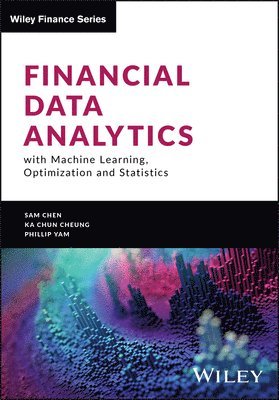
    Financial Data Analytics with Machine Learning, Optimization and Statistics

    AvSam Chen,Ka Chun Cheung

    Inbunden, Engelska, 2024

    Del i serien Wiley Finance

    729 kr

    Beställningsvara. Skickas inom 5-8 vardagar. Fri frakt över 249 kr.

    Beskrivning

    An essential introduction to data analytics and Machine Learning techniques in the business sectorIn Financial Data Analytics with Machine Learning, Optimization and Statistics, a team consisting of a distinguished applied mathematician and statistician, experienced actuarial professionals and working data analysts delivers an expertly balanced combination of traditional financial statistics, effective machine learning tools, and mathematics. The book focuses on contemporary techniques used for data analytics in the financial sector and the insurance industry with an emphasis on mathematical understanding and statistical principles and connects them with common and practical financial problems. Each chapter is equipped with derivations and proofs—especially of key results—and includes several realistic examples which stem from common financial contexts. The computer algorithms in the book are implemented using Python and R, two of the most widely used programming languages for applied science and in academia and industry, so that readers can implement the relevant models and use the programs themselves.This book can help readers become well-equipped with the following skills: To evaluate financial and insurance data quality, and use the distilled knowledge obtained from the data after applying data analytic tools to make timely financial decisionsTo apply effective data dimension reduction tools to enhance supervised learningTo describe and select suitable data analytic tools as introduced above for a given dataset depending upon classification or regression prediction purposeThe book covers the competencies tested by several professional examinations, such as the Predictive Analytics Exam offered by the Society of Actuaries, and the Institute and Faculty of Actuaries' Actuarial Statistics Exam.Besides being an indispensable resource for senior undergraduate and graduate students taking courses in financial engineering, statistics, quantitative finance, risk management, actuarial science, data science, and mathematics for AI, Financial Data Analytics with Machine Learning, Optimization and Statistics also belongs in the libraries of aspiring and practicing quantitative analysts working in commercial and investment banking.

    Produktinformation

    • Utgivningsdatum:2024-10-24
    • Mått:180 x 246 x 61 mm
    • Vikt:1 179 g
    • Format:Inbunden
    • Språk:Engelska
    • Serie:Wiley Finance
    • Antal sidor:816
    • Förlag:John Wiley & Sons Inc
    • ISBN:9781119863373

    Utforska kategorier

    • Matematik inom Naturvetenskap och teknik

    Mer om författaren

    YONGZHAO CHEN (SAM) [BSC(ACTUARSC) & PHD (HKU)] is currently an Assistant Professor at the Department of Mathematics, Statistics and Insurance, The Hang Seng University of Hong Kong. His research interests include actuarial science, especially credibility theory, and data analytics. KA CHUN CHEUNG [BSC(ACTUARSC) & PHD (HKU), ASA (SOA)] was the Director of the Actuarial Science Programme, and is currently Head and full Professor at the Department of Statistics and Actuarial Science in School of Computing and Data Science, The University of Hong Kong. His current research interests include various topics in actuarial science, including optimal reinsurance, stochastic orders, dependence structures, and extreme value theory. PHILLIP YAM [BSC(ACTUARSC) & MPHIL (HKU), MAST (CANTAB), DPHIL (OXON)] is currently Director of QFRM programme, and a full Professor at the Department of Statistics of The Chinese University of Hong Kong, also Assistant Dean (Education) of CUHK Faculty of Science, and a Visiting Professor in Columbia University and UTD Business School. He has more than 100 top journal articles in actuarial science, applied mathematics, data analytics, engineering, financial mathematics, operations management, and statistics. His research project CIBer won a Silver Medal in the 48th International Exhibition of Inventions Geneva in 2023.

    Innehållsförteckning

    • About the Authors xviiForeword xixPreface xxiAcknowledgements xxvIntroduction 1Development of Financial Data Analytics 1Organization of the Book 5References 7Part One Data Cleansing and Analytical ModelsChapter 1 Mathematical and Statistical Preliminaries 111.1 Random Vector 121.2 Matrix Theory 161.3 Vectors and Matrix Norms 231.4 Common Probability Distributions 241.5 Introductory Bayesian Statistics 30References 40Chapter 2 Introduction to Python and R 412.1 What is Python? 412.2 What is R? 422.3 Package Management in Python and R 422.4 Basic Operations in Python and R 442.5 One-Way ANOVA and Tukey’s HSD for Stock Market Indices 49References 64Chapter 3 Statistical Diagnostics of Financial Data 673.1 Normality Assumption for Relative Stock Price Changes 673.2 Student’s tν-distribution for Stock Price Changes 763.3 Testing for Multivariate Normality 813.4 Sample Correlation Matrix 843.5 Empirical Properties of Stock Prices 863.A Appendix 93References 97Chapter 4 Financial Forensics 994.1 Benford’s Law 994.2 Scaling Invariance and Benford’s Law 1014.3 Benford’s Law in Business Reports 1044.4 Benford’s Law in Growth Figures 1174.5 Zipf’s Law 1254.6 Zipf’s Law and COVID-19 Figures 1274.A Appendix 132References 136Chapter 5 Numerical Finance 1395.1 Fundamentals of Simulation 1395.2 Variance Reduction Technique 1465.3 A Review of Financial Calculus and Derivative Pricing 158*5.4 Greeks and their Approximations 179References 199Chapter 6 Approximation for Model Inference 2016.1 EM Algorithm 2016.2 mm Algorithm 216*6.3 A Short Course on the Theory of Markov Chains 222*6.4 Markov Chain Monte Carlo 236*6.A Appendix 261References 268Chapter 7 Time-Varying Volatility Matrix and Kelly Fraction 2717.1 Fluctuation of Volatilities 2717.2 Exponentially Weighted Moving Average 2757.3 ARIMA Time Series Model 2777.4 ARCH and GARCH Models 291*7.5 Kelly Fraction 3177.6 Calendar Effects 330*7.A Appendix 335References 343Chapter 8 Risk Measures, Extreme Values, and Copulae 3458.1 Value-at-Risk and Expected Shortfall 3458.2 Basel Accords and Risk Measures 3488.3 Historical Simulation (Bootstrapping) 3508.4 Statistical Model Building Approach 3548.5 Use of Extreme Value Theory 3568.6 Backtesting 3598.7 Estimates of Expected Shortfall 3648.8 Dependence Modelling via Copulae 369*8.A Appendix 402References 404Part Two Linear ModelsChapter 9 Principal Component Analysis and Recommender Systems 4099.1 US Zero-Coupon Rates 4099.2 PCA Algorithm 4119.3 Financial Interpretation of PCs for US Zero-Coupon Rates 4179.4 PCA as an Eigenvalue Problem 4219.5 Factor Models via PCA 4229.6 Value-at-Risk via PCA 4249.7 Portfolio Immunization 4279.8 Facial Recognition via PCA 4309.9 Non-Life Insurance via PCA 4399.10 Investment Strategies using PCA 442*9.11 Recommender System 447*9.A Appendix 456References 465Chapter 10 Regression Learning 46710.1 Simple and Multiple Linear Regression Models and Beyond 46710.2 Polynomial Regression 47310.3 Generalized Linear Models 47810.4 Logistic Regression 48410.5 Poisson Regression 49710.6 Model Evaluation and Considerations in Practice 501*10.7 Principal Component Regression 510*10.A Appendix 518References 522Chapter 11 Linear Classifiers 52511.1 Perceptron 52611.2 Support Vector Machine 533*11.A Appendix 545References 567Part Three Nonlinear ModelsChapter 12 Bayesian Learning 57112.1 Simple Credibility Theory 571*12.2 Bayesian Asymptotic Inference 57312.3 Revisiting Polynomial Regression 57512.4 Bayesian Classifiers 57812.5 Comonotone-Independence Bayes Classifier (CIBer) 58012.A Appendix 609References 612Chapter 13 Classification and Regression Trees, and Random Forests 61313.1 Classification (Decision) Trees 613*13.2 Concepts of Entropies 61513.3 Information Gain 62313.4 Other Impurity Measures for Information 62613.5 Splitting Against Continuous Attributes 62913.6 Overfitting in Classification Tree 63013.7 Classification Trees in Python and R 63313.8 Regression Trees 64113.9 Random Forest 64913.A Appendix 654References 659Chapter 14 Cluster Analysis 66114.1 K-Means Clustering 66114.2 K-Nearest Neighbour 694*14.3 Kernel Regression 703*14.A Appendix 714References 725Chapter 15 Applications of Deep Learning in Finance 72715.1 Human Brains and Artificial Neurons 72715.2 Feedforward Network 72915.3 ANN with Linear Outputs 73015.4 ANN with Logistic Outputs 73715.5 Adaptive Learning Rate 74015.6 Training Neural Networks via Backpropagation 74215.7 Multilayer Perceptron 74615.8 Universal Approximation Theorem 75215.9 Long Short-Term Memory (LSTM) 754References 764Postlude 767Index 769