• Fri frakt över 249 kr
  • •
  • Snabba leveranser
  • •
  • Billiga böcker
Kundservice

Du är på sajten för privatpersoner.

Företag, bibliotek eller offentlig verksamhet?

Du handlar på classic.bokus.com, där alla dina funktioner finns intakta.
Till classic.bokus.com
Bokus logotyp. Gå till startsidan.
  • Erbjudanden
  • Nyheter
  • Student
  • Topplistor
  • Barn & ungdom
  • Bokus Play
  • E-böcker
  • Pocketböcker
  • Spel & pussel

10% rabatt på allt med kod NYSTART10 →

Sidfot

Mina sidor

    Hjälp

    • Kundservice
    • Vanliga frågor och svar
    • Frakt och leverans
    • Retur vid ångerrätt
    • Reklamera vara
    • Betalning
    • Köpvillkor
    • Allmänna villkor
    • Information om webbplatsens tillgänglighet

    Om Bokus

    • Om oss
    • Pressrum
    • För studenter
    • För företag
    • För bibliotek och offentlig verksamhet
    • För leverantörer
    • Hållbarhet

    Populärt

    • Aktuella erbjudanden
    • Presentkort
    • Studentlitteratur
    • Nya böcker
    • Topplistor
    • Signerade böcker
    • Engelska böcker

    Inspiration

    • Boktips
    • BookTok
    • Populära bokserier
    • Barnbokskaraktärer
    • Populära författare
    Logotyp för Bokus
    Följ oss på Facebook (extern länk)Följ oss på Instagram (extern länk)Följ oss på YouTube (extern länk)Följ oss på TikTok (extern länk)
    bokus @ CookiesAnpassa cookiesIntegritetspolicyKöpvillkor
    Till Citymail hemsida (extern länk)Till Budbee hemsida (extern länk)Till Postnord hemsida (extern länk)Till Schenker hemsida (extern länk)Till Early Bird hemsida (extern länk)Till Walleys hemsida (extern länk)
    1. Ekonomi och Ledarskap
    2. Företagsekonomi

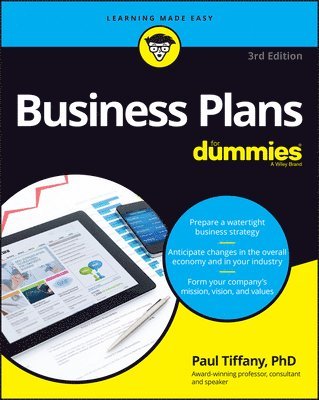
    Business Plans For Dummies

    AvPaul Tiffany,Steven D. Peterson

    Häftad, Engelska, 2022

    222 kr

    Beställningsvara. Skickas inom 5-8 vardagar. Fri frakt över 249 kr.

    Fler format och utgåvor

    Häftad

    183 kr

    Beskrivning

    Plan to succeed as an entrepreneur—we show you how Business Plans For Dummies can guide you, as a new or aspiring business owner, through the process of creating a comprehensive, accurate, and useful business plan. In fact, it is just as appropriate for an already up-and running firm that realizes it's now time for a full-bore check-up, to ensure the business is in tip-top shape to meet the challenges of the globalized, digitized, and constantly changing 21st Century. This edition of is fully updated, featuring the most recent practices in the business world. Let us walk you through each step of the planning process. You'll find everything you need in this one book, so you can finally stop googling, close all those browser tabs, and get organized and get going. Updates to this new revision include knowing how to pivot when your situation changes, recognizing the need for diversity and inclusion in the workplace, where to tap the latest funding sources, and how to plan for a digital strategy, market disruption, and environmental sustainability. You'll also learn how today's globalized marketplace influences your business—and how you can use social media to influence your customers right back. Learn the ins and out of creating a business plan that will actually workSet effective goals and objectives so your business can find successWow investors with your knowledge of today's important business trendsMap out your finances, marketing plan, and operational blueprint—then confidently get to work!Challenge the traditional framework by building a business plan that's workable in today's reality. Dummies is here to help.

    Produktinformation

    • Utgivningsdatum:2022-05-02
    • Mått:185 x 231 x 25 mm
    • Vikt:567 g
    • Format:Häftad
    • Språk:Engelska
    • Antal sidor:416
    • Upplaga:3
    • Förlag:John Wiley & Sons Inc
    • ISBN:9781119866374

    Utforska kategorier

    • Företagsekonomi inom Ekonomi och Ledarskap

    Mer om författaren

    Paul Tiffany, PhD, is a professor at the Haas School of Business, UC Berkeley, where he teaches courses on public policy and management. He is an expert in business strategy and management. Prior to beginning his career in academia, Tiffany worked as a business consultant and continues to lead his own consulting agency.Steven D. Peterson, PhD, is the senior partner and founder of the management tool development company Strategic Play Technologies.

    Innehållsförteckning

    • Introduction 1About This Book 2Foolish Assumptions 3Icons Used in This Book 4Beyond the Book 4Where to Go From Here 4Part 1: Getting Started with Business Plans 5Chapter 1: Preparing to Do a Business Plan 7Identifying Your Planning Resources 8Checking out the variety of sources out there 9Surfing the Internet 9Purchasing business-planning software 12Seeking professional help 12Finding friendly advice 13Assembling Your Planning Team 14Setting the ground rules 15Delegating responsibility 15Putting Your Plan on Paper or in Cyberspace 16Executive summary 17Company overview 18Business environment 19Company description 19Company strategy 20Financial review 20Action plan 21Chapter 2: Understanding the Importance of a Business Plan 23Bringing Your Ideas into Focus 24Looking forward 25Looking back 26Looking around 27Taking the first step 27Understanding the Planning behind the Plan 28Is planning an art or science? 28Why planning matters 29Satisfying Your Audience 30Venture capital 31Bankers, backers, and bootstrappers 33Chapter 3: Setting Off in the Right Direction 39Understanding Why Values Matter 40Facing tough choices 40Weighing utilitarianism and other philosophies 41Applying ethics and the law 42Getting caught lost and unprepared, if not naked and afraid 43Understanding the value of having values 44Clarifying Your Company Values 46Putting together your values statement 46Following through with your values 48Creating Your Company’s Vision Statement 48Chapter 4: Charting the Proper Course 51Creating Your Company’s Mission Statement 52Getting started 52Capturing your business (in 50 words or less) 55Introducing Goals and Objectives 57Why bother? 57Goals versus objectives 58Efficiency versus effectiveness 60Minding Your Own Business: Setting Goals and Objectives 61Creating your business goals 61Laying out your objectives 62Matching goals and objectives with your mission 62Timing is everything 63Part 2: Describing Your Marketplace 67Chapter 5: Examining the Business Environment 69Understanding Your Business 70Analyzing Your Industry 71Configuring the structure 73Measuring the markets 75Remembering the relationships 78Figuring out the finances 80Coming up with supporting data 82Recognizing Critical Success Factors 85Adopting new technologies, procedures, and policies 86Getting a handle on what counts most 86Determining what drives your business 86Looking for a great location 87Dealing with distribution 87Marketing mind games 87Getting along with government regulation 88SWOT: Preparing for Opportunities and Threats 89Finding warm and soothing waters 89Scanning for clouds on the horizon, ice on the water, or worse 92Chapter 6: Slicing and Dicing Markets 95Separating Customers into Groups 96Identifying Market Segments 98Who buys 99What customers buy 103Why customers buy 107Finding Useful Market Segments 110Is the segment the right size? 110Can you identify the customers? 111Can you reach the market? 111Becoming Market Driven 113Chapter 7: Getting Up Close and Personal with Customers 117Keeping Track of the Big Picture 118Categorizing Your Customers 119Comparing generations 120Defining your good customers 121Handling your not-so-best customers 122Scoping out the other guy’s customers 123Discovering the Ways Customers Behave 124Understanding customer needs 125Determining customer motives 127Figuring Out How Customers Make Choices 128Realizing perceptions are reality 128Setting in motion the five steps to adoption 129Understanding the Global Customer 130Serving Your Customers Better 132Looking at a Special Case: Business Customers 134Filling secondhand demand 135Decision-making as a formal affair 136Knowing the forces to be reckoned with 136Chapter 8: Covering Your Competition 139Understanding the Value of Competitors 140Identifying Your Real Competitors 142Considering competition based on customer choice 143Paying attention to product usage and unexpected new competition 146Spotting strategic groups 147Focusing on future competition 149Tracking Your Competitors’ Actions 151Determining competitors’ capabilities 151Assessing competitors’ strategies 153Predicting Your Competitors’ Moves 155Figuring out competitors’ goals 155Uncovering competitors’ assumptions 156Competing to Win 158Organizing facts and figures 158Choosing your battles 160Part 3: Weighing Your Company’s Prospects 161Chapter 9: Assessing Where You Stand Today 163Doing Situation Analysis 164Identifying Strengths and Weaknesses 165Keeping frames of reference 165Defining capabilities and resources 166Monitoring critical success factors 177Analyzing Your Situation in 3-D 180Getting a glance at competitors 180Completing your SWOT analysis 180Chapter 10: Profiting from Your Business Plan 183Describing What You Do Best 184Looking at the links in a value chain 184Forging your value chain 187Understanding your value proposition 189Putting Together a Business Model 190How will you make money? 191How’s your timing? 193Making Your Business Model Work 193Searching for a competitive advantage 194Focusing on core competence 195Sustaining an advantage over time 196Earmarking Resources 197Chapter 11: Figuring Out the Financial Details 201Reading Income Statements 203Rendering revenue 203Calculating costs 205Pondering profits 206Interpreting Balance Sheets 206Ascertaining assets 207Categorizing liabilities and owners’ equity 210Examining Cash-Flow Statements 211Moving money: Cash in and cash out 213Watching cash levels rise and fall 214Evaluating Financial Ratios 214Meeting short-term obligations 215Remembering long-term responsibilities 217Reading relative profitability 218Chapter 12: Forecasting and Budgeting 221Constructing a Financial Forecast 222Piecing together your pro-forma income statement 224Estimating your balance sheet 228Projecting your cash flow 230Exploring Alternative Financial Forecasts 231Utilizing the DuPont formula 231Answering a what-if analysis 233Making a Budget 233Looking inside the budget 234Creating your budget 234Part 4: Looking to the Future 239Chapter 13: Confronting Uncertainty 241Understanding the Dangers of Ignoring Change 242Defining the Dimensions of Change 243Governmental trends 244Economic trends 248Cultural trends 253Technological trends 255Anticipating Change 259Preparing for a Changing Future 261Chapter 14: Thinking Strategically 265Applying Off-the-Shelf Strategies 266Leading with low costs 268Standing out in a crowd 274Focusing on focus 276Changing Your Boundaries 279The evolution of new strategic models 279Outsourcing and offshoring 280Leading and Following 281Market-leader strategies 282Market-follower strategies 282Tailoring Your Own Strategy 284Chapter 15: Growing Up, Growing Bigger, and Growing Old 285Facing Up to the Product Life Cycle 286Starting out 287Growing up 288Maturing in middle age 288Riding out the senior stretch 290Gauging where you are now 290Finding Ways to Expand 292Same product and same market 294New market or new product 296New product and new market 300Managing Your Product Portfolio 302Utilizing strategic business units 302Aiming for the stars 304Asking Two Final Questions About Growth 309Knowing that, yes, growth is good 309Managing growth wisely 310Part 5: Putting Your Business Plan into Action 313Chapter 16: Shaping and Shape-Shifting Your Organization 315Recognizing That Form Follows Function 315Putting Together an Effective Organization 317Choosing a basic design 317Focusing on a functional model 318Divvying up duties with a divisional form 318Sharing talents with the matrix format 319Dealing with too many chefs in the kitchen 320Finding what’s right for you 321Thinking and Organizing for the Future 322Chapter 17: Leading the Way 325Encouraging Leadership Roles 326Leading from the front or the back 326Looking at leadership styles 327Developing Business Skills (And Having the Right Personality Traits) 328Evaluating personality traits 328Distinguishing appropriate skills 329Creating the Right Culture 330Following Through with Your Vision 332Bringing Your Plan to Life (And Making a Final Check) 333Part 6: The Part of Tens 335Chapter 18: Ten (Or So) Signs That Your Business Plan Needs Refreshing — or Worse 337Your Business Goals Change Abruptly 338You Don’t Meet Your Plan Milestones 338New Technology Makes a Splash 338Important Customers Walk Away 339The Competition Heats Up 339Product Demand Falls Sharply 339Revenues Go Down or Costs Go Up 340Company Morale Slumps 340Key Financial Projections Don’t Pan Out 340Too Much Growth, Too Fast 341An Unwanted Surprise Pops Up 341Chapter 19: Ten (Or So) Questions to Ask about Your Plan 343Are Your Goals and Mission in Sync? 343Can You Point to Major Opportunities? 344Have You Prepared for Threats? 344Do You Know Your Customers? 344Can You Track Your Competitors? 345Do You Know Your Strengths and Weaknesses? 345Does Your Strategy Make Sense? 346Can You Stand Behind the Numbers? 346Are You Really Ready for Change? 346Is Your Plan Concise and Up-to-Date? 347What’s the Worst That Can Happen, and How Will You Deal with It? 347Chapter 20: Ten (Or So) Business-Planning Never-Evers 349Failing to Plan in the First Place 349Shrugging Off Values and Vision 350Second-Guessing the Customer 350Underestimating Your Competition 350Ignoring Your Strengths 351Mistaking a Budget for a Plan 351Shying Away from Reasonable Risk 351Allowing One Person to Dominate a Plan 352Being Afraid to Change 352Forgetting to Motivate and Reward 352Faking It 353Appendix: A Sample Business Plan 355Index 381