• Fri frakt över 249 kr
  • •
  • Snabba leveranser
  • •
  • Billiga böcker
Kundservice

Du är på sajten för privatpersoner.

Företag, bibliotek eller offentlig verksamhet?

Du handlar på classic.bokus.com, där alla dina funktioner finns intakta.
Till classic.bokus.com
Bokus logotyp. Gå till startsidan.
  • Erbjudanden
  • Nyheter
  • Student
  • Topplistor
  • Barn & ungdom
  • Bokus Play
  • E-böcker
  • Pocketböcker
  • Spel & pussel

10% rabatt på allt med kod NYSTART10 →

Sidfot

Mina sidor

    Hjälp

    • Kundservice
    • Vanliga frågor och svar
    • Frakt och leverans
    • Retur vid ångerrätt
    • Reklamera vara
    • Betalning
    • Köpvillkor
    • Allmänna villkor
    • Information om webbplatsens tillgänglighet

    Om Bokus

    • Om oss
    • Pressrum
    • För studenter
    • För företag
    • För bibliotek och offentlig verksamhet
    • För leverantörer
    • Hållbarhet

    Populärt

    • Aktuella erbjudanden
    • Presentkort
    • Studentlitteratur
    • Nya böcker
    • Topplistor
    • Signerade böcker
    • Engelska böcker

    Inspiration

    • Boktips
    • BookTok
    • Populära bokserier
    • Barnbokskaraktärer
    • Populära författare
    Logotyp för Bokus
    Följ oss på Facebook (extern länk)Följ oss på Instagram (extern länk)Följ oss på YouTube (extern länk)Följ oss på TikTok (extern länk)
    bokus @ CookiesAnpassa cookiesIntegritetspolicyKöpvillkor
    Till Citymail hemsida (extern länk)Till Budbee hemsida (extern länk)Till Postnord hemsida (extern länk)Till Schenker hemsida (extern länk)Till Early Bird hemsida (extern länk)Till Walleys hemsida (extern länk)
    1. Naturvetenskap och teknik
    2. Teknik och industri
    3. Elektronik och kommunikationer

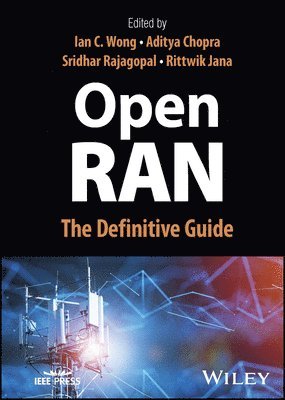
    Open RAN

    The Definitive Guide

    AvIan C. Wong,Ian C. Wong

    Inbunden, Engelska, 2023

    1 408 kr

    Beställningsvara. Skickas inom 5-8 vardagar. Fri frakt över 249 kr.

    Beskrivning

    Open RAN A comprehensive survey of Open RAN technology and its ecosystem In Open RAN: The Definitive Guide, a team of distinguished industry leaders deliver an authoritative guide to all four principles of the Open RAN vision: openness, virtualization, intelligence, and interoperability. Written by the industry experts currently defining the specifications, building the systems, and testing and deploying the networks, the book covers O-RAN architecture, the fronthaul interface, security, cloudification, virtualization, intelligence, certification, badging, and standardization. This critical reference on Open RAN explains how and why an open and disaggregated, intelligent, and fully virtualized network is the way networks should be designed and deployed moving forward. Readers will also find: A thorough introduction from key industry players, including AT&T, Telefonica, Mavenir, VMWare, Google and VIAVIComprehensive explorations of Open X-Haul transport networks and other unique 5G capabilitiesPractical discussions of the four pillars of O-RAN architecture: openness, virtualization, intelligence, and interoperabilityComprehensive treatments of how smaller vendors can introduce their own services and customize the networkPerfect for engineers, product managers, and marketing professionals in the telecom industry, Open RAN: The Definitive Guide will also benefit graduate students, researchers, and engineers in government agencies with involvement in the wireless and telecom industries.

    Produktinformation

    • Utgivningsdatum:2023-09-06
    • Mått:178 x 254 x 14 mm
    • Vikt:640 g
    • Format:Inbunden
    • Språk:Engelska
    • Antal sidor:240
    • Förlag:John Wiley & Sons Inc
    • ISBN:9781119885993

    Utforska kategorier

    • Elektronik och kommunikationer inom Naturvetenskap och teknik

    Mer om författaren

    Ian C. Wong, PhD, is Director of RF and Wireless Architecture at VIAVI Solutions. He is co-chair of the Test and Integration Focus group in the O-RAN Alliance and a Senior Member of the IEEE. Aditya Chopra, PhD, is a communication systems engineer with over 10 years’ experience in wireless standards and transceiver design. Sridhar Rajagopal, PhD, is a SVP and Senior Fellow at Mavenir Systems, where he leads customer engineering and radio integration for Mavenir’s Open RAN products. He has co-invented around 50 issued US patents and is a senior member of IEEE. Rittwik Jana, PhD, is currently a Telco analytics and automation engineer at Google. He is an industry expert with over 25 years of experience in numerous wireless technologies and standards.

    Innehållsförteckning

    • List of Contributors xiiiForeword xvPreface xviiAbout the Authors xixDefinitions / Acronyms xxi1 The Evolution of RAN 1Sameh M. Yamany1.1 Introduction 11.2 RAN Architecture Evolution 41.2.1 The 2G RAN 51.2.2 The 3G RAN 61.2.3 The 4G/LTE RAN 61.2.4 The 5G RAN 91.3 The Case for Open RAN 111.4 6G and the Road Ahead 111.5 Conclusion 13Bibliography 132 Open RAN Overview 14Rittwik Jana2.1 Introduction 142.1.1 What is Open RAN and Why is it Important? 172.1.2 How Does Open RAN Accelerate Innovation? 172.1.3 What are the major challenges that Open RAN can help to address? 182.2 Open RAN Architecture 182.3 Open RAN Cloudification and Virtualization 192.4 RAN Intelligence 202.5 Fronthaul Interface and Open Transport 202.6 Securing Open RAN 212.7 Open Source Software 212.8 RAN Automation and Deployment with CI/CD 222.9 Open RAN Testing 222.10 Industry Organizations 232.11 Conclusion 23Bibliography 233 O-RAN Architecture Overview 24Rajarajan Sivaraj and Sridhar Rajagopal3.1 Introduction 243.1.1 General Description of O-RAN Functions 243.1.1.1 Centralized Unit – Control Plane and User Plane Functions (CU-CP and CU-UP) 263.1.1.2 Distributed Unit Function (DU) 263.1.1.3 Radio Unit Function (RU) 263.1.1.4 Evolved Node B (eNB) 273.1.2 RAN Intelligent Controller (RIC) and Service Management and Orchestration (SMO) Functions 283.1.3 Interfaces 293.2 Near-RT RIC Architecture 303.2.1 Standard Functional Architecture Principles 303.2.2 E2 Interface Design Principles 323.2.3 xApp API Design Architecture 343.3 Non-RT RIC Architecture 373.3.1 Standard Functional Architecture Principles 383.3.2 A1 Interface Design Principles 383.3.3 R1 API Design Principles for rApps 413.4 SMO Architecture 473.4.1 Standard Functional Architecture Principles 473.4.2 O1 Interface Design Principles 483.4.3 Open M-Plane Fronthaul Design Principles 513.4.4 O2 Interface Design Principles 523.5 Other O-RAN Functions and Open Interfaces 543.5.1 O-RAN compliant Centralized Unit Control Plane (O-CU-CP) 543.5.1.1 Control Plane Procedures 543.5.1.2 Management Plane Procedures 543.5.2 O-CU-UP 543.5.2.1 Control Plane Procedures 553.5.2.2 User Plane Procedures 553.5.2.3 Management Plane Procedures 553.5.3 O-DU 553.5.3.1 Control Plane Procedures 553.5.3.2 User Plane Procedures 553.5.3.3 Management Plane Procedures 553.5.4 O-eNB 563.5.5 O-RU 563.6 Conclusion 57Bibliography 574 Cloudification and Virtualization 59Padma Sudarsan and Sridhar Rajagopal4.1 Virtualization Trends 594.2 Openness and Disaggregation with vRAN 594.3 Cloud Deployment Scenarios 614.3.1 Private, Public, and Hybrid Cloud 614.3.2 Telco Features Required for “Any Cloud” Deployment 624.3.3 On Premise, Far Edge, Edge, and Central Deployments 634.3.4 Classical, Virtual Machines (VMs), Containers, and Hybrid Deployments 644.4 Unwinding the RAN Monolith 644.4.1 Adapting Cloud-Native Principles 664.4.2 Architectural Patterns 674.4.3 Software Architecture Portability and Refactoring Considerations 684.4.4 Compute Architecture Consideration 694.5 Orchestration, Management, and Automation as Key to Success 704.5.1 Acceleration Abstraction Layer 734.5.2 Cloud Deployment Workflow Automation 754.6 Summary 76Bibliography 765 RAN Intelligence 77Dhruv Gupta, Rajarajan Sivaraj, and Rittwik Jana5.1 Introduction 775.2 Challenges and Opportunities in Building Intelligent Networks 775.3 Background on Machine Learning Life Cycle Management 785.4 ML-Driven Intelligence and Analytics for Non-RT RIC 805.5 ML-Driven Intelligence and Analytics for Near-RT RIC 825.6 E2 Service Models for Near-RT RIC 835.6.1 E2SM-KPM 845.6.2 E2SM-RC 845.6.3 Other E2SMs 855.7 ml Algorithms for Near-RT RIC 865.7.1 Reinforcement Learning Models 875.8 Near-RT RIC Platform Functions for AI/ML Training 885.9 RIC Use Cases 895.10 Conclusion 90Bibliography 906 The Fronthaul Interface 91Aditya Chopra6.1 The Lower-Layer Split RAN 916.1.1 Lower Layer Fronthaul Split Options 926.2 Option 8 Split – CPRI and eCPRI 936.3 Option 6 Split – FAPI and nFAPI 946.3.1 Subinterfaces 976.3.2 Architecture Agnostic Deployment 976.4 Option 7 Split – O-RAN Alliance Open Fronthaul 976.4.1 Control (C) and User (U) Plane 986.4.2 Management (M) Plane 986.4.3 Synchronization (S) Plane 1006.4.4 Key Features 1006.4.4.1 Fronthaul Compression 1006.4.4.2 Delay Management 1026.4.4.3 Beamforming 1026.4.4.4 Initial Access 1036.4.4.5 License Assisted Access and Spectrum Sharing 1046.5 Conclusions 104Bibliography 1047 Open Transport 105Reza Vaez-Ghaemi and Luis Manuel Contreras Murillo7.1 Introduction 1057.2 Requirements 1057.2.1 Fronthaul Requirements 1067.2.2 Midhaul Requirements 1067.2.3 Backhaul Requirements 1077.2.4 Synchronization Requirements 1077.3 WDM Solutions 1087.3.1 Passive WDM 1097.3.2 Active WDM 1097.3.3 Semiactive WDM 1107.4 Packet-Switched Solutions 1117.4.1 Technology Overview 1127.4.2 Deployment Patterns 1127.4.3 Connectivity Service and Protocols 1137.4.4 Quality of Service (QoS) 1147.5 Management and Control Interface 1147.5.1 Control and Management Architecture 1147.5.2 Interaction with O-RAN Management 1167.6 Synchronization Solutions 1177.6.1 Synchronization Baseline 1177.6.2 Synchronization Accuracy and Limits 1187.7 Testing 1187.8 Conclusion 119Bibliography 1208 O-RAN Security 121Amy Zwarico8.1 Introduction 1218.2 Zero Trust Principles 1218.3 Threats to O-RAN 1228.3.1 Stakeholders 1228.3.2 Threat Surface and Threat Actors 1228.3.3 Overall Threats 1238.3.4 Threats Against the Lower Layer Split (LLS) Architecture and Open Fronthaul Interface 1238.3.5 Threats Against O-RU 1248.3.6 Threats Against Near- and Non-Real-Time RICs, xApps, and rApps 1248.3.7 Threats Against Physical Network Functions (PNFs) 1248.3.8 Threats Against SMO 1258.3.9 Threats Against O-Cloud 1258.3.10 Threats to the Supply Chain 1258.3.11 Physical Threats 1268.3.12 Threats Against 5G Radio Networks 1268.3.13 Threats to Standards Development 1268.4 Protecting O-RAN 1268.4.1 Securing the O-RAN-Defined Interfaces 1268.4.1.1 A1 1278.4.1.2 O1 1278.4.1.3 O2 1288.4.1.4 E2 1288.4.1.5 Open Fronthaul 1288.4.1.6 R1 1308.4.1.7 3GPP Interfaces 1318.4.2 Securing the O-Cloud 1318.4.3 Container Security 1318.4.4 O-RAN Software Security 1318.4.5 Software Bill of Materials (SBOM) 1328.5 Recommendations for Vendors and MNOs 1328.6 Conclusion 134Bibliography 1349 Open RAN Software 137David Kinsey, Padma Sudarsan, and Rittwik Jana9.1 Introduction 1379.2 O-RAN Software Community (OSC) 1389.2.1 OSC Projects 1389.2.2 The Service Management and Orchestration (SMO) Framework 1389.2.3 Near-RT RIC (RIC) 1399.2.4 O-CU-CP and O-CU-UP 1409.2.5 O-DU Project 1409.2.6 O-RU 1409.2.7 O-Cloud 1409.2.8 The AI/ML Framework 1419.2.9 Support Projects 1419.3 Open Network Automation Platform (ONAP) 1419.3.1 Netconf/YANG Support 1419.3.2 Configuration Persistence 1429.3.3 VES Support 1429.3.4 A1 Support 1429.3.5 Optimization Support 1429.4 Other Open-Source Communities 1439.5 Conclusion 144Bibliography 14410 Open RAN Deployments 145Sidd Chenumolu10.1 Introduction 14510.2 Network Architecture 14610.2.1 Network Components 14710.2.1.1 Antenna 14710.2.1.2 O-RAN – Radio Unit 14810.2.1.3 O-RAN-Distributed Unit (O-DU) 15010.2.1.4 O-RAN-Centralized Unit (O-CU) 15010.2.1.5 RAN Intelligent Controller (RIC) 15010.2.2 Traditional vs. O-RAN Deployment 15110.2.3 Typical O-RAN Deployment 15210.2.4 Spectrum and Regulatory 15310.3 Network Planning and Design 15310.3.1 Cell Site Design 15410.3.2 Network Function Placement 15510.3.3 Dimensioning 15510.3.3.1 Application Dimensioning 15510.3.3.2 Platform Dimensioning 15610.3.4 Virtualization Impact 15610.3.4.1 Non-Uniform Memory Access 15710.3.4.2 Hyper-Threading 15710.3.4.3 CPU Pinning 15710.3.4.4 Huge Page 15710.3.4.5 Single Root Input/Output Virtualization 15810.3.4.6 PCI Passthrough 15810.3.4.7 Data Plane Development Kit 15810.3.4.8 Resource Director Technology 15810.3.4.9 Cache Allocation Technology 15810.3.4.10 Resource Overcommitment 15910.3.4.11 Operating System 15910.3.4.12 K8S Impact 15910.3.5 Networking Hardware 15910.3.6 Hardware Type 16010.3.7 Reliability and Availability 16010.3.8 Impact of Network Slicing 16110.4 Network Deployment 16210.4.1 DU Deployment 16210.4.1.1 DU Deployed at a Centralized Data Center 16210.4.1.2 Timing Design When DU is at the dc 16310.4.1.3 DU Deployed at Cell Site 16410.4.2 CU Deployment 16510.4.3 Radio Unit Instantiation 16510.4.4 Radio Unit Management 16610.4.4.1 Hierarchical Management Architecture Model 16610.4.4.2 Hybrid Management Architecture Model 16610.4.5 Network Management 16610.4.6 Public Cloud Provider Overview 16710.4.6.1 Native Services 16710.4.6.2 CD Pipeline 16710.4.6.3 Cluster Creation and Management 16810.4.6.4 Transport Design 16810.4.7 Life Cycle Management of NFs 16810.4.8 Network Monitoring and Observability 16910.4.8.1 Prometheus 16910.4.8.2 Jaeger 16910.4.8.3 Fluentd and Fluentbit 16910.4.8.4 Probing 16910.4.9 Network Inventory 16910.4.10 Building the Right Team 17010.5 Conclusion 170Bibliography 17011 Open RAN Test and Integration 172Ian Wong, Ph.D.11.1 Introduction 17211.2 Testing Across the Network Life Cycle 17411.3 O-RAN ALLIANCE Test and Integration Activities 17511.3.1 Test Specifications 17511.3.2 Conformance Test Specifications 17611.3.2.1 A1 Interface Test Specification (O-RAN.WG2.A1TS) 17811.3.2.2 E2 Interface Test Specification (O-RAN.WG3.E2TS) 17911.3.2.3 Open Fronthaul Conformance Test Specification (O-RAN.WG4.CONF) 18011.3.2.4 Xhaul Transport Testing (O-RAN.WG9.XTRP-Test.0) 18111.3.2.5 Security Test Specifications (O-RAN.SFG.Security-Test-Specifications) 18111.3.3 Interoperability Test Specifications 18111.3.3.1 Fronthaul Interoperability Test Specification (O-RAN.WG4.IOT.0-09.00) 18211.3.3.2 Open F1/W1/E1/X2/Xn Interoperability Test Specification (O-RAN.WG5.IOT.0) 18311.3.3.3 Stack Interoperability Test Specification (O-RAN.WG8.IOT) 18311.3.4 End-to-End Test Specifications 18511.3.5 O-RAN Certification and Badging 18611.3.6 Open Test and Integration Centers 18711.3.7 O-RAN Global PlugFests 18911.4 Conclusion 189Bibliography 18912 Other Open RAN Industry Organizations 191Aditya Chopra, Manish Singh, Prabhakar Chitrapu, Luis Lopes, and Diane Rinaldo12.1 Telecom Infra Project 19112.1.1 Organizational Structure 19212.1.2 Core Activities 19412.2 Trials and Deployments 19412.3 Small Cell Forum 19512.3.1 A History of Openness at SCF 19612.3.2 Alignment with the 3GPP and O-RAN Alliance Solutions 19612.4 3rd Generation Partnership Project 19712.5 Open RAN Policy Coalition 19912.6 Conclusion 200Bibliography 200Index 201