• Fri frakt över 249 kr
  • •
  • Snabba leveranser
  • •
  • Billiga böcker
Kundservice

Du är på sajten för privatpersoner.

Företag, bibliotek eller offentlig verksamhet?

Du handlar på classic.bokus.com, där alla dina funktioner finns intakta.
Till classic.bokus.com
Bokus logotyp. Gå till startsidan.
  • Erbjudanden
  • Nyheter
  • Student
  • Topplistor
  • Barn & ungdom
  • Bokus Play
  • E-böcker
  • Pocketböcker
  • Spel & pussel

10% rabatt på allt med kod NYSTART10 →

Sidfot

Mina sidor

    Hjälp

    • Kundservice
    • Vanliga frågor och svar
    • Frakt och leverans
    • Retur vid ångerrätt
    • Reklamera vara
    • Betalning
    • Köpvillkor
    • Allmänna villkor
    • Information om webbplatsens tillgänglighet

    Om Bokus

    • Om oss
    • Pressrum
    • För studenter
    • För företag
    • För bibliotek och offentlig verksamhet
    • För leverantörer
    • Hållbarhet

    Populärt

    • Aktuella erbjudanden
    • Presentkort
    • Studentlitteratur
    • Nya böcker
    • Topplistor
    • Signerade böcker
    • Engelska böcker

    Inspiration

    • Boktips
    • BookTok
    • Populära bokserier
    • Barnbokskaraktärer
    • Populära författare
    Logotyp för Bokus
    Följ oss på Facebook (extern länk)Följ oss på Instagram (extern länk)Följ oss på YouTube (extern länk)Följ oss på TikTok (extern länk)
    bokus @ CookiesAnpassa cookiesIntegritetspolicyKöpvillkor
    Till Citymail hemsida (extern länk)Till Budbee hemsida (extern länk)Till Postnord hemsida (extern länk)Till Schenker hemsida (extern länk)Till Early Bird hemsida (extern länk)Till Walleys hemsida (extern länk)
    1. Ekonomi och Ledarskap
    2. Företagsekonomi
    3. Redovisning och finansiering

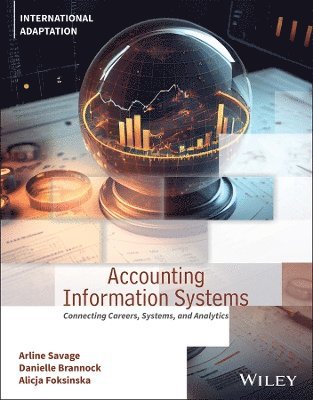
    Accounting Information Systems

    Connecting Careers, Systems, and Analytics, International Adaptation

    AvArline A. Savage,Danielle Brannock

    Häftad, Engelska, 2024

    723 kr

    Beställningsvara. Skickas inom 5-8 vardagar. Fri frakt över 249 kr.

    Beskrivning

    Accounting Information Systems presents a modern, professional perspective that develops the necessary skills students need to be the accountants of the future. Through high-quality assessment and a tool-agnostic approach, students learn course concepts more efficiently and understand how course concepts are applied in the workplace through real-world application. To help students to be the accountants of the future, the authors incorporate their own industry experience and help showcase how AIS concepts are used through tools, spotlighting real accounting professionals and job opportunities.This international edition provides new and expanded coverage of topics, including components of AIS, database forms and reports, and software tools for graphical documentation. The edition also includes new cases from across the world in the “In the Real World” feature in select chapters, showing how the concepts in the chapter apply to a real-world company or business. Every chapter now includes new Concept Review questions at the end of each section, focusing on key points students need to remember.

    Produktinformation

    • Utgivningsdatum:2024-03-22
    • Mått:277 x 218 x 36 mm
    • Vikt:1 848 g
    • Format:Häftad
    • Språk:Engelska
    • Antal sidor:848
    • Förlag:John Wiley & Sons Inc
    • ISBN:9781119889380

    Utforska kategorier

    • Redovisning och finansiering inom Ekonomi och Ledarskap

    Mer om författaren

    ARLINE SAVAGE, PHD, CA is Professor and Sallie W. Dean Faculty Fellow in Accounting in the Collat School of Business at The University of Alabama at Birmingham (UAB). She has taught a wide variety of courses across multiple countries, including her birthplace of South Africa, Canada, and the United States. She is the recipient of numerous teaching awards, most recently the 2021 UAB President’s Award for Excellence in Teaching for exceptional accomplishments in teaching. Arline received her bachelor’s, master’s, and doctoral degrees in accounting from Nelson Mandela Metropolitan University in South Africa. She began teaching at UAB in 2012 and has served as chair of the Accounting and Finance department. She currently serves on the board of directors of the Federation of Schools of Accountancy. Arline's research in accounting education has received international recognition; based on BYU accounting research rankings, she ranks 12th for the world over the last 12 years and 26th for all time. Arline has published more than 40 academic and professional publications as well as two scholarly books and two other textbooks.DANIELLE BRANNOCK, CPA, CSPO is an Internal Audit Data Analyst at Intuitive, a robotics firm that provides surgeons assistance in performing minimally invasive procedures by using robots, such as the da Vinci Surgical System. Danielle is a licensed CPA in the state of Georgia, a certified Core Alteryx Designer, and a Certified Scrum Product Owner (CSPO), which is a project management certification for Agile and scrum software development frameworks. Prior to starting at Intuitive, Danielle performed internal audit data analytics at WestRock and Invesco after a career in external audit data analytics at both PwC and EY. Danielle was named the 2020 Young Accounting Alum of the Year and 2015 Outstanding Accounting Undergraduate Student at the University of Alabama at Birmingham (UAB) and was the recipient of the 2015 Alabama Society of CPA’s Accounting Achievement Award. With a passion for public speaking, and educating both accounting professionals and academics, Danielle has presented at more than 10 conferences and in many classrooms since 2016. Danielle has a BS in accountancy and an AAS in paralegal research.ALICJA FOKSINSKA, CISA, CFE has been Lead IT Auditor at Protective Life Corporation since 2015. At Protective, Alicja spearheaded the creation of data analytics, visualization, and storytelling efforts in the (world’s greatest) Internal Audit department, becoming the data specialist of the team. She is currently managing and maturing the newly created Data Analytics shop. Alicja is also an instructor at The University of Alabama at Birmingham (UAB), where she teaches classes in accounting information systems and data visualization for business. Alicja earned BS degrees in information systems and in management (business administration) from UAB. She also earned an MS in business analytics from Indiana University. In addition to being a Certified Information Systems Auditor (CISA) and Certified Fraud Examiner (CFE), Alicja is a certified Tableau Desktop Specialist. She serves on the board of directors of a local chapter of ISACA (Birmingham, Alabama) as the current President, where she leads more than 300 IT audit, risk, compliance, and governance professionals. Alicja is a recipient of the UAB Rising Star Award and a graduate of Momentum Upward Leadership Program, which is Alabama’s premier women’s leadership program.

    Innehållsförteckning

    • From the Authors viAbout the Authors viiOur Approach viiiACKNOWLEDGMENTS xivPart I: Foundations of AIS1 Accounting as Information1.1 Why Is Accounting Information Important? 1-21.2 How Have Accounting Information Systems Evolved? 1-131.3 How Does Management Use Information? 1-191.4 What Is the Relationship Between Accounting and Data Analytics? 1-252 Risks and Risk Assessments2.1 How Do We Understand Risk? 2-22.2 What Are the Types of Risks? 2-82.3 How Do We Prioritize Risk? 2-142.4 How Do We Respond to Risk? 2-193 Risk Management and Internal Controls3.1 How Do Internal Controls Mitigate Risk? 3-23.2 How Are Controls Classified? 3-83.3 How Do We Assess Internal Controls? 3-173.4 Why Are Internal Control Frameworks Important? 3-234 Software and Systems4.1 How Do Systems Capture and Process Data? 4-24.2 How Do Startups and Small Businesses Use Technology? 4-114.3 What Are the Characteristics of Information Systems for Growing Companies? 4-164.4 Why Are Enterprise Resource Planning (ERP) Systems Considered Ideal? 4-225 Data Storage and Analysis5.1 What Is Data? 5-25.2 How Is Data Stored? 5-95.3 What Makes Data “Big Data”? 5-135.4 How Do Accounting Professionals Use Data? 5-186 Designing Systems and Databases6.1 How Are Systems Developed? 6-26.2 Which Methodology Should Be Used? 6-96.3 What Type of Database Should Be Used? 6-166.4 How Are Relational Databases Designed? 6-216.5 How Do We Interact with Data in a Database? 6-306.6 How Can We Create Database Forms and Reports? 6-407 Emerging and Disruptive Technologies7.1 How Do Companies Approach Emerging and Disruptive Technologies? 7-27.2 How Do Disruptive Technologies Provide Business Opportunities? 7-77.3 How Does Robotic Process Automation (RPA) Benefit Accounting Professionals? 7-137.4 What Is Blockchain? 7-247.5 Why Should Accountants Care About Blockchain? 7-328 Documenting Systems and Processes8.1 Why Do We Document Systems and Processes? 8-28.2 How Do We Know Which Type of Documentation to Use? 8-68.3 How Do Flowcharts Illustrate Systems or Business Processes? 8-138.4 How Do Data Flow Diagrams Show Information Flow? 8-208.5 What Software Tools Can Be Used for Graphical Documentation? 8-26Part II: Business Processes9 Human Resources and Payroll Processes9.1 How Are Human Resources and Payroll Related? 9-29.2 How Are New Employees Hired? 9-69.3 What Happens When an Employee Is Terminated? 9-149.4 How Do We Compensate Employees for Their Work? 9-209.5 How Can Human Resources and Payroll Data Be Used to Identify Risks? 9-2910 Purchasing and Payments Processes10.1 What Is the Relationship Between Purchasing, Inventory Management, and Supply Chain Management? 10-210.2 How Are Inventory and Other Goods and Services Purchased? 10-910.3 What Makes Fixed Assets Unique to Purchasing and Payments? 10-1710.4 How Do We Evaluate the Credit Payments Process? 10-2410.5 How Does the AIS Capture Purchasing and Payments Data? 10-2911 Conversion Processes11.1 What Is the Relationship Between Conversion Processes, Inventory, and Supply Chain Management? 11-211.2 Why Is Cost Accounting Important to the Accounting Information System? 11-1411.3 What Is Digital Manufacturing? 11-2211.4 How Is Data Collected and Used? 11-2612 Marketing, Sales, and Collections Processes12.1 How Do Marketing, Sales, and Collections Complete the Business Model? 12-212.2 Why Are Business Credit Sales More Complex Than Consumer Cash Sales? 12-1112.3 How Do We Ensure That Revenue Is Correctly Recognized? 12-2312.4 How Are Customer Payments Collected? 12-2912.5 Which Reports and Analytics Give Insights into These Processes? 12-3613 Financial Reporting Processes13.1 How Is an AIS Involved in Financial Reporting? 13-213.2 How Are Financial Statements Generated by an AIS? 13-613.3 How Does XBRL Create Efficient Financial Reporting? 13-1613.4 Are There Other Important Financial Accounting Reports? 13-2013.5 How Is Financial Reporting Data Used for Insights and Decision Making? 13-25Part III: Risk Assurance14 Information Systems and Controls14.1 What Framework Can We Use to Mitigate Risk Around Our Systems? 14-214.2 How Do We Decide Who Can Access Systems? 14-614.3 How Do We Physically Protect Our Systems? 14-1314.4 How Do We Keep Our Systems Running? 14-1914.5 How Do We Make Changes to Systems? 14-2815 Fraud15.1 What Is Fraud? 15-215.2 How Do We Manage Fraud Risk? 15-815.3 How Does Asset Misappropriation Result in Fraud? 15-1415.4 What Are the Characteristics of Financial Statement Fraud? 15-2316 Cybersecurity16.1 How Is Cybersecurity Relevant to the Accounting Profession? 16-216.2 How Do Cybercriminals Plan Attacks? 16-816.3 How Do Hackers Gain Unauthorized Access? 16-1516.4 How Do Attackers Shut Down a System? 16-20Part IV: Technology and Analytics17 Data Analytics17.1 How Is Data Analytics Changing the Accounting Profession? 17-217.2 How Do We Explore a Data Set? 17-717.3 How Do We Investigate Interesting Occurrences in a Data Set? 17-1417.4 Which Analytics Techniques Are Gaining Popularity in the Accounting Profession? 17-1918 Data Visualization18.1 How Does Visualization Tell a Story with Data? 18-218.2 What Are the Fundamentals of Design? 18-718.3 How Do Visualizations Help Us Explore Data? 18-1318.4 When Should Explanatory Visualizations Be Used for Storytelling? 18-2619 Audit Assurance19.1 What Is the Difference Between Internal Audit and External Audit? 19-219.2 How Are Internal Audits Performed? 19-819.3 How Is Testing Performed? 19-1319.4 What Happens After an Audit? 19-21Index I-1