• Fri frakt över 249 kr
  • •
  • Snabba leveranser
  • •
  • Billiga böcker
Kundservice

Du är på sajten för privatpersoner.

Företag, bibliotek eller offentlig verksamhet?

Du handlar på classic.bokus.com, där alla dina funktioner finns intakta.
Till classic.bokus.com
Bokus logotyp. Gå till startsidan.
  • Erbjudanden
  • Nyheter
  • Student
  • Topplistor
  • Barn & ungdom
  • Bokus Play
  • E-böcker
  • Pocketböcker
  • Spel & pussel

10% rabatt på allt med kod: NYSTART10 →

Sidfot

Mina sidor

    Hjälp

    • Kundservice
    • Vanliga frågor och svar
    • Frakt och leverans
    • Retur vid ångerrätt
    • Reklamera vara
    • Betalning
    • Köpvillkor
    • Allmänna villkor
    • Information om webbplatsens tillgänglighet

    Om Bokus

    • Om oss
    • Pressrum
    • För studenter
    • För företag
    • För bibliotek och offentlig verksamhet
    • För leverantörer
    • Hållbarhet

    Populärt

    • Aktuella erbjudanden
    • Presentkort
    • Studentlitteratur
    • Nya böcker
    • Topplistor
    • Signerade böcker
    • Engelska böcker

    Inspiration

    • Boktips
    • BookTok
    • Populära bokserier
    • Barnbokskaraktärer
    • Populära författare
    Logotyp för Bokus
    Följ oss på Facebook (extern länk)Följ oss på Instagram (extern länk)Följ oss på YouTube (extern länk)Följ oss på TikTok (extern länk)
    bokus @ CookiesAnpassa cookiesIntegritetspolicyKöpvillkor
    Till Citymail hemsida (extern länk)Till Budbee hemsida (extern länk)Till Postnord hemsida (extern länk)Till Schenker hemsida (extern länk)Till Early Bird hemsida (extern länk)Till Walleys hemsida (extern länk)
    1. Psykologi och pedagogik
    2. Pedagogik

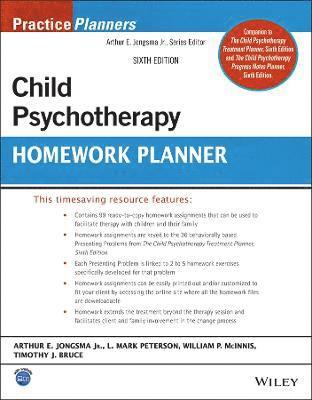
    Child Psychotherapy Homework Planner

    AvArthur E. Jongsma Jr.,L. Mark Peterson

    Häftad, Engelska, 2023

    Del i serien PracticePlanners

    685 kr

    Beställningsvara. Skickas inom 5-8 vardagar. Fri frakt över 249 kr.

    Beskrivning

    Beneficial take-home assignments for young psychotherapy clients and their parentsThe Child Psychotherapy Homework Planner, Sixth Edition provides ready-to-use, between-session assignments designed to fit most therapeutic modes. Organized by presenting problem, this homework planner covers 36 issues, including anxiety, depression, adoption, academic underachievement, ADHD, low self-esteem, and PTSD. In this new edition, the homework assignments have been modified to be more accessible to children. Assignment sheets can be easily photocopied, and they are also available online to download and print—making client-specific modification simple. This easy-to-use sourcebook features: Nearly 100 ready-to-copy exercises covering the most common issues encountered by childrenA format that’s easy to navigate, including cross-references to alternate assignments that are relevant across multiple presentationsExpert guidance on how and when to make the most efficient use of the exercisesClearly referenced correspondence with the The Child Psychotherapy Treatment Planner for a complete treatment approachThe Child Psychotherapy Homework Planner is a high-quality resource that practitioners can use to improve care and accountability. This is a valuable planner that will save therapists time on office work so they can focus on patients.

    Produktinformation

    • Utgivningsdatum:2023-04-17
    • Mått:213 x 272 x 25 mm
    • Vikt:816 g
    • Format:Häftad
    • Språk:Engelska
    • Serie:PracticePlanners
    • Antal sidor:448
    • Upplaga:6
    • Förlag:John Wiley & Sons Inc
    • ISBN:9781119981619

    Utforska kategorier

    • Pedagogik inom Psykologi och pedagogik

    Mer om författaren

    ARTHUR E. JONGSMA, Jr., PhD, is Series Editor of the bestselling PracticePlanners®. He has over five decades experience providing mental health services to inpatient and outpatient clients. He has authored or co-authored over fifty books.L. MARK PETERSON, ACSW, retired Program Manager for Bethany Christian Services Residential Treatment and Family Counseling programs in Grand Rapids, Michigan. WILLIAM P. McINNIS, PsyD, is a private practitioner with Aspen Psychological Services in Grand Rapids, Michigan. He is co-author of the Adolescent Psychotherapy Treatment Planner. TIMOTHY J. BRUCE, PhD, is Professor Emeritus in the Department of Psychiatry and Behavioral Medicine at the University of Illinois College of Medicine.

    Innehållsförteckning

    • About the Downloadable AssignmentsWiley PracticePlanners® Series Preface   xvAcknowledgments            xviiIntroduction                      1SECTION 1—Academic Underachievement             4Exercise 1.A        Establish a Homework Routine   5Exercise 1.B        Positive Self-Statements               9Exercise 1.C        Reading Adventure          11SECTION 2—Adoption                    14Exercise 2.A        Questions and Concerns About Being Adopted    15Exercise 2.B        Some Things I Would Like You to Know About Me             17SECTION 3—Anger Control Problems       20Exercise 3.A        Anger Control    21Exercise 3.B        Child Anger Checklist      29Exercise 3.C        The Lesson of Salmon Rock . . . Fighting Leads to Loneliness          32SECTION 4—Anxiety                                      37Exercise 4.A        An Anxious Story              38Exercise 4.B        Deep Breathing Exercise               41Exercise 4.C        Finding and Losing Your Anxiety 44Exercise 4.D        Worry Time        48SECTION 5— Reactive Attachment/Disinhibited Social Engagement Disorder         50Exercise 5.A        Attachment Survey          51Exercise 5.B        Building Relationships     54SECTION 6—Attention-¬Deficit/Hyperactivity Disorder (ADHD)     56Exercise 6.A        Getting It Done  57Exercise 6.B        Problem-Solving Exercise              62Exercise 6.C        Social Skills Exercise        66Exercise 6.D        Reasons for Negative Attention-Seeking BehaviorsSECTION 7—Autism Spectrum Disorder   69Exercise 7.A        Initial Reaction to Diagnosis of Autism     70Exercise 7.B        Reaction to Change and Excessive Stimulation     73SECTION 8—Blended Family        76Exercise 8.A        Blended Family Sentence Completion      77Exercise 8.B        Interviewing My New Family Member     81Exercise 8.C        Thoughts and Feelings About Parent’s Live-¬In Partner    85SECTION 9—Bullying/Aggression Perpetrator       88Exercise 9.A        Apology Letter for Bullying           89Exercise 9.B        Bullying Incident Report 92SECTION 10—Bullying/Aggression VictimSECTION 11—Conduct Disorder/Delinquency        94Exercise 10.A      Building Empathy             95Exercise 10.B      Childhood Patterns of Stealing    100Exercise 10.C      Concerns About Parent’s Drug or Alcohol Problem             104Exercise 10.D     Risk Factors Leading to Child Behavior Problems 108SECTION 12—Depression                             110Exercise 11.A      Childhood Depression Survey      111Exercise 11.B      Replace Negative Thoughts With Positive Self-Talk            114Exercise 11.C      Surface Behavior/Inner Feelings 116Exercise 11.D     Three Ways to Change the World              120SECTION 13—Disruptive Mood Dysregulation DisorderExercise 12.A      Finding Ways to Get Positive Attention    123Exercise 12.B      Practice Being Mindful [New]Exercise 12.C      Let’s Go STOP [New]  SECTION 14—Divorce Reaction   130Exercise 13.A      Feelings and Faces Game              131Exercise 13.B      My Thoughts and Feelings About My Parents’ Divorce     135SECTION 15—Enuresis/Encopresis             137Exercise 14.A      Bladder Retention Training Program        138Exercise 14.B      Bowel Control Training Program 142Exercise 14.C      Dry Bed Training Program            149SECTION 16—Fire Setting             152Exercise 15.A      Fireproofing Your Home and Family         153Exercise 15.B      When a Fire Has No Fuel               156SECTION 17: Gender DysphoriaExercise 16.A      I Want to Be Like . . .       ###Exercise 16.B      Exploring the Growth of My Gender Identity ###Exercise 16.C      My Gender Identity ###               SECTION 18—Grief/Loss Unresolved        164Exercise 17.A      Create a Memory Album               165Exercise 17.B      Grief Letter         167Exercise 17.C      Petey’s Journey Through Sadness              171SECTION 19—Intellectual Development Disorder               177Exercise 18.A      Activities of Daily Living Program              178Exercise 18.B      A Sense of Belonging      183SECTION 20—Low Self-¬Esteem 186Exercise 19.A      Dixie Overcomes Her Fears          187Exercise 19.B      Learn From Your Mistakes            194Exercise 19.C      Symbols of Self-¬Worth 197Exercise 19.D     Three Ways to Change Yourself  200Exercise 19.E      Three Wishes Game        203SECTION 21—Lying/Manipulative              204Exercise 20.A      Bad Choice—Lying to Cover Up Another Lie          205Exercise 20.B      The Value of Honesty      209Exercise 20.C      Truthful/Lying Incident Reports  215SECTION 22—Medical Condition               217Exercise 21.A      Dealing with Childhood Asthma  218Exercise 21.B      Gaining Acceptance of Physical Handicap or Illness            223SECTION 23—Obsessive-¬Compulsive Disorder (OCD)      226Exercise 22.A      Concerns, Feelings, and Hopes About OCD            227Exercise 22.B      Refocusing          230Exercise 22.C      Ritual Exposure and Response Prevention             233SECTION 24—Oppositional Defiant          237Exercise 23.A      Filing a Complaint            238Exercise 23.B      If I Could Run My Family               241Exercise 23.C      Share a Family Meal        245Exercise 23.D     Switching From Defense to Offense         251SECTION 25—Overweight/Obesity             254Exercise 24.A      Developing and Implementing a Healthier Diet    255Exercise 24.B      Increasing My Physical Activity    260Exercise 24.C      My Eating and Exercise Journal   264SECTION 26—Parenting                 267Exercise 25.A      Being a Consistent Parent             268Exercise 25.B      Picking Your Battles         272SECTION 27—Peer/Sibling Conflict           274Exercise 26.A      Joseph, His “Amazing Technicolor Coat,” and More           275Exercise 26.B      Negotiating a Peace Treaty          279SECTION 28—Physical/Emotional Abuse Victim   281Exercise 27.A      Letter of Empowerment 282Exercise 27.B      My Thoughts and Feelings            286SECTION 29—Posttraumatic Stress Disorder (PTSD)           288Exercise 28.A      Finding My Triggers         289Exercise 28.B      PTSD Incident Report      293SECTION 30—School Refusal       295Exercise 29.A      A Pleasant Journey          296Exercise 29.B      Letter of Encouragement              299Exercise 29.C      School Fear Reduction    302SECTION 31—Separation Anxiety              305Exercise 30.A      Explore Your World         306Exercise 30.B      Parents’ Time Away        309SECTION 32—Sexual Abuse Victim            311Exercise 31.A      My Story              312Exercise 31.B      You Are Not Alone           315SECTION 33—Sleep Disturbance 319Exercise 32.A      Childhood Sleep Problems            320Exercise 32.B      Reduce Nighttime Fears 324SECTION 34—Social Anxiety         327Exercise 33.A      Greeting Peers   328Exercise 33.B      Learn to Be Assertive      331Exercise 33.C      Show Your Strengths       337SECTION 35—Specific Phobia      339Exercise 34.A      Expressions of Fear Through Art 340Exercise 34.B      Maurice Faces His Fear   343SECTION 36—Speech/Language Disorders             348Exercise 35.A      Home-¬Based Reading and Language Program    349Exercise 35.B      Shauna’s Song   354Exercise 35.C      Tell All About It 362    Appendix A: Alternate Assignments for Presenting Problems         364Appendix B: Alphabetical Index of Exercises         377