• Fri frakt över 249 kr
  • •
  • Snabba leveranser
  • •
  • Billiga böcker
Kundservice

Du är på sajten för privatpersoner.

Företag, bibliotek eller offentlig verksamhet?

Du handlar på classic.bokus.com, där alla dina funktioner finns intakta.
Till classic.bokus.com
Bokus logotyp. Gå till startsidan.
  • Erbjudanden
  • Nyheter
  • Student
  • Topplistor
  • Barn & ungdom
  • Bokus Play
  • E-böcker
  • Pocketböcker
  • Spel & pussel

10% rabatt på allt med kod NYSTART10 →

Sidfot

Mina sidor

    Hjälp

    • Kundservice
    • Vanliga frågor och svar
    • Frakt och leverans
    • Retur vid ångerrätt
    • Reklamera vara
    • Betalning
    • Köpvillkor
    • Allmänna villkor
    • Information om webbplatsens tillgänglighet

    Om Bokus

    • Om oss
    • Pressrum
    • För studenter
    • För företag
    • För bibliotek och offentlig verksamhet
    • För leverantörer
    • Hållbarhet

    Populärt

    • Aktuella erbjudanden
    • Presentkort
    • Studentlitteratur
    • Nya böcker
    • Topplistor
    • Signerade böcker
    • Engelska böcker

    Inspiration

    • Boktips
    • BookTok
    • Populära bokserier
    • Barnbokskaraktärer
    • Populära författare
    Logotyp för Bokus
    Följ oss på Facebook (extern länk)Följ oss på Instagram (extern länk)Följ oss på YouTube (extern länk)Följ oss på TikTok (extern länk)
    bokus @ CookiesAnpassa cookiesIntegritetspolicyKöpvillkor
    Till Citymail hemsida (extern länk)Till Budbee hemsida (extern länk)Till Postnord hemsida (extern länk)Till Schenker hemsida (extern länk)Till Early Bird hemsida (extern länk)Till Walleys hemsida (extern länk)
    1. Naturvetenskap och teknik
    2. Teknik och industri
    3. Elektronik och kommunikationer

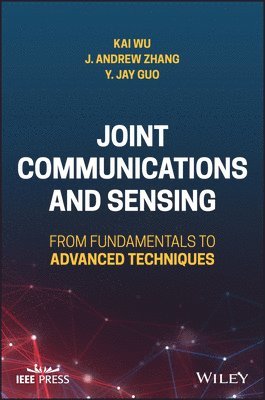
    Joint Communications and Sensing

    From Fundamentals to Advanced Techniques

    AvKai Wu,J. Andrew Zhang

    Inbunden, Engelska, 2022

    1 409 kr

    Beställningsvara. Skickas inom 5-8 vardagar. Fri frakt över 249 kr.

    Beskrivning

    JOINT COMMUNICATIONS AND SENSINGAuthoritative resource systematically introducing JCAS technologies and providing valuable information and knowledge to researchers and engineersBased on over six years of dedicated research on joint communications and sensing (JCAS) by the authors, their collaborators, and students, Joint Communications and Sensing is the first book to comprehensively cover the subject of JCAS, which is expected to deliver huge cost and energy savings, and therefore has become a hallmark of future 6G and next generation radar technologies.The book has three parts. Part I presents the basic JCAS concepts and applications and the basic signal processing algorithms to support JCAS. Part II covers communications-centric JCAS designs that describe how sensing can be integrated into communications networks such as 5G and 6G. Part III presents ways to integrate communications in various radar sensing technologies and platforms.Specific sample topics covered in Joint Communications and Sensing include: Three categories of JCAS systems, potential sensing applications of JCAS, signal processing fundamentals, and channel models for communications and radarFrameworks for perceptive mobile networks (PMNs), system modifications to enable PMN sensing, and PMN system issuesOrthogonal time-frequency space waveform-based JCAS for IoT, including signal models, echo pre-processing, and target parameter estimationJoint Communications and Sensing provides valuable information and knowledge to researchers and engineers in the communications and radar sensing communities and industries, enabling them to upskill and prepare for JCAS technology research and development. The text is of particular interest to engineers in the wireless communications industry who are pursuing new capabilities in 6G.

    Produktinformation

    • Utgivningsdatum:2022-11-16
    • Mått:157 x 235 x 22 mm
    • Vikt:668 g
    • Format:Inbunden
    • Språk:Engelska
    • Antal sidor:320
    • Förlag:John Wiley & Sons Inc
    • ISBN:9781119982913

    Utforska kategorier

    • Elektronik och kommunikationer inom Naturvetenskap och teknik

    Mer om författaren

    Kai Wu, PhD, is a Research Fellow at the Global Big Data Technologies Centre, University of Technology Sydney (UTS), Australia. J. Andrew Zhang, PhD, is an Associate Professor at the School of Electrical and Data Engineering, University of Technology Sydney, Australia. Y. Jay Guo, PhD, is the Director of Global Big Data Technologies Centre and ­Distinguished Professor at University of Technology Sydney, Australia. He co-edited the Wiley-IEEE Press title Antenna and Array Technologies for Future Wireless Ecosystems (2022) and co-authored the Wiley-IEEE Press title Advanced Antenna Array Engineering for 6G and Beyond Wireless Communications (2021).

    Innehållsförteckning

    • Acknowledgments xiiiPreface xvAcronyms xviiPart I Fundamentals of Joint Communications andSensing (JCAS) 11 Introduction to Joint Communications and Sensing(JCAS) 31.1 Background 31.2 Three Categories of JCAS Systems 51.2.1 Major Differences Between Communications and Sensing 71.2.2 Communications-Centric Design 121.2.3 Radar-Centric Design 151.2.4 Joint Design without an Underlying System 171.2.5 Summary of Key Research Problems 181.3 Potential Sensing Applications of JCAS 181.4 Book Organization 22References 242 Signal Processing Fundamentals for JCAS 312.1 Channel Model for Communications and Radar 312.2 Basic Communication Signals and Systems 332.2.1 Single-Carrier MIMO 332.2.2 MIMO-OFDM 342.2.3 Transmitter and Receiver Signal Processing in Communications 342.3 MIMO Radar Signals and Systems 362.3.1 Single-Carrier MIMO Radar 362.3.2 MIMO-OFDM Radar 372.3.3 FH-MIMO Radar 382.4 Basic Signal Processing for Radar Sensing 402.4.1 Matched Filtering 402.4.2 Moving Target Detection (MTD) 412.4.3 Spatial-Domain Processing 422.4.4 Target Detection 432.4.5 Spatial Refinement 442.5 Signal Processing Basics for Communication-Centric JCAS 442.5.1 802.11ad JCAS Systems 442.5.2 Mobile Network with JCAS Capabilities 462.5.3 Sensing Parameter Estimation 462.5.3.1 Direct and Indirect Sensing 472.5.3.2 Sensing Algorithms 492.6 Signal Processing Basics for DFRC 502.6.1 Embedding Information in RadarWaveform 502.6.2 Signal Reception and Processing for Communications 522.6.2.1 Demodulation 532.6.2.2 Channel Estimation 542.6.3 Codebook Design 542.7 Conclusions 55References 553 Efficient Parameter Estimation 593.1 Q-Shifted Estimator (QSE) 603.2 Refined QSE (QSEr) 623.2.1 Impact ofq 623.2.2 Refined Optimalq 663.2.3 Numerical Illustration of QSEr 673.3 Padé approximation-Enabled Estimator 703.3.1 Core Updating Function 713.3.2 Initialization and Overall Estimation Procedure 743.3.3 Numerical Illustrations 763.4 Conclusions 80References 80Part II Communication-Centric JCAS 834 Perceptive Mobile Network (PMN) 854.1 Framework for PMN 854.1.1 System Platform and Infrastructure 86Trim Size: 6in x 9in Single Column Wu982913 ftoc.tex V1 - 09/06/2022 5:13pm Page vii[1][1] [1][1]Contents vii4.1.1.1 CRAN 874.1.1.2 Standalone BS 874.1.2 Three Types of Sensing Operations 884.1.2.1 Downlink Active Sensing 884.1.2.2 Downlink Passive Sensing 884.1.2.3 Uplink Sensing 894.1.2.4 Comparison 894.1.3 Signals Usable from 5G NR for Radio Sensing 904.1.3.1 Reference Signals Used for Channel Estimation 904.1.3.2 Nonchannel Estimation Signals 924.1.3.3 Data Payload Signals 924.2 System Modifications to Enable Sensing 924.2.1 Dedicated Transmitter for Uplink Sensing 934.2.2 Dedicated Receiver for Downlink (and Uplink) Sensing 944.2.3 Full-Duplex Radios for Downlink Sensing 944.2.4 Base Stations with Widely Separated Transmitting and ReceivingAntennas 964.3 System Issues 984.3.1 Performance Bounds 984.3.2 Waveform Optimization 1004.3.2.1 Spatial Optimization 1024.3.2.2 Optimization in Time and Frequency Domains 1054.3.2.3 Optimization with Next-Generation Signaling Formats 1064.3.3 Antenna Array Design 1064.3.3.1 Virtual MIMO and Antenna Grouping 1074.3.3.2 Sparse Array Design 1084.3.3.3 Spatial Modulation 1094.3.3.4 Reconfigurable Intelligent Surface-Assisted JCAS 1094.3.4 Clutter Suppression Techniques 1104.3.4.1 Recursive Moving Averaging (RMA) 1124.3.4.2 Gaussian Mixture Model (GMM) 1134.3.5 Sensing Parameter Estimation 1144.3.5.1 Periodogram such as 2D DFT 1154.3.5.2 Subspace-Based Spectrum Analysis Techniques 1154.3.5.3 On-Grid Compressive Sensing Algorithms 1174.3.6 Resolution of Sensing Ambiguity 1194.3.7 Pattern Analysis 1224.3.8 Networked Sensing under Cellular Topology 1234.3.8.1 Fundamental Theories and Performance Bounds for “Cellular SensingNetworks” 1234.3.8.2 Distributed Sensing with Node Grouping and Cooperation 1244.3.9 Sensing-Assisted Communications 1244.3.9.1 Sensing-Assisted Beamforming 1244.3.9.2 Sensing-Assisted Secure Communications 1284.4 Conclusions 128References 1285 Integrating Low-Complexity and Flexible Sensing intoCommunication Systems: A Unified SensingFramework 1395.1 Problem Statement and Signal Model 1395.1.1 Signal Model 1405.1.2 Classical OFDM Sensing (COS) 1425.1.3 Problem Statement 1435.1.3.1 CP-limited Sensing Distance 1435.1.3.2 Communication-limited Velocity measurement 1435.1.3.3 COS adapted for DFT-S-OFDM 1445.2 A Low-Complexity Sensing Framework 1445.3 Performance Analysis 1505.3.1 Preliminary Results 1505.3.2 Analyzing Signal Components in Two RDMs 1515.3.3 Comparison and Insights 1545.3.4 Criteria for Setting Key Sensing Parameters 1575.4 Simulation Results 1585.4.1 Illustrating SINRs in RDMs 1595.4.2 Illustration of Target Detection 1625.5 Conclusions 166References 1676 Sensing Framework Optimization 1696.1 Echo Preprocessing 1696.1.1 Reshaping 1706.1.2 Virtual Cyclic Prefix (VCP) 1716.1.3 Removing Communication Information 1746.2 Target Parameter Estimation 1776.2.1 Parameter Estimation Method 1776.2.2 Computational Complexity 1816.3 Optimizing Parameters of Sensing Methods 1826.3.1 Preliminary Results 1836.3.2 Maximizing SINR for Parameter Estimation 1846.4 Simulation Results 1866.4.1 Comparison with Benchmark Method 186Trim Size: 6in x 9in Single Column Wu982913 ftoc.tex V1 - 09/06/2022 5:13pm Page ix[1][1] [1][1]Contents ix6.4.2 Wide Applicability 1896.5 Conclusions 192References 193Part III Radar-Centric Joint Communications andSensing 1957 FH-MIMO Dual-Function Radar-Based Communications:Single-Antenna Receiver 1977.1 Problem Statement 1987.2 Waveform Design for FH-MIMO DFRC 1997.2.1 FH-MIMO RadarWaveform 2007.2.2 Overall Channel Estimation Scheme 2027.2.2.1 Estimate Timing Offset 2037.2.2.2 Estimate Channel Parameters 2037.3 Estimating Timing Offset 2037.3.1 Two Estimation Methods 2047.3.2 Performance Analysis and Comparison of the Estimators 2057.3.3 Design of a Suboptimal Hopping Frequency Sequence 2087.4 Estimating Channel Response 2097.4.1 Estimation Method 2097.4.2 Complexity Analysis 2107.5 Using Estimations in Data Communications 2117.6 Extensions to Multipath Cases 2127.7 Simulation Results 2147.8 Conclusions 219References 2198 Frequency-Hopping MIMO Radar-Based Communicationswith Multiantenna Receiver 2218.1 Signal Model 2218.2 The DFRC Signal Mode 2238.3 A Multiantenna Receiving Scheme 2268.3.1 Estimating Channel Response 2268.3.2 Estimating Timing Offset 2278.3.2.1 Estimating L𝜂 2288.3.2.2 Removing Estimation Ambiguity 2298.3.3 Information Demodulation 2308.3.3.1 Estimating khm 2308.3.3.2 FHCS Demodulation 2328.3.3.3 PSK Demodulation 2328.4 Performance Analysis 2328.4.1 Performance of Channel Coefficient Estimation 2328.4.2 Performance of Timing Offset Estimation 2338.4.3 Communication Performance 2348.4.3.1 Achievable Rate 2348.4.3.2 SER of PSK-Based FH-MIMO DFRC 2348.5 Simulations 2358.6 Conclusions 240References 2409 Integrating Secure Communications into Frequency HoppingMIMO Radar with Improved Data Rates 2439.1 Signal Models and Overall Design 2439.1.1 Signal Model of Bob 2449.1.2 Signal Model of Eve 2459.1.3 Overall Description 2469.1.4 Maximum Achievable Rate (MAR) 2479.2 Elementwise Phase Compensation 2499.2.1 AoD-Dependence Issue of Hopping Frequency Permutation Selection(HFPS) Demodulation 2499.2.2 Elementwise phase compensation and HFPS Demodulation atBob 2509.2.3 Enhancing Physical-Layer Security by Elementwise PhaseCompensation 2529.3 Random Sign Reversal 2539.3.1 Random Sign Reversal and Maximum Likelihood (ML)Decoding 2539.3.2 Detecting Random Sign Reversal at Bob 2549.3.3 Random Sign Reversal Impact Analysis 2559.3.4 Impact of Presented Design on Radar Performance 2589.3.4.1 Impact of HFCS on R(𝜏) 2589.3.4.2 Impact of HFPS on R(𝜏) 2599.3.4.3 Impact of Elementwise Phase Compensation and Random SignReversal on R(𝜏) 2599.3.4.4 Limitations of Presented Design for Radar Applications 2609.3.5 Extension to Multipath and Multiuser Scenarios 2609.3.5.1 Multipath Scenario 2609.3.5.2 Multiuser Scenario 2619.4 Simulation Results 2619.5 Conclusions 267References 267Trim Size: 6in x 9in Single Column Wu982913 ftoc.tex V1 - 09/06/2022 5:13pm Page xi[1][1] [1][1]Contents xiA Proofs, Analyses, and Derivations 271A.1 Proof of Lemma 5.1 271A.2 Proof of Lemma 5.2 271A.3 Proof of Lemma 5.3 272A.4 Proof of Proposition 5.1 273A.5 Proof of Proposition 5.2 274A.6 Proof of Proposition 6.1 275A.7 Deriving the Powers of the Four Terms of X̃ n[l] Given in (6.33) 277A.8 Proof of Proposition 6.2 280A.9 Proof of Proposition 6.3 281A.10 Deriving (9.31) 282References 283Index 285