• Fri frakt över 249 kr
  • •
  • Snabba leveranser
  • •
  • Billiga böcker
Kundservice

Du är på sajten för privatpersoner.

Företag, bibliotek eller offentlig verksamhet?

Du handlar på classic.bokus.com, där alla dina funktioner finns intakta.
Till classic.bokus.com
Bokus logotyp. Gå till startsidan.
  • Erbjudanden
  • Nyheter
  • Student
  • Topplistor
  • Barn & ungdom
  • Bokus Play
  • E-böcker
  • Pocketböcker
  • Spel & pussel

10% studentrabatt med kod TERM26

Sidfot

Mina sidor

    Hjälp

    • Kundservice
    • Vanliga frågor och svar
    • Frakt och leverans
    • Retur vid ångerrätt
    • Reklamera vara
    • Betalning
    • Köpvillkor
    • Allmänna villkor
    • Information om webbplatsens tillgänglighet

    Om Bokus

    • Om oss
    • Pressrum
    • För studenter
    • För företag
    • För bibliotek och offentlig verksamhet
    • För leverantörer
    • Hållbarhet

    Populärt

    • Aktuella erbjudanden
    • Presentkort
    • Studentlitteratur
    • Nya böcker
    • Topplistor
    • Signerade böcker
    • Engelska böcker

    Inspiration

    • Boktips
    • BookTok
    • Populära bokserier
    • Barnbokskaraktärer
    • Populära författare
    Logotyp för Bokus
    Följ oss på Facebook (extern länk)Följ oss på Instagram (extern länk)Följ oss på YouTube (extern länk)Följ oss på TikTok (extern länk)
    bokus @ CookiesAnpassa cookiesIntegritetspolicyKöpvillkor
    Till Citymail hemsida (extern länk)Till Budbee hemsida (extern länk)Till Postnord hemsida (extern länk)Till Schenker hemsida (extern länk)Till Early Bird hemsida (extern länk)Till Walleys hemsida (extern länk)
    1. Naturvetenskap och teknik
    2. Teknik och industri
    3. Elektronik och kommunikationer

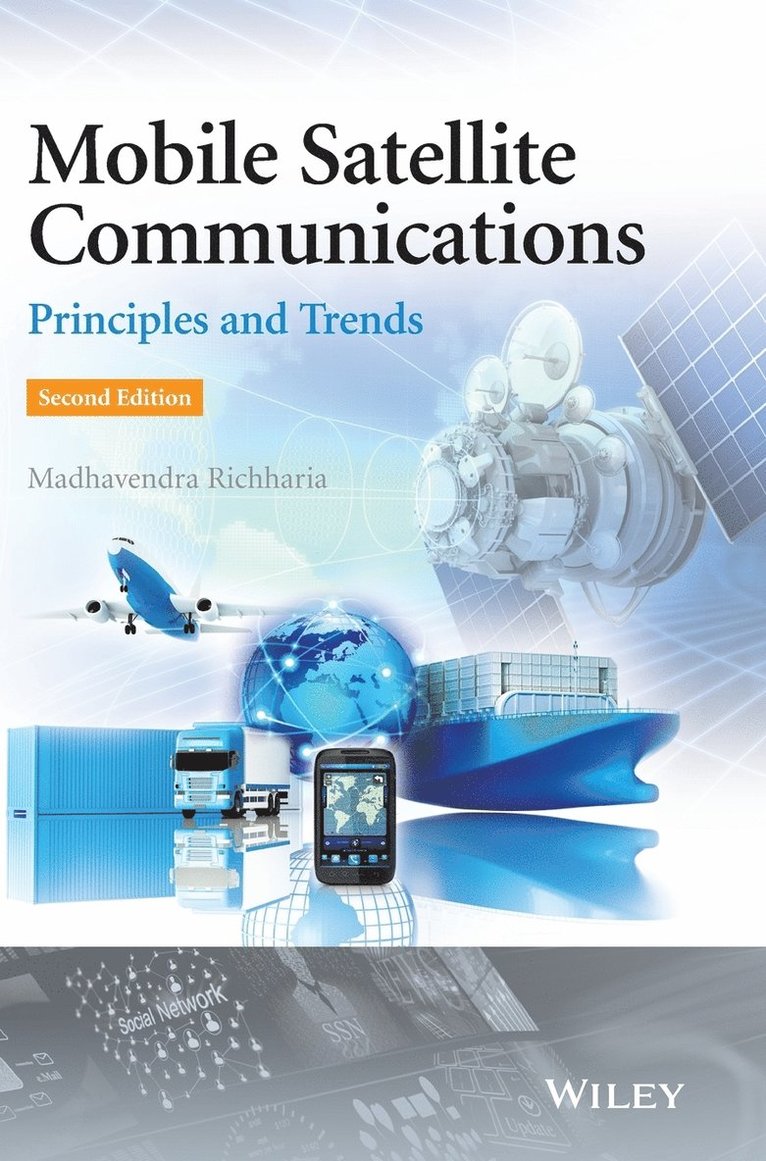
    Mobile Satellite Communications

    Principles and Trends

    AvMadhavendra Richharia

    Inbunden, Engelska, 2014

    1 643 kr

    Beställningsvara. Skickas inom 5-8 vardagar. Fri frakt över 249 kr.

    Fler format och utgåvor

    E-bok

    1 909 kr

    Beskrivning

    Demand for Mobile Satellite Service (MSS) is on the increase, with a huge surge of interest in mobile communications in recent years and high-paced advancements in the supporting system architectures, devices and applications. This thoroughly revised and updated book provides a comprehensive guide to the MSS technologies and emerging trends. It takes a system level approach, giving in-depth treatment of technical and business related issues. The author, a leading professional in the area, draws on his extensive experience in industry and research, to provide the reader with a sound and informed understanding of the technology.Mobile Satellite Communications includes introductory material for the reader new to the field, in addition to exploring prevalent system concepts, architecture, practices and trends for the more experienced. An in-depth review of scientific principles merged with business models and regulatory considerations presents a balanced perspective of commercial mobile satellite systems.This book will be of interest to practicing engineers in mobile satellite communications and mobile broadcasting, research and development professionals working in these areas, mobile satellite service providers and operators. Academics and students studying satellite systems/technology, specialists in other classes of satellite systems, technical and marketing managers, strategists and planners of telecommunication systems: individuals interested in mobile communications, satellite and telecommunications/broadcasting technology will also find this book insightful.Key Features: Comprehensive treatment of mobile satellite communications topics, including radio link aspects, satellite constellations, architectural and operational aspects, as well as business planning models, MSS radio interface standards, spectrum forecast methodologies and system examples.Addresses related themes such as mobile broadcasting, mobile VSATs, search and rescue, and navigation systems.Introduces emerging technologies such as mobile broadband, television broadcasting to handheld units, advanced capacity enhancement techniques, hybrid system architecture concepts, including a rich sample of research topics such as multiple input multiple output, satellite-based ad-hoc networks, and highlights initiatives in the use of Q/V frequency bands.Includes revision questions at the end of each chapter.An accompanying website for interaction (www.satellitesandyou.com).

    Produktinformation

    • Utgivningsdatum:2014-04-28
    • Mått:178 x 252 x 41 mm
    • Vikt:1 279 g
    • Format:Inbunden
    • Språk:Engelska
    • Antal sidor:752
    • Upplaga:2
    • Förlag:John Wiley & Sons Inc
    • ISBN:9781119998860

    Utforska kategorier

    • Elektronik och kommunikationer inom Naturvetenskap och teknik

    Mer om författaren

    Madhavendra Richharia is a practising professional for well over three decades, with experience in diverse areas such as design and development of earth station products, satellite system design and operation, system planning, academics and research. He is currently a senior consultant and director of Knowledge Space Ltd, UK, prior to which he held a senior technical position at Inmarsat for over 15 years. Earlier, he was a faculty member at the University of Surrey. He has also contributed to satellite communication programmes of ISRO as an engineering scientist. He has published a number of technical papers on a variety of satellite communications topic, authored a book on satellite system design and co-authored a book covering concepts and technologies applicable to satellite systems for personal applications. The first edition of this book was well-received and continues to be recommended for many university courses. He obtained his PhD degree from the University of Birmingham UK and Bachelor and Masters from BHU. He is a member of the IEEE and the IET.

    Innehållsförteckning

    • Preface xvAbout the Author xviiAcknowledgements xix1 Introduction 11.1 Scope and Organization 11.2 Evolution of Mobile Telecommunications 51.3 Satellite System Architecture 131.4 Business Plan 231.5 Regulatory Considerations 231.6 Operational Considerations 241.7 Mobile Systems – A Comparison 261.8 Example Applications 271.9 Practical Limitations 271.10 Related Satellite Systems 291.11 Trends 31Revision 34References 352 Satellite Constellations 372.1 Introduction 372.2 Satellite Orbits 382.3 Satellite Constellations 69Revision 85References 863 Radio Link 893.1 Introduction 893.2 Spectrum Issues 893.3 Propagation Characteristics 1003.4 Radio Link Analysis 162Revision 170References 1714 Modulation, Coding and Multiple Access 1754.1 Introduction 1754.2 Modulation 1754.3 Coding 1974.4 Multiple Access Schemes 208Revision 222References 2235 Fixed Earth Stations and User Terminals 2275.1 Introduction 2275.2 Gateways 2285.3 User Terminals 2305.4 Environmental Issues 264Revision 269References 2696 Spacecraft 2716.1 Introduction 2716.2 Satellites for MSS 2726.3 Intersatellite links 3026.4 Emerging Technologies 3066.5 Launching Satellite Constellations 308Revision 312References 3127 System Architecture 3157.1 Introduction 3157.2 Air Interface 3167.3 System Development 3207.4 Network Considerations 334Revision 355References 3568 Satellite Radio Interface Standards 3578.1 Introduction 3578.2 Satellite Radio Interface Standards 3598.3 Interactive Mobile Broadband Broadcast Standard 407Revision 422References 4239 Operational Considerations 4259.1 Introduction 4259.2 Perspective 4259.3 Subscriber and Gateway Commissioning 4289.4 Radio Resource Management 4319.5 Radio Frequency Monitoring 4559.6 Quality of Service 4639.7 Licensing Issues 464Revision 466References 46610 Commercial Issues 46910.1 Introduction 46910.2 System Planning 47210.3 Service Distribution Model 48310.4 Billing Issues 48610.4.1 Investment Routes 48710.5 Regulatory Issues 48810.6 Traffic Forecast 48910.7 End-User Perspective – A Case Study 507Revision 513References 51311 Representative MSS Systems 51511.1 Introduction 51511.2 Geostationary Satellite Systems 51611.3 LightSquared MSS-ATC Proposal 54411.4 Big-LEO Systems 54711.5 Little-LEO System 56411.6 MEO System 56811.6.1 ICO System 56811.7 Hybrid Orbit Systems 57211.7.1 ELLIPSOTM System 572References 57712 Mobile Satellite Broadcast Systems 58112.1 Introduction 58112.2 Evolution 58212.3 Mobile Broadcast System Requirements 58512.4 System Configuration 58712.5 Space Segment 58812.6 Transmission Technology 59012.7 OSI Architecture in a Broadcast Context 59412.8 Prevalent Transmission Systems 59712.9 Receiver Architecture 60412.10 DVB-SH System Architecture 60612.11 Multimedia Broadcast and Multicast Services (MBMS) 61112.12 DBS Reception on Mobile Terminals 612Revision 613References 61413 Related Satellite Systems 61713.1 Introduction 61713.2 Distress and Safety Systems 61713.3 Navigation Systems 62713.4 Mobile Very Small Aperture Terminals 64213.5 Terrestrial Cellular System 64913.5.1 System Architecture 650Revision 653References 65314 The Future 65514.1 Introduction 65514.2 Market Projections 65614.3 Spectrum Forecast 65914.4 Capacity Enhancement Techniques 65914.5 System Architecture 67214.6 Enabling Concepts and Technologies 67814.7 Little-LEO Systems 69214.8 Mobile Satellite Systems in Future Networks 693Revision 698References 699Appendix 703A.1 Coverage Snapshot of Representative Non-Geostationary MSS Systems 703A.2 A List of Useful Formulas 705A.2.1 Geostationary Orbit 705A.2.2 Propagation 711A.2.3 Receiver 713References 714Index 715