• Fri frakt över 249 kr
  • •
  • Snabba leveranser
  • •
  • Billiga böcker
Kundservice

Du är på sajten för privatpersoner.

Företag, bibliotek eller offentlig verksamhet?

Du handlar på classic.bokus.com, där alla dina funktioner finns intakta.
Till classic.bokus.com
Bokus logotyp. Gå till startsidan.
  • Erbjudanden
  • Nyheter
  • Student
  • Topplistor
  • Barn & ungdom
  • Bokus Play
  • E-böcker
  • Pocketböcker
  • Spel & pussel

10% rabatt på allt med kod: NYSTART10 →

Sidfot

Mina sidor

    Hjälp

    • Kundservice
    • Vanliga frågor och svar
    • Frakt och leverans
    • Retur vid ångerrätt
    • Reklamera vara
    • Betalning
    • Köpvillkor
    • Allmänna villkor
    • Information om webbplatsens tillgänglighet

    Om Bokus

    • Om oss
    • Pressrum
    • För studenter
    • För företag
    • För bibliotek och offentlig verksamhet
    • För leverantörer
    • Hållbarhet

    Populärt

    • Aktuella erbjudanden
    • Presentkort
    • Studentlitteratur
    • Nya böcker
    • Topplistor
    • Signerade böcker
    • Engelska böcker

    Inspiration

    • Boktips
    • BookTok
    • Populära bokserier
    • Barnbokskaraktärer
    • Populära författare
    Logotyp för Bokus
    Följ oss på Facebook (extern länk)Följ oss på Instagram (extern länk)Följ oss på YouTube (extern länk)Följ oss på TikTok (extern länk)
    bokus @ CookiesAnpassa cookiesIntegritetspolicyKöpvillkor
    Till Citymail hemsida (extern länk)Till Budbee hemsida (extern länk)Till Postnord hemsida (extern länk)Till Schenker hemsida (extern länk)Till Early Bird hemsida (extern länk)Till Walleys hemsida (extern länk)
    1. Psykologi och pedagogik
    2. Psykologi
    3. Socialpsykologi och gruppsykologi

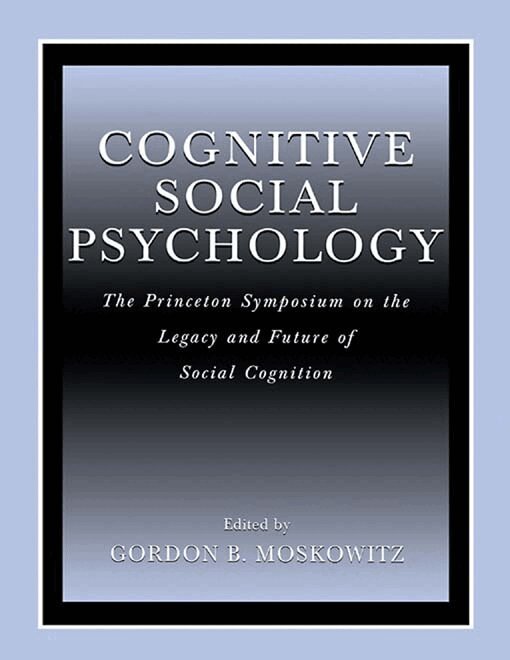
    Cognitive Social Psychology

    The Princeton Symposium on the Legacy and Future of Social Cognition

    AvGordon B. Moskowitz

    E-bok
    PDF, Engelska, 2013

    997 kr

    Läs direkt i Bokus Reader – eller ladda ned till din enhet (PDF kräver ofta zoom och scroll på små skärmar).

    Beskrivning

    A comprehensive overview of the mechanisms involved in how cognitive processes determine thought and behavior toward the social world, Cognitive Social Psychology:*examines cognition as a motivated process wherein cognition and motivation are seen as intertwined; * reviews the latest research on stereotyping, prejudice, and the ability to control these phenomena--invaluable information to managers who need to prevent against bias in the workplace; and *provides a current analysis of classic problems/issues in social psychology, such as cognitive dissonance, the fundamental attribution error, social identity, stereotyping, social comparison, heuristic processing, the self-concept, assimilation and contrast effects, and goal pursuit. Intended for psychology and management students, as well as social, cognitive, and industrial/organizational psychologists in both academic and applied settings. This new book is also an ideal text for courses in social cognition due to its cohesive structure.

    Produktinformation

    • Utgivningsdatum:2013-05-13
    • Språk:Engelska
    • Filformat:PDF
    • Kopieringsskydd:LCP
    • ISBN:9781135664251
    • Förlag:Taylor & Francis Ltd

    Utforska kategorier

    • Socialpsykologi och gruppsykologi inom Psykologi och pedagogik

    Innehållsförteckning

    • Contents: Part I:The Motives Driving Social Cognition.C.D. Hardin, T.D. Conley, A Relational Approach to Cognition: Shared Experience and Relationship Affirmation in Social Cognition. M.M. Thompson, M.E. Naccarato, K.C.H. Parker, G.B. Moskowitz, The Personal Need for Structure and Personal Fear of Invalidity Measures: Historical Perspectives, Current Applications, and Future Directions. J. Stone, Behavioral Discrepancies and the Role of Construal Processes in Cognitive Dissonance. E.M. Pomerantz, J.L. Saxon, G.A. Kenney, Self-Evaluation: The Development of Sex Differences. H. Blanton, Evaluating the Self in the Context of Another: The Three-Selves Model of Social Comparison Assimilation and Contrast. J.T. Jost, Outgroup Favoritism and the Theory of System Justification: A Paradigm for Investigating the Effects of Socioeconomic Success on Stereotype Content. Part II:Building Blocks of Social Cognition: Representation and Structure.J.J. Hetts, B.W. Pelham, A Case for the Nonconscious Self-Concept. S. Chen, The Role of Theories in Mental Representations and Their Use in Social Perception: A Theory-Based Approach to Significant-Other Representations and Transference. M.W. Morris, D.R. Ames, E.D. Knowles, What We Theorize When We Theorize That We Theorize: Examining the "Implicit Theory" Construct From a Cross-Disciplinary Perspective. M. Schaller, L.G. Conway, III, From Cognition to Culture: The Origins of Stereotypes That Really Matter. J.W. Sherman, The Dynamic Relationship Between Stereotype Efficiency and Mental Representation. L.S. Newman, A Cornerstone for the Science of Interpersonal Behavior? Person Perception and Person Memory, Past, Present, and Future. Part III:Subjective Perception and Motivated Judgment.D.S. Krull, On Partitioning the Fundamental Attribution Error: Dispositionalism and the Correspondence Bias. D.A. Stapel, W. Koomen, Let's Not Forget the Past When We Go to the Future: On Our Knowledge of Knowledge Accessibility. S.J. Stroessner, J.E. Plaks, Illusory Correlation and Stereotype Formation: Tracing the Arc of Research Over a Quarter Century. J.D. Vorauer, The Other Side of the Story: Transparency Estimation in Social Interaction. D.T. Wegener, M. Dunn, D. Tokusato, The Flexible Correction Model: Phenomenology and the Use of Naive Theories in Avoiding or Removing Bias. A. Liberman, Exploring the Boundaries of Rationality: A Functional Perspective on Dual-Process Models in Social Psychology. Part IV:Control Over Cognition and Action.N. Roese, The Crossroads of Affect and Cognition: Counterfactuals as Compensatory Cognition. C.M. Brendl, Goals and the Compatibility Principle in Attitudes, Judgment, and Choice. G.B. Moskowitz, Preconscious Control and Compensatory Cognition. I.V. Blair, Implicit Stereotypes and Prejudice. M.J. Monteith, C.I. Voils, Exerting Control Over Prejudiced Responses.