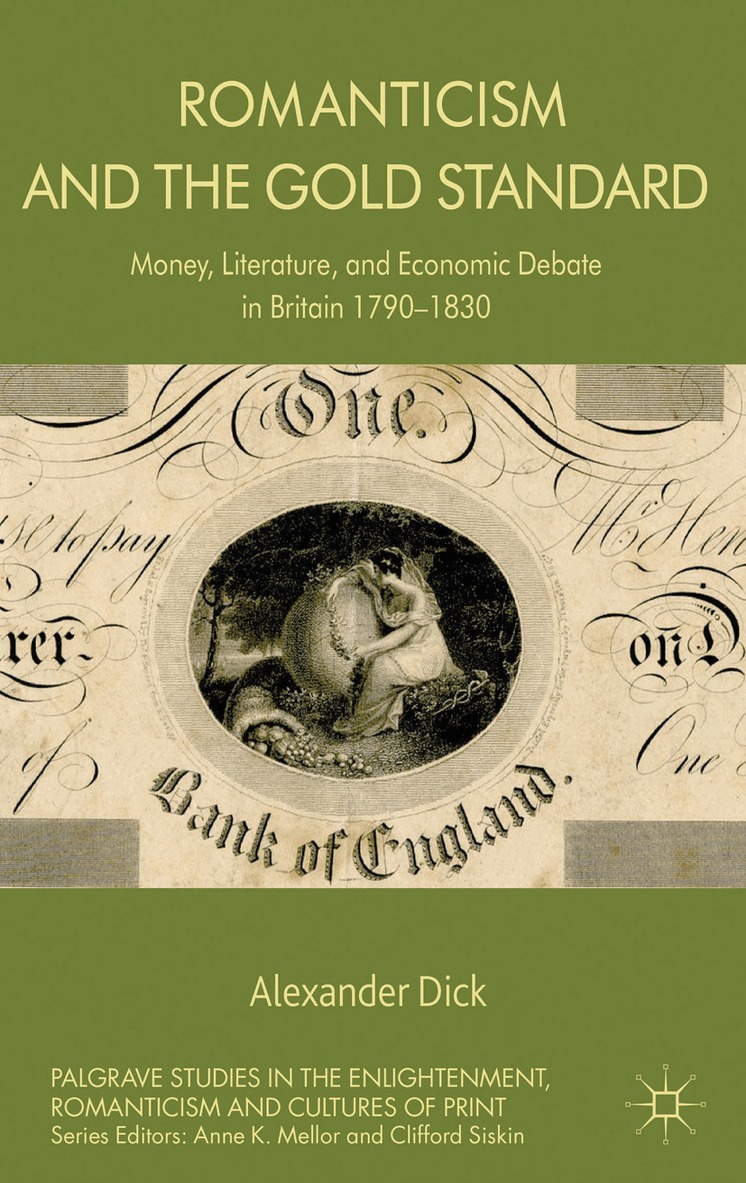
Romanticism and the Gold Standard
Money, Literature, and Economic Debate in Britain 1790-1830
AvA. Dick
640 kr
Beställningsvara. Skickas inom 10-15 vardagar. Fri frakt över 249 kr.
Du är på sajten för privatpersoner.
AvA. Dick
640 kr
Beställningsvara. Skickas inom 10-15 vardagar. Fri frakt över 249 kr.
ALEXANDER DICK is Assistant Professor in the Department of English at the University of British Columbia, Canada.
"The publication of Alexander Dick's monograph is significant in terms of the contribution it makes to interdisciplinary approaches to Romanticism... Dick's sharp focus on the gold standard, and the 'confidence' and 'embarrassment' that arose following the suspension of cash payments in 1797, offers new ways of investigating the shifting definitions of economic and literary value during the Romantic period ... Dick's monograph ... will undoubtedly inspire research across the nineteenth century" Review of English Studies "Dick's ability to combine careful attention to the age's debates about monetary issues with a more speculative sense of the broader theoretical possibilities generated by the idea of the standard in its various forms constitutes an important addition to these discussions." Paul Keen, The BARS Review
Du är på sajten för privatpersoner.
AvA. Dick
640 kr
Beställningsvara. Skickas inom 10-15 vardagar. Fri frakt över 249 kr.
ALEXANDER DICK is Assistant Professor in the Department of English at the University of British Columbia, Canada.
"The publication of Alexander Dick's monograph is significant in terms of the contribution it makes to interdisciplinary approaches to Romanticism... Dick's sharp focus on the gold standard, and the 'confidence' and 'embarrassment' that arose following the suspension of cash payments in 1797, offers new ways of investigating the shifting definitions of economic and literary value during the Romantic period ... Dick's monograph ... will undoubtedly inspire research across the nineteenth century" Review of English Studies "Dick's ability to combine careful attention to the age's debates about monetary issues with a more speculative sense of the broader theoretical possibilities generated by the idea of the standard in its various forms constitutes an important addition to these discussions." Paul Keen, The BARS Review