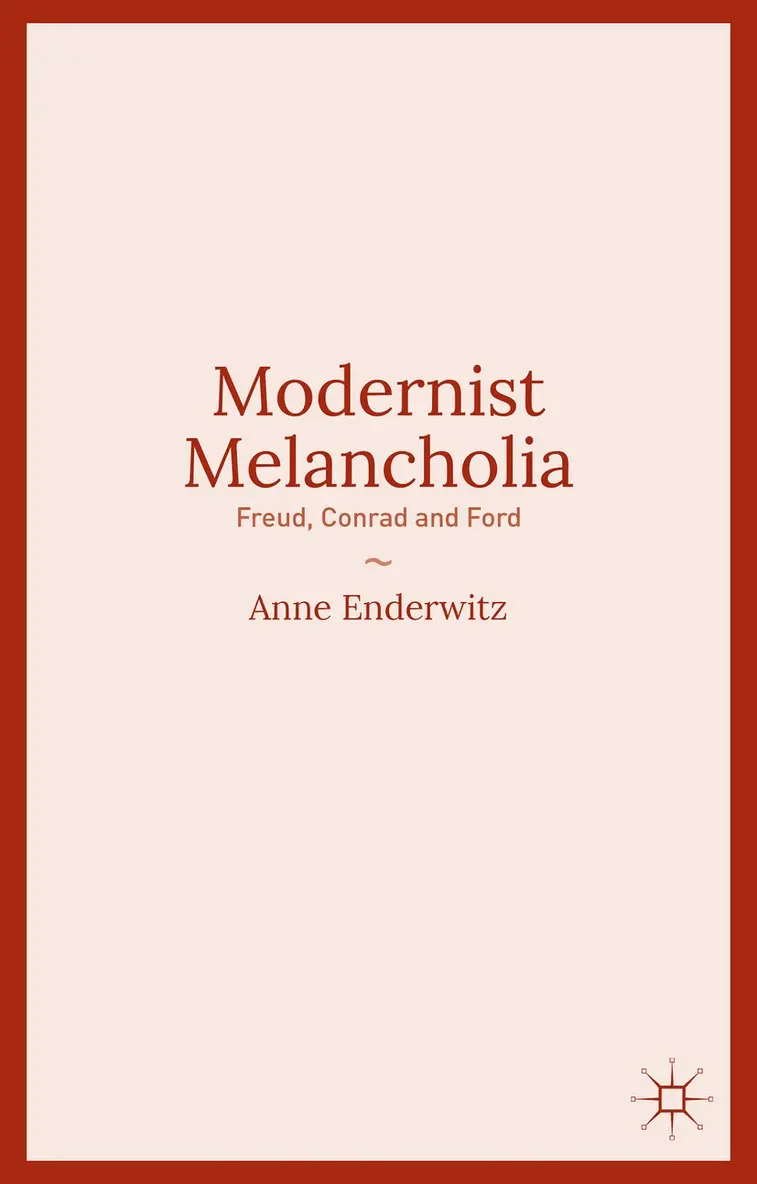
Modernist Melancholia
Freud, Conrad and Ford
639 kr
Beställningsvara. Skickas inom 10-15 vardagar. Fri frakt över 249 kr.
Du är på sajten för privatpersoner.
639 kr
Beställningsvara. Skickas inom 10-15 vardagar. Fri frakt över 249 kr.
Anne Enderwitz teaches comparative literature at Freie Universität Berlin, Germany. She holds a PhD from the University of London and wrote her thesis as Marie Curie Fellow at UCL. Anne Enderwitz has taught English Literature in London, Erlangen and Berlin. Her research interests are modernism, melancholia, economics, early modern drama, and theory.
'Synthesizing an impressive array of theoretical, historical, and literary material, Anne Enderwitz develops a new interpretation of two important modern novelists whose sometimes uneasy relationship was vital to both, but has not been sufficiently understood. Arguing that Conrad and Ford should be seen not as master and acolyte but as equally insightful psychologists and cultural critics, Enderwitz suggests compelling connections between Freud's much-discussed ideas about melancholia, the historical developments leading to the emergence of modernism (factors as diverse as Darwin's evolutionary theories, new technologies like the phonograph, and cultural phenomena like the celebrity writer and the 'great divide' between literary and popular fiction), as well as the formal innovations of these two novelists (their 'impressionism' and their narrative experiments with epistemological uncertainty).' - Paul Armstrong, Brown University, USA
Du är på sajten för privatpersoner.
639 kr
Beställningsvara. Skickas inom 10-15 vardagar. Fri frakt över 249 kr.
Anne Enderwitz teaches comparative literature at Freie Universität Berlin, Germany. She holds a PhD from the University of London and wrote her thesis as Marie Curie Fellow at UCL. Anne Enderwitz has taught English Literature in London, Erlangen and Berlin. Her research interests are modernism, melancholia, economics, early modern drama, and theory.
'Synthesizing an impressive array of theoretical, historical, and literary material, Anne Enderwitz develops a new interpretation of two important modern novelists whose sometimes uneasy relationship was vital to both, but has not been sufficiently understood. Arguing that Conrad and Ford should be seen not as master and acolyte but as equally insightful psychologists and cultural critics, Enderwitz suggests compelling connections between Freud's much-discussed ideas about melancholia, the historical developments leading to the emergence of modernism (factors as diverse as Darwin's evolutionary theories, new technologies like the phonograph, and cultural phenomena like the celebrity writer and the 'great divide' between literary and popular fiction), as well as the formal innovations of these two novelists (their 'impressionism' and their narrative experiments with epistemological uncertainty).' - Paul Armstrong, Brown University, USA