• Fri frakt över 249 kr
  • •
  • Snabba leveranser
  • •
  • Billiga böcker
Kundservice

Du är på sajten för privatpersoner.

Företag, bibliotek eller offentlig verksamhet?

Du handlar på classic.bokus.com, där alla dina funktioner finns intakta.
Till classic.bokus.com
Bokus logotyp. Gå till startsidan.
  • Erbjudanden
  • Nyheter
  • Student
  • Topplistor
  • Barn & ungdom
  • Bokus Play
  • E-böcker
  • Pocketböcker
  • Spel & pussel

10% studentrabatt med kod TERM26

Sidfot

Mina sidor

    Hjälp

    • Kundservice
    • Vanliga frågor och svar
    • Frakt och leverans
    • Retur vid ångerrätt
    • Reklamera vara
    • Betalning
    • Köpvillkor
    • Allmänna villkor
    • Information om webbplatsens tillgänglighet

    Om Bokus

    • Om oss
    • Pressrum
    • För studenter
    • För företag
    • För bibliotek och offentlig verksamhet
    • För leverantörer
    • Hållbarhet

    Populärt

    • Aktuella erbjudanden
    • Presentkort
    • Studentlitteratur
    • Nya böcker
    • Topplistor
    • Signerade böcker
    • Engelska böcker

    Inspiration

    • Boktips
    • BookTok
    • Populära bokserier
    • Barnbokskaraktärer
    • Populära författare
    Logotyp för Bokus
    Följ oss på Facebook (extern länk)Följ oss på Instagram (extern länk)Följ oss på YouTube (extern länk)Följ oss på TikTok (extern länk)
    bokus @ CookiesAnpassa cookiesIntegritetspolicyKöpvillkor
    Till Citymail hemsida (extern länk)Till Budbee hemsida (extern länk)Till Postnord hemsida (extern länk)Till Schenker hemsida (extern länk)Till Early Bird hemsida (extern länk)Till Walleys hemsida (extern länk)
    1. Naturvetenskap och teknik
    2. Teknik och industri
    3. Energiteknik

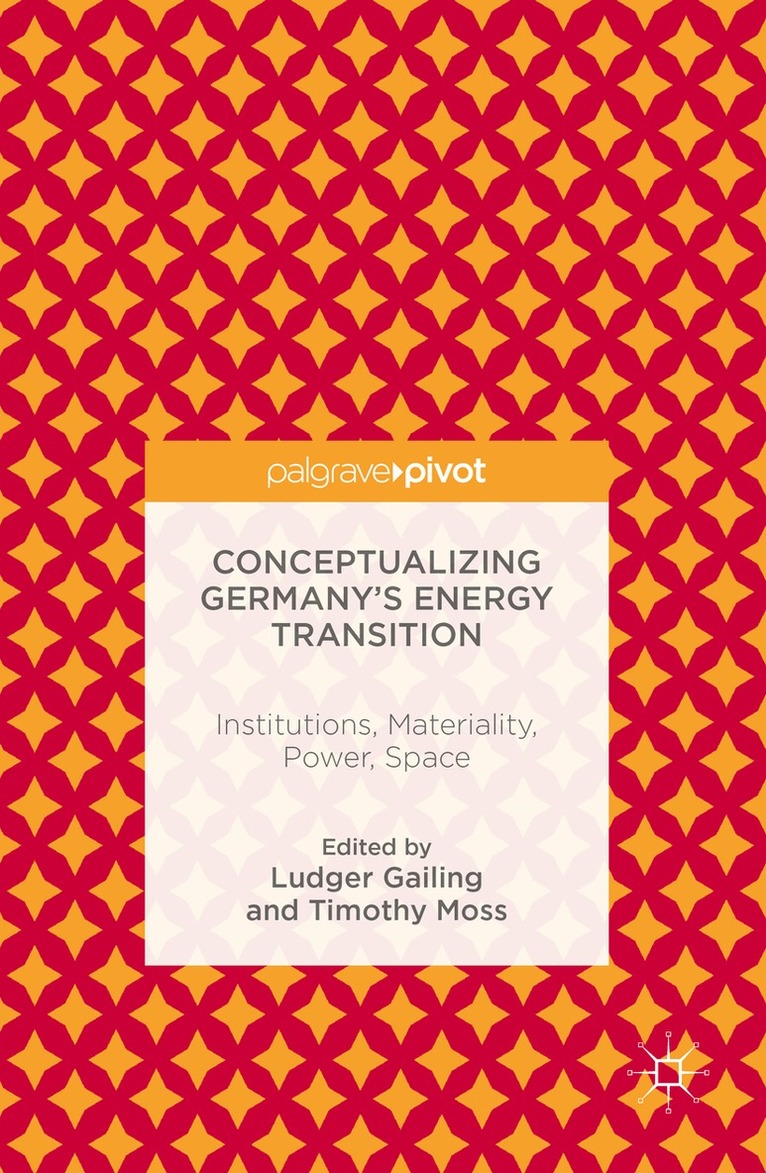
    Conceptualizing Germany’s Energy Transition

    Institutions, Materiality, Power, Space

    AvLudger Gailing,Timothy Moss

    Inbunden, Engelska, 2016

    604 kr

    Beställningsvara. Skickas inom 10-15 vardagar. Fri frakt över 249 kr.

    Beskrivning

    This is the first book to explore ways of conceptualizing Germany’s ongoing energy transition. Although widely acclaimed in policy and research circles worldwide, the Energiewende is poorly understood in terms of social science scholarship. There is an urgent need to delve beyond descriptive accounts of policy implementation and contestation in order to unpack the deeper issues at play in what has been termed a 'grand societal transformation.' The authors approach this in three ways: First, they select and characterize conceptual approaches suited to interpreting the reordering of institutional arrangements, socio-material configurations, power relations and spatial structures of energy systems in Germany and beyond. Second, they assess the value of these concepts in describing and explaining energy transitions, pinpointing their relative strengths and weaknesses and exploring areas of complementarity and incompatibility. Third, they illustrate how these concepts can be applied – individually and in combination – to enrich empirical research of Germany’s energy transition.

    Produktinformation

    • Utgivningsdatum:2016-06-03
    • Mått:148 x 210 x 13 mm
    • Vikt:348 g
    • Format:Inbunden
    • Språk:Engelska
    • Antal sidor:147
    • Upplaga:2016
    • Förlag:Palgrave Macmillan
    • ISBN:9781137505927

    Utforska kategorier

    • Energiteknik inom Naturvetenskap och teknik
    • Referensverk och tvärvetenskap inom Samhälle och politik
    • Politik och statsskick inom Samhälle och politik

    Mer om författaren

    Ludger Gailing is deputy head of the research department of Institutional Change and Regional Public Goods at the Leibniz Institute for Research on Society and Space (IRS), Germany. In his work he draws on concepts relating to governance and institutional theories, constructivist perspectives on space and place, governmentality and socio-materiality. Current research foci include energy transitions and landscape policies.Timothy Moss is head of the research department of Institutional Change and Regional Public Goods at the Leibniz Institute for Research on Society and Space (IRS), Germany. His research interests span the governance of urban infrastructures past and present, the spatial organization of water and energy and the institutional dynamics of resource use in cities and regions.

    Innehållsförteckning

    • Chapter 1: Introduction; Timothy Moss and Ludger Gailing.- Chapter 2: Germany's Energiewende and the spatial configuration of an energy system; Ludger Gailing and Andreas Röhring.- Chapter 3: Energy transitions and institutional change: between structure and agency; Sören Becker, Ross Beveridge and Andreas Röhring.- Chapter 4: Energy transitions and materiality: between dispositives, assemblages and metabolisms; Timothy Moss, Sören Becker and Ludger Gailing.- Chapter 5: Energy transitions and power: between governmentality and depoliticization; Andrea Bues and Ludger Gailing.- Chapter 6: The importance of space: towards a socio-material and political geography of energy transitions; Sören Becker, Timothy Moss and Matthias Naumann.- Chapter 7: Conclusions and outlook for future energy transitions research; Ludger Gailing and Timothy Moss.-