• Fri frakt över 249 kr
  • •
  • Snabba leveranser
  • •
  • Billiga böcker
Kundservice

Du är på sajten för privatpersoner.

Företag, bibliotek eller offentlig verksamhet?

Du handlar på classic.bokus.com, där alla dina funktioner finns intakta.
Till classic.bokus.com
Bokus logotyp. Gå till startsidan.
  • Erbjudanden
  • Student
  • Topplistor
  • Barn & ungdom
  • Bokus Play
  • E-böcker
  • Ljudböcker
  • Pocketböcker
  • Spel och pussel

5% studentrabatt – använd koden KURSBOK27 →

Sidfot

Mina sidor

    Hjälp

    • Kundservice
    • Vanliga frågor och svar
    • Frakt och leverans
    • Retur vid ångerrätt
    • Reklamera vara
    • Betalning
    • Köpvillkor
    • Allmänna villkor
    • Information om webbplatsens tillgänglighet

    Om Bokus

    • Om oss
    • Pressrum
    • För studenter
    • För företag
    • För bibliotek och offentlig verksamhet
    • För leverantörer
    • Hållbarhet

    Populärt

    • Aktuella erbjudanden
    • Presentkort
    • Studentlitteratur
    • Nya böcker
    • Topplistor
    • Signerade böcker
    • Engelska böcker

    Inspiration

    • Boktips
    • BookTok
    • Barnbokskaraktärer
    • Populära författare
    Logotyp för Bokus
    Följ oss på Facebook (extern länk)Följ oss på Instagram (extern länk)Följ oss på YouTube (extern länk)Följ oss på TikTok (extern länk)
    bokus @ CookiesAnpassa cookiesIntegritetspolicyKöpvillkor
    Till Citymail hemsida (extern länk)Till Budbee hemsida (extern länk)Till Postnord hemsida (extern länk)Till Schenker hemsida (extern länk)Till Early Bird hemsida (extern länk)Till Walleys hemsida (extern länk)
    1. Språk och ordböcker
    2. Språk: referensverk och allmänt

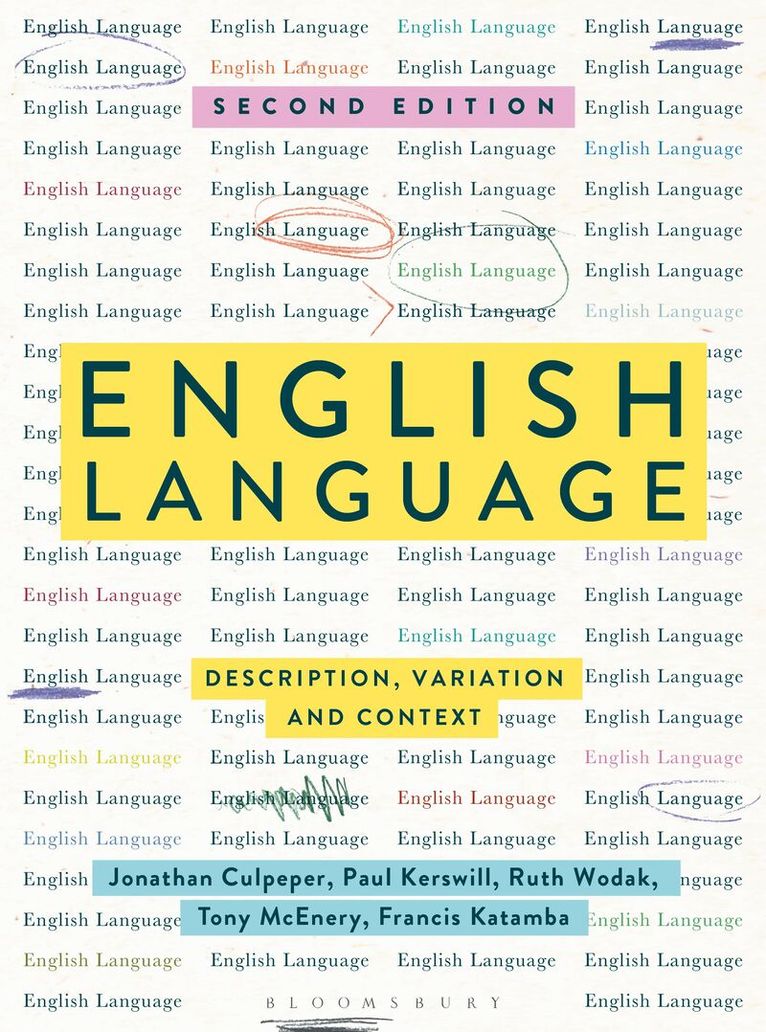
    English Language

    Description, Variation and Context

    AvJonathan Culpeper,Paul Kerswill

    Häftad, Engelska, 2018

    509 kr

    Beställningsvara. Skickas inom 5-8 vardagar. Fri frakt över 249 kr.

    Beskrivning

    The second edition of this hugely successful textbook provides comprehensive coverage of a wide range of topics in theoretical and applied linguistics. Written by leading academics in the field, this text offers a firm grounding in linguistics and includes engaging insights into current research. It covers all the key areas of linguistic analysis, including phonetics, morphology, semantics and pragmatics, and core domains of study, comprising the history of the English language, regional and social variation, style and communication and interaction. Fresh material on research methods outlines key areas for consideration when carrying out a research project, and provides students with the framework they need to investigate linguistic phenomena for themselves.This is an invaluable resource for both undergraduate and postgraduate students on English language and linguistics degree programmes. New to this Edition:- Seven new chapters covering topics such as second language acquisition, corpus linguistics and research methods- A number of chapters have been substantially revised, including those on World Englishes, Literacies in Cyberspace and TEFL, TESOL and Linguistics- Fully updated throughout to reflect the latest advances in the field

    Produktinformation

    • Utgivningsdatum:2018-02-05
    • Mått:194 x 260 x 38 mm
    • Vikt:1 504 g
    • Format:Häftad
    • Språk:Engelska
    • Antal sidor:696
    • Upplaga:2
    • Förlag:Bloomsbury Publishing PLC
    • ISBN:9781137571823

    Utforska kategorier

    • Språk: referensverk och allmänt inom Språk och ordböcker
    • Språkvetenskap och lingvistik inom Språk och ordböcker

    Mer om författaren

    Jonathan Culpeper is Professor of English Language and Linguistics in the Department of Linguistics and English Language at Lancaster University, UK. Spanning pragmatics, stylistics and the history of English, his major publications include Early Modern English Dialogues: Spoken Interaction as Writing (2010, CUP; co-authored with Merja Kytö), Impoliteness: Using Language to Cause Offence (2011, CUP), and most recently Pragmatics and the English Language (2014, Palgrave; with Michael Haugh). He is currently leading the AHRC-funded Encyclopaedia of Shakespeare's Language project, which will provide evidence-based and contextualised accounts of Shakespeare's language.Paul Kerswill is Professor of Sociolinguistics at the University of York. His research has focused on migration and dialect contact in both Norway and Britain, including Bergen and the New Town of Milton Keynes. He has worked on projects on the emergence of Multicultural London English. His publications include work on the role of children in language change, the phonology of new dialects and the representation of youth language in the media. He has co-edited Dialect Change: Convergence and Divergence in European Languages (with Frans Hinskens and Peter Auer, 2005) and The Sage Handbook of Sociolinguistics (with Ruth Wodak and Barbara Johnstone, 2010).Ruth Wodak is Emeritus Distinguished Professor of Discourse Studies at Lancaster University, UK, and affiliated to the University of Vienna. Besides various other prizes, she was awarded the Wittgenstein Prize for Elite Researchers in 1996 and an Honorary Doctorate from University of Örebro in Sweden in 2010. She is member of the British Academy of Social Sciences and of the Academia Europaea. Currently, she is PI of a three-year research project on ‘The Discursive Construction of Austrian identity – 2015.’ (http://nationale-identitaet-2015.univie.ac.at/) Recent book publications include The Politics of Fear. What Right-wing Populist Discourses Mean (Sage, 2015; translation into the German 2016); The Discourse of Politics in Action: ‘Politics as Usual’ (Palgrave), revised edition (2011); Migration, Identity and Belonging (with G. Delanty, P. Jones, 2011); The Discursive Construction of History. Remembering the German Wehrmacht’s War of Annihilation (with H. Heer, W. Manoschek, A. Pollak, 2008); and The SAGE Handbook of Sociolinguistics (with Barbara Johnstone and Paul Kerswill, 2010).Tony McEnery is Distinguished Professor of English Language and Linguistics at Lancaster University. His research interests include English corpus linguistics as well as corpus linguistics applied to languages other than English. He has wide experience of editing and authoring, and is currently editor of the book series Advances in Corpus Linguistics (Routledge). His books include Corpus Linguistics: Method, Theory and Practice (with Andrew Hardie, CUP, 2011) and Discourse Analysis and Media Attitudes (With Paul Baker and Costas Gabrielatos, CUP, 2013).Francis Katamba is Emeritus Professor of Linguistics in the Department of Linguistics and English Language at the University of Lancaster, UK. His research interests are in the areas of phonology and morphology. His publications include An Introduction to Phonology (1989), Morphology: Critical Concepts in Linguistics (2004), English Words (2nd edition, 2005), Morphology (2nd edition with John Stonham, 2006) and Contemporary Linguistics: An Introduction (2nd edition, with William O'Grady and John Archibald, 2011).

    Recensioner i media

    This is an unusually rich textbook that combines breadth of coverage with depth of analysis. It provides accessible yet rigorous introductions to all aspects of the English language and uncovers English in all its fascinating varieties.

    Innehållsförteckning

    • INTRODUCTION1. Studying the English languageENGLISH: STRUCTURE2. Phonetics3. Phonology4. Morphology: word structure5. Grammar: words (and phrases)6. Grammar: phrases (and clauses)7. Grammar: clauses (and sentences)8. Text linguistics9. Semantics10. PragmaticsENGLISH: HISTORY11. Standard English and standardization12. Spelling13. Phonological change14. Lexical change15. Semantic change16. Grammatical changeENGLISH SPEECH: REGIONAL AND SOCIAL VARIATION17. Regional variation in English accents and dialects18. Language and social class19. Language and ethnicity20. Pidgins and creole Englishes21. American English22. World Englishes and English as a lingua franca23. Language discourses: attitudes to diversityENGLISH WRITING: STYLE, GENRE AND PRACTICE24. Speech, writing and discourse type25. Language in newspapers26. Language in advertisements27. Language in literature: stylistics28. Literary practices29. New technologies: literacies in cyberspaceENGLISH: COMMUNICATION AND INTERACTION30. Structures of conversation31. Language, reality and power32. Politeness in interaction33. Gender and language34. Language and sexuality35. Bad language36. Language and politics37. Business communicationENGLISH: LEARNING AND TEACHING38. First language acquisition39. Second language acquisition40. Languages and literacies in education41. TEFL, TESOL and linguisticsENGLISH INVESTIGATING42. Methods for researching English43. The corpus method and EnglishCONCLUSION44. The English language: reflections.