• Fri frakt över 249 kr
  • •
  • Snabba leveranser
  • •
  • Billiga böcker
Kundservice

Du är på sajten för privatpersoner.

Företag, bibliotek eller offentlig verksamhet?

Du handlar på classic.bokus.com, där alla dina funktioner finns intakta.
Till classic.bokus.com
Bokus logotyp. Gå till startsidan.
  • Erbjudanden
  • Nyheter
  • Student
  • Topplistor
  • Barn & ungdom
  • Bokus Play
  • E-böcker
  • Pocketböcker
  • Spel & pussel

10% rabatt på allt med kod: NYSTART10 →

Sidfot

Mina sidor

    Hjälp

    • Kundservice
    • Vanliga frågor och svar
    • Frakt och leverans
    • Retur vid ångerrätt
    • Reklamera vara
    • Betalning
    • Köpvillkor
    • Allmänna villkor
    • Information om webbplatsens tillgänglighet

    Om Bokus

    • Om oss
    • Pressrum
    • För studenter
    • För företag
    • För bibliotek och offentlig verksamhet
    • För leverantörer
    • Hållbarhet

    Populärt

    • Aktuella erbjudanden
    • Presentkort
    • Studentlitteratur
    • Nya böcker
    • Topplistor
    • Signerade böcker
    • Engelska böcker

    Inspiration

    • Boktips
    • BookTok
    • Populära bokserier
    • Barnbokskaraktärer
    • Populära författare
    Logotyp för Bokus
    Följ oss på Facebook (extern länk)Följ oss på Instagram (extern länk)Följ oss på YouTube (extern länk)Följ oss på TikTok (extern länk)
    bokus @ CookiesAnpassa cookiesIntegritetspolicyKöpvillkor
    Till Citymail hemsida (extern länk)Till Budbee hemsida (extern länk)Till Postnord hemsida (extern länk)Till Schenker hemsida (extern länk)Till Early Bird hemsida (extern länk)Till Walleys hemsida (extern länk)
    1. Skönlitteratur
    2. Litteraturvetenskap
    3. Litteraturvetenskap

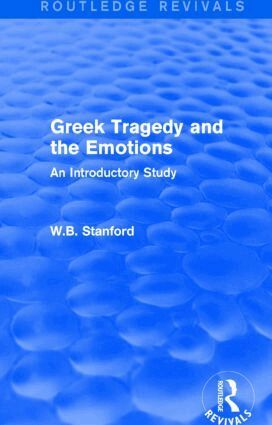
    Greek Tragedy and the Emotions (Routledge Revivals)

    An Introductory Study

    AvW. Stanford

    Inbunden, Engelska, 2013

    Del i serien Routledge Revivals

    2 784 kr

    Beställningsvara. Skickas inom 10-15 vardagar. Fri frakt över 249 kr.

    Fler format och utgåvor

    Häftad

    944 kr

    E-bok

    1 118 kr

    E-bok

    1 121 kr

    Beskrivning

    According to Aristotle the main purpose of tragedy is the manipulation of emotions, and yet there are relatively few accessible studies of the precise dynamics of emotion in the Athenian theatre.In Greek Tragedy and the Emotions, first published in 1993, W.B. Stanford reviews the evidence for ‘emotionalism’ – as the great Attic playwrights presented it, as the actors and choruses expressed it, and as their audiences reacted to it. Sociological aspects of the issue are considered, and the whole range of emotions, not just ‘pity and fear’, is discussed. The aural, visual and stylistic methods of inciting emotion are analysed, and Aeschylus’ Oresteia is examined exclusively in terms of the emotions that it exploits. Finally, Stanford’s conclusions are contrasted with the accepted theories of tragic ‘catharsis’. Greek terms are transliterated and all quotations are in translation, so Greek Tragedy and the Emotions will appeal particularly to those unfamiliar with Classical Greek.

    Produktinformation

    • Utgivningsdatum:2013-12-12
    • Mått:138 x 216 x 15 mm
    • Vikt:520 g
    • Format:Inbunden
    • Språk:Engelska
    • Serie:Routledge Revivals
    • Antal sidor:202
    • Förlag:Taylor & Francis Ltd
    • ISBN:9781138019027

    Utforska kategorier

    • Litteraturvetenskap inom Skönlitteratur
    • Forntidens historia inom Historia och arkeologi

    Innehållsförteckning

    • Preface 1. The centrality of emotionalism 2. The conditions of performance 3. The emotions of Greek tragedy 4. The aural element I: song, music, noises, cries and silences 5. The aural element II: the music of the spoken word 6. The visual element 7. Emotionalism through vocabulary and stylistic figures 8. Emotionalism through subject-matter, imagery, irony and structure 9. The tragic emotions in the Oresteia 10. The ultimate effect? Abbreviations; References; Works Cited; Index 1 Proper names and dramatic characters; Index 2 General topics; Index 3 Selective list of Greek terms; Index 4 Passages quoted from Greek tragedy