• Fri frakt över 249 kr
  • •
  • Snabba leveranser
  • •
  • Billiga böcker
Kundservice

Du är på sajten för privatpersoner.

Företag, bibliotek eller offentlig verksamhet?

Du handlar på classic.bokus.com, där alla dina funktioner finns intakta.
Till classic.bokus.com
Bokus logotyp. Gå till startsidan.
  • Erbjudanden
  • Nyheter
  • Student
  • Topplistor
  • Barn & ungdom
  • Bokus Play
  • E-böcker
  • Pocketböcker
  • Spel & pussel

10% rabatt på allt med kod NYSTART10 →

Sidfot

Mina sidor

    Hjälp

    • Kundservice
    • Vanliga frågor och svar
    • Frakt och leverans
    • Retur vid ångerrätt
    • Reklamera vara
    • Betalning
    • Köpvillkor
    • Allmänna villkor
    • Information om webbplatsens tillgänglighet

    Om Bokus

    • Om oss
    • Pressrum
    • För studenter
    • För företag
    • För bibliotek och offentlig verksamhet
    • För leverantörer
    • Hållbarhet

    Populärt

    • Aktuella erbjudanden
    • Presentkort
    • Studentlitteratur
    • Nya böcker
    • Topplistor
    • Signerade böcker
    • Engelska böcker

    Inspiration

    • Boktips
    • BookTok
    • Populära bokserier
    • Barnbokskaraktärer
    • Populära författare
    Logotyp för Bokus
    Följ oss på Facebook (extern länk)Följ oss på Instagram (extern länk)Följ oss på YouTube (extern länk)Följ oss på TikTok (extern länk)
    bokus @ CookiesAnpassa cookiesIntegritetspolicyKöpvillkor
    Till Citymail hemsida (extern länk)Till Budbee hemsida (extern länk)Till Postnord hemsida (extern länk)Till Schenker hemsida (extern länk)Till Early Bird hemsida (extern länk)Till Walleys hemsida (extern länk)
    1. Data och IT
    2. Systemvetenskap och AI

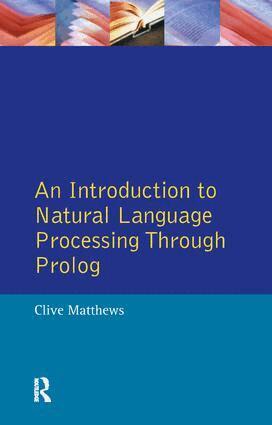
    Introduction to Natural Language Processing Through Prolog

    AvClive Matthews

    Inbunden, Engelska, 2017

    Del i serien Learning about Language

    2 250 kr

    Beställningsvara. Skickas inom 10-15 vardagar. Fri frakt över 249 kr.

    Fler format och utgåvor

    Häftad

    1 179 kr

    E-bok

    1 403 kr

    E-bok

    1 399 kr

    Beskrivning

    Research into Natural Language Processing - the use of computers to process language - has developed over the last couple of decades into one of the most vigorous and interesting areas of current work on language and communication. This book introduces the subject through the discussion and development of various computer programs which illustrate some of the basic concepts and techniques in the field. The programming language used is Prolog, which is especially well-suited for Natural Language Processing and those with little or no background in computing.Following the general introduction, the first section of the book presents Prolog, and the following chapters illustrate how various Natural Language Processing programs may be written using this programming language. Since it is assumed that the reader has no previous experience in programming, great care is taken to provide a simple yet comprehensive introduction to Prolog. Due to the 'user friendly' nature of Prolog, simple yet effective programs may be written from an early stage. The reader is gradually introduced to various techniques for syntactic processing, ranging from Finite State Network recognisors to Chart parsers. An integral element of the book is the comprehensive set of exercises included in each chapter as a means of cementing the reader's understanding of each topic. Suggested answers are also provided.An Introduction to Natural Language Processing Through Prolog is an excellent introduction to the subject for students of linguistics and computer science, and will be especially useful for those with no background in the subject.

    Produktinformation

    • Utgivningsdatum:2017-02-24
    • Mått:138 x 216 x 19 mm
    • Vikt:750 g
    • Format:Inbunden
    • Språk:Engelska
    • Serie:Learning about Language
    • Antal sidor:318
    • Förlag:Taylor & Francis Ltd
    • ISBN:9781138167315

    Utforska kategorier

    • Systemvetenskap och AI inom Data och IT
    • Språkvetenskap och lingvistik inom Språk och ordböcker

    Mer om författaren

    Clive Matthews is a lecturer in Linguistics at the University of East Anglia.

    Innehållsförteckning

    • PrefacePart I: Introduction1. Natural Language Processing1.1 Natural Language Interfaces1.2 The Linguistic Application of NLP1.3 NLP as a Tool for Linguistic Research1.4 Further Reading2. The Challenge of Natural Language Processing2.1 Knowledge of the Linguistic Structure2.2 Ambiguity and Contextual Knowledge2.3 The Process of Language Understanding2.4 Psycholinguistics and NLP2.5 Further ReadingPart II: The Fundamentals of Prolog Programming3. Facts3.1 Facts3.2 Asking Simple Questions in Prolog3.3 Compound Questions3.4 Questions and Variables3.5 Finding Alternative Answers: Backtracking3.6 Using Variables in Facts3.7 Further Reading4. Rules and Complex Names4.1 Rules4.2 How Prolog Answers Questions Using Rules4.3 Structured Objects5. Lists and Recursive Structures5.1 Lists5.2 Recursive Rules6. Developing Prolog Programs6.1 The Meaning of Prolog Programs6.2 Designing Programs6.3 Laying Out Programs6.4 Search Trees6.5 Search Strategies6.6 Tracing a Proof6.7 Some Common Programming Errors7. Built-In Predicates7.1 Input and Output7.2 fail7.3 consult and reconsult7.4 Modifying a Database7.5 Defining Operators7.6 The 'cut'7.7 Program ListingPart III: Natural Language Processing with Prolog8. Sentence Recognition And Finite State Grammars8.1 Sentence Frame Grammars8.2 A Sentence Frame Grammar-based Recognisor8.3 An Alternative Notation for Sentence Frame Grammars8.4 An FSG-Based Recognisor8.5 Extending The Range of Finite State Grammars8.6 Further Reading8.7 Program Listings9. Recursive Transition Networks9.1 Constituent Structure9.2 Extending the Network Notation9.3 An RTN-Based Recognisor9.4 Implementing an RTN Recognisor in Prolog9.5 Extending the RTN Notation9.6 Further Reading9.7 Program Listings10. Phrase Structure Grammars10.1 Phrase Structure Grammars10.2 A Simple Phrase Structure Recognisor10.3 Directly Representing Phrase Structure Grammars in Prolog10.4 Efficiency10.5 Difference Lists10.6 The Grammar Rule Notation10.7 Further Reading10.8 Program Listings11. Definite Clause Grammars11.1 Grammar Symbols as Complex Terms11.2 Procedure Calls11.3 Further Reading11.4 Program Listings12. Alternative Parsing Strategies12.1 A Top-Down Interpreter12.2 Problems with Top-Down Parsing12.3 A Bottom-Up Interpreter12.4 A Left-Corner Interpreter12.5 Deterministic Parsing12.6 Chart Parsing12.7 Further Reading12.8 Program ListingsSolutions to ExercisesGlossary of TermsBibliographyIndex