• Fri frakt över 249 kr
  • •
  • Snabba leveranser
  • •
  • Billiga böcker
Kundservice

Du är på sajten för privatpersoner.

Företag, bibliotek eller offentlig verksamhet?

Du handlar på classic.bokus.com, där alla dina funktioner finns intakta.
Till classic.bokus.com
Bokus logotyp. Gå till startsidan.
  • Erbjudanden
  • Nyheter
  • Student
  • Topplistor
  • Barn & ungdom
  • Bokus Play
  • E-böcker
  • Pocketböcker
  • Spel & pussel

10% rabatt på allt med kod NYSTART10 →

Sidfot

Mina sidor

    Hjälp

    • Kundservice
    • Vanliga frågor och svar
    • Frakt och leverans
    • Retur vid ångerrätt
    • Reklamera vara
    • Betalning
    • Köpvillkor
    • Allmänna villkor
    • Information om webbplatsens tillgänglighet

    Om Bokus

    • Om oss
    • Pressrum
    • För studenter
    • För företag
    • För bibliotek och offentlig verksamhet
    • För leverantörer
    • Hållbarhet

    Populärt

    • Aktuella erbjudanden
    • Presentkort
    • Studentlitteratur
    • Nya böcker
    • Topplistor
    • Signerade böcker
    • Engelska böcker

    Inspiration

    • Boktips
    • BookTok
    • Populära bokserier
    • Barnbokskaraktärer
    • Populära författare
    Logotyp för Bokus
    Följ oss på Facebook (extern länk)Följ oss på Instagram (extern länk)Följ oss på YouTube (extern länk)Följ oss på TikTok (extern länk)
    bokus @ CookiesAnpassa cookiesIntegritetspolicyKöpvillkor
    Till Citymail hemsida (extern länk)Till Budbee hemsida (extern länk)Till Postnord hemsida (extern länk)Till Schenker hemsida (extern länk)Till Early Bird hemsida (extern länk)Till Walleys hemsida (extern länk)
    1. Språk och ordböcker
    2. Språkvetenskap och lingvistik

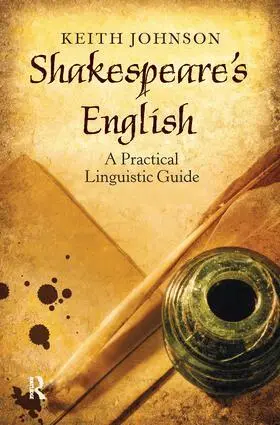
    Shakespeare's English

    A Practical Linguistic Guide

    AvKeith Johnson

    Inbunden, Engelska, 2015

    2 495 kr

    Beställningsvara. Skickas inom 10-15 vardagar. Fri frakt över 249 kr.

    Fler format och utgåvor

    E-bok

    743 kr

    E-bok

    745 kr

    Häftad

    703 kr

    Beskrivning

    Shakespeare's English: A Practical Linguistic Guide provides students with a solid grounding for understanding the language of Shakespeare and its place within the development of English. With a prime focus on Shakespeare and his works, Keith Johnson covers all aspects of his language (vocabulary, grammar, sounds, rhetorical structure etc.), and gives illuminating background information on the linguistic context of the Elizabethan Age. As well as providing a unique introduction to the subject, Johnson encourages a "hands-on" approach, guiding students, through the use of activities, towards an understanding of how Shakespeare's English works. This book offers:· A unique approach to the study of Early Modern English which enables students to engage independently with the topic· Clear and engagingly written explanations of linguistic concepts· Plentiful examples and activities, including suggestions for further work · A glossary, further reading suggestions and guidance to relevant websitesShakespeare's English is perfect for undergraduate students following courses that combine English language, linguistics and literature, or anyone with an interest in knowing more about the language with which Shakespeare worked his literary magic.

    Produktinformation

    • Utgivningsdatum:2015-10-30
    • Mått:156 x 234 x 23 mm
    • Vikt:453 g
    • Format:Inbunden
    • Språk:Engelska
    • Antal sidor:336
    • Förlag:Taylor & Francis Ltd
    • ISBN:9781138168657

    Utforska kategorier

    • Språkvetenskap och lingvistik inom Språk och ordböcker

    Mer om författaren

    Keith Johnson has published widely in the area of applied linguistics, including Introduction to Foreign Language Learning and Teaching (Pearson Education, 2008). He has many years of experience in directing MA level courses for participants coming from all over the world, and is now Emeritus Professor of Linguistics and Language Education at Lancaster University.

    Recensioner i media

    'With its masterly blend of general perspective, detailed illustration, and practical activity, this book takes Shakespearean languages studies to a new level.'Professor David Crystal, author of 'Think On My Words: Exploring Shakespeare's Language"A fascinating and practical guide to the uses and development of the English language in Shakespeare's work... It is a detailed, light-hearted, informative and wholly comprehensive guide to the pleasures and vicissitudes of Shakespeare's – and our – English."Charlotte Scott, Goldsmiths, University of London, UK, in Shakespeare Survey 68 (2015)“Keith Johnson’s Shakespeare’s English: A Practical Linguistic Guide … does more than any other book to engage readers in the practice of learning Shakespeare’s language. The important point to note about Keith Johnson, an emeritus professor at Lancaster University, is that he spent a career researching language teaching. His book does not present Shakespeare’s plays with a list of glosses for the difficult bits, in just the same way as nobody learning a foreign language today would be presented with simply a text accompanied by a list of notes translating the difficult words. What one gets in Johnson’s book, as one would in a language learning class, are texts and explanations but also, crucially, exercises to engage the learner and get them actively practicing linguistic points.“Murphy, S., Culpeper, J., Gillings, M., and Pace-Sigge, M. ‘What do students find difficult when they read Shakespeare? Problems and solutions’, Language and Literature 29/3, 2020.

    Innehållsförteckning

    • Author’s acknowledgementsPublisher’s acknowledgementsChronology of Shakespeare’s worksPhonetic symbols used 1. Why, What, and How1.1. Shakespeare’s language? Why study it? 1.2 What is Shakespeare’s language like? An initial look 1.3 How hard is Shakespeare’s English? 1.4 Something about this book and how to use it 1.5 Shakespeare’s English? Which Shakespeare? Whose English?2. Inventing Words: The ‘great feast of languages’2.1 Admiring Shakespeare’s vocabulary 2.2 The Renaissance and words 2.3 Shakespeare’s word coining 2.4 Shakespeare and the spirit of the age 3. Using Words: The fatal Cleopatras3.1 Playing with words 3.2 ‘Kitchen diction’ 3.3 ‘Never-broken chain of imagery’ 3.4 Words then and now: historical false friends 3.5 Register, and other levels of variation 3.6 Fine volleys of words 4 Grammar: Inside the bonnet 4.1 Grammar and cars 4.2 Expressing grammatical information 4.3 Shakespeare as ‘half-way house’ 4.4 Shakespeare: an initial look inside the bonnet 4.5 The noun phrase 4.6 The verb phrase 4.7 Towards today 5. Pragmatics: Shakespeare as a foreign language5.1 What pragmatics is 5.2 Working out pragmatic meaning: exclamations 5.3 How to be polite in Shakespeare 5.4 A speech act: directives 5.5 Thou and you (and ye) 5.6 Implicature 5.7 The need for pragmatic awareness 6. Rhetoric: ‘Sweet and honeyed sentences’6.1 Complicated sentences 6.2 Compound and complex sentences 6.3 The history of rhetoric in a nutshell 6.4 Some Renaissance styles 6.5 Rhetorical devices 6.6 Energy and growth 7. Verse and Prose: Iambic pentameters all the time?7.1 Blank verse 7.2 Verse and prose 7.3 Blank, rhyme and prose: the mix 8. Shakespeare on the Page: ‘Wryting englysh treu’8.1 Taste and fancy 8.2 Spelling 8.3 Punctuation 8.4 A look at the First Folio 8.5 Variation and standardisation 9. Sounds: The ‘tongue’s sweet melody’9.1 How different . . . and why bother? 9.2 A first look (or listen) 9.3 Looking at some consonants 9.4 Some vowels and diphthongs 9.5 Some EModE pronunciation ‘practice drills’ 9.6 Shakespearean pronunciation: how do we know? 9.7 More on puns and homophones 9.8 Stress 9.9 Pronunciation and comprehension 10. Our revels now are ended10.1 Language points in one passage 10.2 After the revels Glossary References Index