• Fri frakt över 249 kr
  • •
  • Snabba leveranser
  • •
  • Billiga böcker
Kundservice

Du är på sajten för privatpersoner.

Företag, bibliotek eller offentlig verksamhet?

Du handlar på classic.bokus.com, där alla dina funktioner finns intakta.
Till classic.bokus.com
Bokus logotyp. Gå till startsidan.
  • Erbjudanden
  • Nyheter
  • Student
  • Topplistor
  • Barn & ungdom
  • Bokus Play
  • E-böcker
  • Pocketböcker
  • Spel & pussel

10% rabatt på allt med kod: NYSTART10 →

Sidfot

Mina sidor

    Hjälp

    • Kundservice
    • Vanliga frågor och svar
    • Frakt och leverans
    • Retur vid ångerrätt
    • Reklamera vara
    • Betalning
    • Köpvillkor
    • Allmänna villkor
    • Information om webbplatsens tillgänglighet

    Om Bokus

    • Om oss
    • Pressrum
    • För studenter
    • För företag
    • För bibliotek och offentlig verksamhet
    • För leverantörer
    • Hållbarhet

    Populärt

    • Aktuella erbjudanden
    • Presentkort
    • Studentlitteratur
    • Nya böcker
    • Topplistor
    • Signerade böcker
    • Engelska böcker

    Inspiration

    • Boktips
    • BookTok
    • Populära bokserier
    • Barnbokskaraktärer
    • Populära författare
    Logotyp för Bokus
    Följ oss på Facebook (extern länk)Följ oss på Instagram (extern länk)Följ oss på YouTube (extern länk)Följ oss på TikTok (extern länk)
    bokus @ CookiesAnpassa cookiesIntegritetspolicyKöpvillkor
    Till Citymail hemsida (extern länk)Till Budbee hemsida (extern länk)Till Postnord hemsida (extern länk)Till Schenker hemsida (extern länk)Till Early Bird hemsida (extern länk)Till Walleys hemsida (extern länk)
    1. Skönlitteratur
    2. Litteraturvetenskap
    3. Litteraturvetenskap

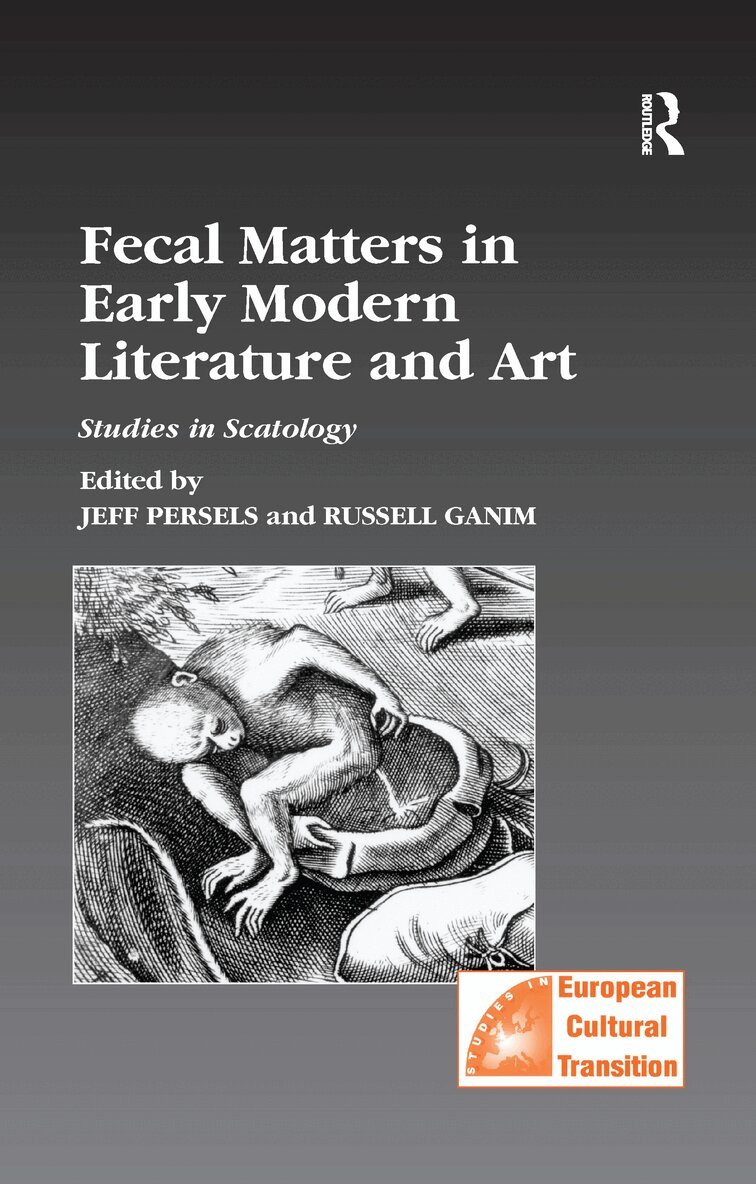
    Fecal Matters in Early Modern Literature and Art

    Studies in Scatology

    AvJeff Persels,Russell Ganim

    Häftad, Engelska, 2016

    Del i serien Studies in European Cultural Transition

    960 kr

    Beställningsvara. Skickas inom 10-15 vardagar. Fri frakt över 249 kr.

    Beskrivning

    Feces, urine, flatus, phlegm, vomitus - unlike ourselves, our most educated forebears did not disdain these functions, and, further, they employed scatological references in all manner of works. This collection of essays was provoked by what its editors considered to be a curious lacuna: the relative academic neglect of the copious and ubiquitous scatological rhetoric of Early Modern Europe, here broadly defined as the representation of the process and product of elimination of the body's waste products. The contributors to this volume examine the many forms and functions of scatology as literary and artistic trope, and reconsider this last taboo in the context of Early Modern European expression. They address unflinchingly both the objective reality of the scatological as part and parcel of material culture - inescapably a much larger part, a much heavier parcel then than now - and the subjective experience of that reality among contemporaries.

    Produktinformation

    • Utgivningsdatum:2016-11-11
    • Mått:156 x 234 x 12 mm
    • Vikt:400 g
    • Format:Häftad
    • Språk:Engelska
    • Serie:Studies in European Cultural Transition
    • Antal sidor:216
    • Förlag:Taylor & Francis Ltd
    • ISBN:9781138257924

    Utforska kategorier

    • Litteraturvetenskap inom Skönlitteratur

    Mer om författaren

    Jeff Persels is an Associate Professor at the Department of Languages, Literatures & Cultures, University of South Carolina, USA and Russell Ganim is Department Chair of the Department of Modern Languages & Literatures, University of Nebraska-Lincoln, USA.

    Recensioner i media

    'This is a much welcomed addition to a rather neglected aspect of cultural studies in the early modern period. It supplements both Bakhtin's theory of the grotesque and Elias's analysis of the "civilizing process" in a creative, imaginative way, reconciling the historical perspective with a carefully formulated post-Freudian assessment of scatological rhetoric as it was used and misused in 16th- and 17th-century England, France and Germany. In many ways it successfully bridges an unfortunate gap between literary studies and critical investigations in anthropology, history, sociology and psychology.' Francois Rigolot, Meredith Howland Pyne Professor of French Literature and Chair, Renaissance Studies, Princeton University '... there is much of interest to enjoy in this welcome collection of essays about our squeamishness toward what we are - and are not.' Ballast Quarterly Review 'This is no book for the lily-livered.' Cahiers Elisabéthains 'The editors do an excellent job of situating their study in the context of anthropological work on the subject of dirt, or matter out of place, as Mary Douglas famously put it, and its definitions and perceived dangers; likewise, they follow in the footsteps of Mikhail Bakhtin, Peter Stallybrass, and Allon White in their efforts to focus on the 'grotesque' body and its carnivalesque and subversive symbolic functions... In breaching that taboo (so to speak), the essays gathered in this volume contribute importantly to the cultural materialist and Foucauldian project of constructing a genealogical history of the body's discursively productive wastes.' Renaissance Quarterly '... this volume realizes the ideals of a fascinating interdisciplinary approach to this topic, including studies on French, German, and English literature, along with investigations of scientific issues and art historical issues... This most unusual collection of fascinating articles on a subject we normally do not even dare to talk about in public concludes with a list of works cited or consulted, and an index... this is a well-edited volume and excellent contribution to research on early modern scatology.' Sixteenth Century Journal

    Innehållsförteckning

    • Contents: Introduction: scatology, the last taboo; The 'honorable art of farting' in continental Renaissance literature, Barbara C. Bowen; 'The wife multiplies the secret' (AaTh 1381D): some fortunes of an exemplary tale, Geoffrey R. Hope; Doctor Rabelais and the medicine of scatology, David LaGuardia; 'The mass and the fart are sisters': scatology and Calvinist rhetoric against the mass, 1560-63, Jeff Persels; Community, commodities and commodes in the French Nouvelle, Emily E. Thompson; Pissing glass and the body crass: adaptations of the scatological in Théophile, Russell Ganim; Scatology as political protest: a 'scandalous' medal of Louis XIV, Jeanne Morgan Zarucchi; Foolectomies, fool enemas, and the Renaissance anatomy of folly, Glenn Ehrstine; Holy and unholy shit: the pragmatic context of scatological curses in early German Reformation satire, Josef Schmidt, with Mary Simon; Expelling from top and bottom: the changing role of scatology in images of peasant festivals from Albrecht Dürer to Pieter Bruegel, Alison G. Stewart; Tamburlaine's urine, Joseph Tate; 'The wronged breeches': cavalier scatology, Peter J. Smith; List of works cited or consulted; Index.