• Fri frakt över 249 kr
  • •
  • Snabba leveranser
  • •
  • Billiga böcker
Kundservice

Du är på sajten för privatpersoner.

Företag, bibliotek eller offentlig verksamhet?

Du handlar på classic.bokus.com, där alla dina funktioner finns intakta.
Till classic.bokus.com
Bokus logotyp. Gå till startsidan.
  • Erbjudanden
  • Nyheter
  • Student
  • Topplistor
  • Barn & ungdom
  • Bokus Play
  • E-böcker
  • Pocketböcker
  • Spel & pussel

10% rabatt på allt med kod: NYSTART10 →

Sidfot

Mina sidor

    Hjälp

    • Kundservice
    • Vanliga frågor och svar
    • Frakt och leverans
    • Retur vid ångerrätt
    • Reklamera vara
    • Betalning
    • Köpvillkor
    • Allmänna villkor
    • Information om webbplatsens tillgänglighet

    Om Bokus

    • Om oss
    • Pressrum
    • För studenter
    • För företag
    • För bibliotek och offentlig verksamhet
    • För leverantörer
    • Hållbarhet

    Populärt

    • Aktuella erbjudanden
    • Presentkort
    • Studentlitteratur
    • Nya böcker
    • Topplistor
    • Signerade böcker
    • Engelska böcker

    Inspiration

    • Boktips
    • BookTok
    • Populära bokserier
    • Barnbokskaraktärer
    • Populära författare
    Logotyp för Bokus
    Följ oss på Facebook (extern länk)Följ oss på Instagram (extern länk)Följ oss på YouTube (extern länk)Följ oss på TikTok (extern länk)
    bokus @ CookiesAnpassa cookiesIntegritetspolicyKöpvillkor
    Till Citymail hemsida (extern länk)Till Budbee hemsida (extern länk)Till Postnord hemsida (extern länk)Till Schenker hemsida (extern länk)Till Early Bird hemsida (extern länk)Till Walleys hemsida (extern länk)
    1. Skönlitteratur
    2. Litteraturvetenskap

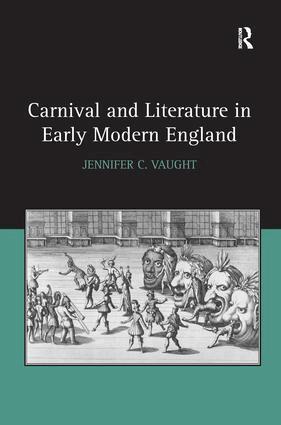
    Carnival and Literature in Early Modern England

    AvJennifer C. Vaught

    Häftad, Engelska, 2016

    960 kr

    Beställningsvara. Skickas inom 10-15 vardagar. Fri frakt över 249 kr.

    Fler format och utgåvor

    E-bok

    1 138 kr

    E-bok

    1 141 kr

    Inbunden

    2 784 kr

    Beskrivning

    Carnival and Literature in Early Modern England explores the elite and popular festive materials appropriated by authors during the English Renaissance in a wide range of dramatic and non-dramatic texts. Although historical records of rural, urban, and courtly seasonal customs in early modern England exist only in fragmentary form, Jennifer Vaught traces the sustained impact of festivals and rituals on the plays and poetry of sixteenth- and seventeenth-century English writers. She focuses on the diverse ways in which Shakespeare, Spenser, Marlowe, Dekker, Jonson, Milton and Herrick incorporated the carnivalesque in their works. Further, she demonstrates how these early modern texts were used-and misused-by later writers, performers, and inventors of spectacles, notably Mardi Gras krewes organizing parades in the American Deep South. The works featured here often highlight violent conflicts between individuals of different ranks, ethnicities, and religions, which the author argues reflect the social realities of the time. These Renaissance writers responded to republican, egalitarian notions of liberty for the populace with radical support, ambivalence, or conservative opposition. Ultimately, the vital, folkloric dimension of these plays and poems challenges the notion that canonical works by Shakespeare and his contemporaries belong only to 'high' and not to 'low' culture.

    Produktinformation

    • Utgivningsdatum:2016-11-25
    • Mått:156 x 234 x 11 mm
    • Vikt:380 g
    • Format:Häftad
    • Språk:Engelska
    • Antal sidor:208
    • Förlag:Taylor & Francis Ltd
    • ISBN:9781138268807

    Utforska kategorier

    • Litteraturvetenskap inom Skönlitteratur
    • Litteraturvetenskap inom Skönlitteratur

    Mer om författaren

    Jennifer C. Vaught is Jean-Jacques and Aurore Labbé Fournet / Board of Regents Professor in English at the University of Louisiana at Lafayette, USA.

    Recensioner i media

    'Carnival and Literature in Early Modern England is an exciting study of transatlantic scope and transhistorical span. Vaught's analysis highlights the cultural and historical specificity of carnival forms and productions, and the different ways they had been appropriated for divergent political ends, normative and transgressive. Juxtaposing early modern poetic and dramatic texts with St. George plays, mummery, street theater, and Mardi Gras productions, Vaught brings out the diverse cultural registers of the festive that would be available to Renaissance audiences, and she reimagines for readers today the traditional cultural literacies early modern writers and audiences brought to the texts and performances.' Joan Linton, Indiana University, USA 'This book offers the reader a rich Carnival of materials, sometimes upsetting ordinary expectations, but always providing a focused interpretation. The extensive footnotes sometimes turn the conventional page of print upside down, the upstart footnote threatening the dominant culture.' Renaissance Quarterly 'For a reader looking for an extensive bibliography on carnival and literature in early modern England and wide-ranging observations on a series of texts, this book could be a useful resource.' The Spenser Review 'This is, certainly, a fascinating study, which traces carnivalesque themes in English literature through some expected, and some far from expected, times and locales; it is highly recommended.' Parergon 'Vaught does a fine job of demonstrating the influence of festive practice on some of the most canonical works of English Renaissance literature; her book will be of keen interest to students of early modern popular culture.' Studies in English Literature 1500-1900 'Vaught has produced a study of considerable scope and ambition, and her readings of the texts collectively illustrate the profound extent to which carnival themes and motifs permeated the literature and culture of early modern England.' Seventeenth-Century News

    Innehållsförteckning

    • Introduction; Chapter 1 Grotesque Imperialists, Alien Scapegoats, and Feasting in Marlowe's Doctor Faustus and The Jew of Malta and Shakespeare's Merchant of Venice; Chapter 2 Protestant Spiritualism, English Nationalism, and Holiday Festivity in Spenser's Shepheardes Calendar and The Faerie Queene; Chapter 3 Carnival, Economics, and Social Mobility in Dekker's Shoemaker's Holiday, Shakespeare's Twelfth Night and The Winter's Tale, and Jonson's Bartholomew Fair; Chapter 4 The Decline of Carnivalesque Egalitarianism: Milton's Comus, Herrick's Hesperides, and Mardi Gras Appropriations of Renaissance Texts in the American Deep South;