• Fri frakt över 249 kr
  • •
  • Snabba leveranser
  • •
  • Billiga böcker
Kundservice

Du är på sajten för privatpersoner.

Företag, bibliotek eller offentlig verksamhet?

Du handlar på classic.bokus.com, där alla dina funktioner finns intakta.
Till classic.bokus.com
Bokus logotyp. Gå till startsidan.
  • Erbjudanden
  • Nyheter
  • Student
  • Topplistor
  • Barn & ungdom
  • Bokus Play
  • E-böcker
  • Pocketböcker
  • Spel & pussel

10% rabatt på allt med kod NYSTART10 →

Sidfot

Mina sidor

    Hjälp

    • Kundservice
    • Vanliga frågor och svar
    • Frakt och leverans
    • Retur vid ångerrätt
    • Reklamera vara
    • Betalning
    • Köpvillkor
    • Allmänna villkor
    • Information om webbplatsens tillgänglighet

    Om Bokus

    • Om oss
    • Pressrum
    • För studenter
    • För företag
    • För bibliotek och offentlig verksamhet
    • För leverantörer
    • Hållbarhet

    Populärt

    • Aktuella erbjudanden
    • Presentkort
    • Studentlitteratur
    • Nya böcker
    • Topplistor
    • Signerade böcker
    • Engelska böcker

    Inspiration

    • Boktips
    • BookTok
    • Populära bokserier
    • Barnbokskaraktärer
    • Populära författare
    Logotyp för Bokus
    Följ oss på Facebook (extern länk)Följ oss på Instagram (extern länk)Följ oss på YouTube (extern länk)Följ oss på TikTok (extern länk)
    bokus @ CookiesAnpassa cookiesIntegritetspolicyKöpvillkor
    Till Citymail hemsida (extern länk)Till Budbee hemsida (extern länk)Till Postnord hemsida (extern länk)Till Schenker hemsida (extern länk)Till Early Bird hemsida (extern länk)Till Walleys hemsida (extern länk)
    1. Naturvetenskap och teknik
    2. Teknik och industri
    3. Teknik: allmänt

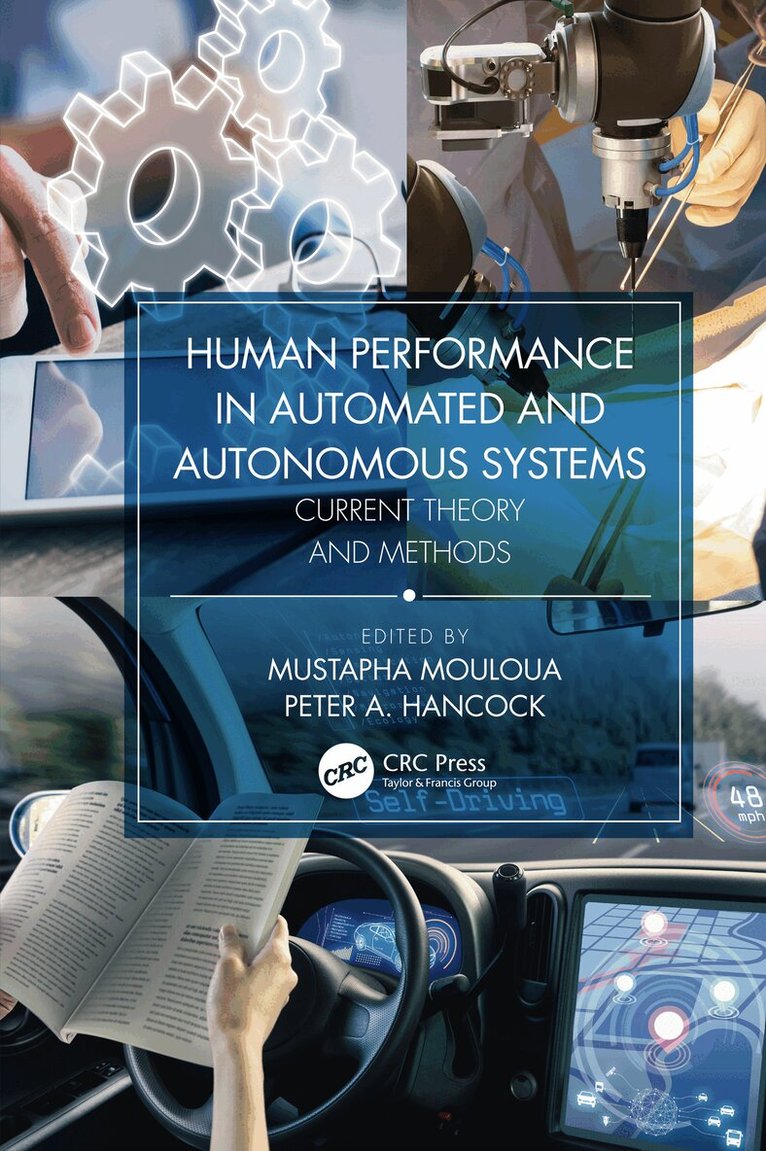
    Human Performance in Automated and Autonomous Systems

    Current Theory and Methods

    AvMustapha Mouloua,Peter A. Hancock

    Inbunden, Engelska, 2019

    2 423 kr

    Beställningsvara. Skickas inom 10-15 vardagar. Fri frakt över 249 kr.

    Beskrivning

    This book examines recent advances in theories, models, and methods relevant to automated and autonomous systems. The following chapters provide perspectives on modern autonomous systems, such as self-driving cars and unmanned aerial systems, directly from the professionals working with and studying them. Current theories surrounding topics such as vigilance, trust, and fatigue are examined throughout as predictors of human performance in the operation of automated systems. The challenges related to attention and effort in autonomous vehicles described within give credence to still-developing methods of training and selecting operators of such unmanned systems. The book further recognizes the need for human-centered approaches to design; a carefully crafted automated technology that places the "human user" in the center of that design process. Features Combines scientific theories with real-world applications where automated technologies are implemented Disseminates new understanding as to how automation is now transitioning to autonomy Highlights the role of individual and team characteristics in the piloting of unmanned systems and how models of human performance are applied in system design Discusses methods for selecting and training individuals to succeed in an age of increasingly complex human-machine systems Provides explicit benchmark comparisons of progress across the last few decades, and identifies future prognostications and the constraints that impinge upon these lines of progressHuman Performance in Automated and Autonomous Systems: Current Theory and Methods illustrates the modern scientific theories and methods to be applied in real-world automated technologies.

    Produktinformation

    • Utgivningsdatum:2019-10-02
    • Mått:156 x 234 x 21 mm
    • Vikt:660 g
    • Format:Inbunden
    • Språk:Engelska
    • Antal sidor:320
    • Förlag:Taylor & Francis Ltd
    • ISBN:9781138312272

    Utforska kategorier

    • Teknik: allmänt inom Naturvetenskap och teknik

    Mer om författaren

    Dr. Mouloua is Professor of Psychology at the University of Central Florida, Orlando, Florida and was the Director (2009 –2017) and Associate Director (2006-2009) of the Applied/Experimental and Human Factors Psychology Doctoral Program, Director and Chief Scientist (2001-2014), Associate Director and Senior Research Scientist (1998-2001) of the Center for Applied Human Factors in Aviation, and Associate Director Human Factors Research at the Center for Advanced Transportation Systems Simulation (2001-2003). Dr. Mouloua has over 30 years of experience in the field of Human Factors and Ergonomics. His research interests include human-automation interaction, attention and workload, assessment of older drivers and pilots, UAS operation, selection, training, and simulation technologies across a variety of transportation systems. Dr. Mouloua is the editor or co-editor of several books including Human Performance in Automated Systems: Current Research and Trends (1994, Erlbaum Press), Human-Automation Interaction: Research and Practice (1997, Erlbaum Press), Automation and Human Performance: Theory and Applications (1996, Erlbaum Press), Automation Technology and Human Performance: Current Research and Trends (1999, Erlbaum), Human Factors in Simulation and Training (2009, Taylor & Francis Group), Automation and human performance: Theory, research, and practice (2004, Volumes I & II; Lawrence Erlbaum Associates), and Proceedings of the 2nd ACM Symposium on Computer Human Interaction for Management of Information Technology (ACM, CHIMIT, 2008). Dr. Mouloua published over 190 papers and scientific reports and made over 300 presentations at various national and international meetings. Dr. Mouloua was the recipient of the prestigious Jerome Ely (1997) and the Tidewater (1999) Awards from the Human Factors and Ergonomics Society. At UCF, Dr. Mouloua received eight prestigious Teaching and Research Awards including the recent Teaching Incentive Program Award (2015) and Research Incentive Award (2019) for his outstanding teaching and research contributions. Similarly, he was also a recipient of the UCF International Golden Key and Honorary Award (2011) and the UCF "Twenty Years of Service" Award (2014) for his dedicated work and commitment to students. Dr. Mouloua is currently the Director of the Neurolinguistics, Aviation, and Driving Research Laboratories at UCF. P.A. Hancock is Provost Distinguished Research Professor in the Department of Psychology and the Institute for Simulation and Training at the University of Central Florida (UCF) and is the author of over nine hundred refereed scientific articles. He has written and edited more than twenty-five books including Human Performance and Ergonomics (1999), Stress, Workload, and Fatigue (2001) and Performance under Stress (2008). He is a Fellow and past President of the Human Factors and Ergonomics Society, the Society of Engineering Psychologists as well as being a former Chair of the Board of the Society for Human Performance in Extreme Environments.

    Innehållsförteckning

    • Chapter 1 Designing Wearable Interfaces for People Who Have Hard Jobs. Chapter 2 Humans and Automated Decision Aids: A Match Made in Heaven? Chapter 3 The Quest for Alternatives to “Levels of Automation” and “Task Allocation”. Chapter 4 Why Representations Matter: Designing to Support Productive Thinking. Chapter 5 Vigilance and Workload in Automated Systems:Patterns of Association, Dissociation, and Insensitivity. Chapter 6 Theoretical Perspectives on Adaptive Automation. Chapter 7 Fatigue, Automation, and Autonomy: Challenges for Operator Attention, Effort, and Trust. Chapter 8 Human-Automation Interaction and the Challenge of Maintaining Situation Awareness in Future Autonomous Vehicles. Chapter 9 Human Factors Issues Regarding Automation Trust in UAS Operation, Selection, and Training. Chapter 10 Autonomous Systems Theory and Design and a Paradox of Automation for Safety. Chapter 11 Workload and Attention Management in Automated Vehicles. Chapter 12 Attention Management in Highly Autonomous Driving. Chapter 13 To Autonomy and Beyond. Chapter 14 Teleology for Technology. Chapter 15 The Axial Age of Artificial Autonomy.