• Fri frakt över 249 kr
  • •
  • Snabba leveranser
  • •
  • Billiga böcker
Kundservice

Du är på sajten för privatpersoner.

Företag, bibliotek eller offentlig verksamhet?

Du handlar på classic.bokus.com, där alla dina funktioner finns intakta.
Till classic.bokus.com
Bokus logotyp. Gå till startsidan.
  • Erbjudanden
  • Nyheter
  • Student
  • Topplistor
  • Barn & ungdom
  • Bokus Play
  • E-böcker
  • Pocketböcker
  • Spel & pussel

10% rabatt på allt med kod: NYSTART10 →

Sidfot

Mina sidor

    Hjälp

    • Kundservice
    • Vanliga frågor och svar
    • Frakt och leverans
    • Retur vid ångerrätt
    • Reklamera vara
    • Betalning
    • Köpvillkor
    • Allmänna villkor
    • Information om webbplatsens tillgänglighet

    Om Bokus

    • Om oss
    • Pressrum
    • För studenter
    • För företag
    • För bibliotek och offentlig verksamhet
    • För leverantörer
    • Hållbarhet

    Populärt

    • Aktuella erbjudanden
    • Presentkort
    • Studentlitteratur
    • Nya böcker
    • Topplistor
    • Signerade böcker
    • Engelska böcker

    Inspiration

    • Boktips
    • BookTok
    • Populära bokserier
    • Barnbokskaraktärer
    • Populära författare
    Logotyp för Bokus
    Följ oss på Facebook (extern länk)Följ oss på Instagram (extern länk)Följ oss på YouTube (extern länk)Följ oss på TikTok (extern länk)
    bokus @ CookiesAnpassa cookiesIntegritetspolicyKöpvillkor
    Till Citymail hemsida (extern länk)Till Budbee hemsida (extern länk)Till Postnord hemsida (extern länk)Till Schenker hemsida (extern länk)Till Early Bird hemsida (extern länk)Till Walleys hemsida (extern länk)
    1. Språk och ordböcker
    2. Språk: referensverk och allmänt

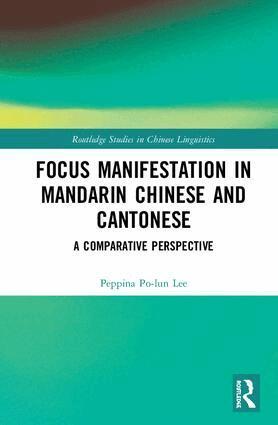
    Focus Manifestation in Mandarin Chinese and Cantonese

    A Comparative Perspective

    AvPeppina Po-lun Lee

    Inbunden, Engelska, 2019

    Del i serien Routledge Studies in Chinese Linguistics

    2 493 kr

    Beställningsvara. Skickas inom 10-15 vardagar. Fri frakt över 249 kr.

    Fler format och utgåvor

    Häftad

    701 kr

    E-bok

    831 kr

    E-bok

    829 kr

    Beskrivning

    One prominent function of natural language is to convey information. One peculiarity is that it does not do so randomly, but in a structured way, with information structuring formally recognized to be a component of grammar. Among all information structuring notions, focus is one primitive needed to account for all phenomena. Focus Manifestation in Mandarin Chinese and Cantonese: A Comparative Perspective aims to examine from a semantic perspective how syntactic structures and focus adverbs in Mandarin Chinese and semantic particles in Cantonese conspire to encode focus structures and determine focus manifestation in Chinese. With both being tonal languages, Mandarin Chinese and Cantonese manifest different morpho-syntactic configurations to mark focus. A general principle governing focus marking in Mandarin Chinese and Cantonese is given in the book, which aims to give a better understanding of the underlying principles the two use to mark additive and restrictive meanings, and related focus interpretations. Particular attention is also drawn to the co-occurrence of multiple forms of restrictive and additive particles in Cantonese, including adverbs, verbal suffixes and sentence-final particles. Linearity has been shown to be an important parameter to determine how focus is structured in Cantonese. This book is aimed at advanced graduate students, researchers, and scholars working on Chinese linguistics, syntax and semantics, and comparative dialectal grammar.

    Produktinformation

    • Utgivningsdatum:2019-05-21
    • Mått:156 x 234 x 23 mm
    • Vikt:453 g
    • Format:Inbunden
    • Språk:Engelska
    • Serie:Routledge Studies in Chinese Linguistics
    • Antal sidor:254
    • Förlag:Taylor & Francis Ltd
    • ISBN:9781138568112

    Utforska kategorier

    • Språk: referensverk och allmänt inom Språk och ordböcker
    • Språkvetenskap och lingvistik inom Språk och ordböcker

    Mer om författaren

    Peppina Po-lun Lee is Associate Professor in the Department of Linguistics and Translation at City University of Hong Kong. She has published more than 40 research papers in refereed journals and edited books. Her major publications have appeared in Lingua, Linguistics, Journal of Pragmatics, and Language and Linguistics, as well as ZhongguoYuwen (Studies of the Chinese Language) and Dangdai Yuyanxue (Contemporary Linguistics). Specializing in theoretical linguistics, her research interests cover semantics, syntax-semantics interface, and Chinese and Cantonese linguistics. She has worked on a variety of research topics, including focus and information structure, negation, eventuality, quantification, and particles.

    Innehållsförteckning

    • Table of Contents List of tablesAcknowledgements List of abbreviations Chapter One: Introduction 1.1 The Problem 1.2 Scope of the Study and Major Ideas to be Proposed 1.3 Organization Chapter Two: Theoretical Background 2.1 Information Structure and Focus Particles 2.2 Focus Representation and Interpretation 2.2.1 Association with Focus 2.2.2 Syntax-semantics Mapping of Focus 2.3 What is Special about Cantonese? 2.3.1 Some Basic Facts about Cantonese 2.3.2 Post-verbal Particles in Cantonese 2.4 The Meaning of Focus Particles in Mandarin Chinese and Cantonese: An Overview2.4.1 Additives and Restrictives in Mandarin 2.4.2 Additives and Restrictives in Cantonese Chapter Three: Additive Focus Particles 3.1 Introduction 3.2 Additive Focus Adverbs in Mandarin Chinese 3.2.1 Additive Focus Adverbs you ‘again’, ye ‘also’, hai ‘still’ and zai ‘again’ 3.2.2 A Comparison of Mandarin Additive Adverbs with their Cantonese Counterparts 3.3 Additive Particles in Cantonese 3.3.1 Additive Cantonese sentence-final Particle tim1 ‘add’ 3.3.2 Cantonese Additive Adverb gau3 ‘enough’ 3.3.3 Additive Verbal Suffix -maai4 ‘also’3.4 Summary: What do Cantonese additives and Mandarin additives tell you? Chapter Four: Restrictive Focus Particles 4.1 Introduction 4.2 Restrictive Focus Adverbs in Mandarin Chinese 4.2.1 Restrictive Focus Adverbs cai ‘only’ and jiu ‘only’ 4.2.2 Restrictive Focus Adverbs zhi (-you/-shi) ‘only (-have/-be)’ 4.3 Cantonese Restrictive Sentence-final Particles zaa3 ‘only’ and ze1 ‘only’ 4.3.1 Previous Analyses of Cantonese Restrictive SFPs zaa3 ‘only’ and ze1 ‘only’ 4.3.2 Reanalyzing zaa3 ‘only’ and ze1 ‘only’ under the Relativist Semantic Theory 4.3.3 A Comparison of zaa3 ‘only’ and ze1 ‘only’ with Mandarin cai ‘only’/jiu ‘only’ and Cantonese adverb sin1 ‘then’4.4 Cantonese Restrictive Verbal Suffix –dak1 ‘only’ 4.4.1 Previous Analyses of -dak1 ‘only’ 4.4.2 Unresolved Issues of –dak1 ‘only’ 4.4.3 A Unified Account to –dak1 ‘only’ 4.4.4 Focused Readings of -dak14.5 Restrictive Adverbs in Cantonese 4.6 What Restrictive Particles and Additives Particles in Mandarin Chinese and Cantonese Can Tell You? 4.6.1 Restrictive Particles in Mandarin Chinese and Cantonese 4.6.2 Generalizing the Picture of focus particles in Mandarin Chinese and Cantonese Chapter Five: Distribution of Additives and Restrictives in Mandarin Chinese and Cantonese5.1 Introduction 5.2 Co-occurrence of Additives in Mandarin and Cantonese and the Linearity Principle 5.3 Distribution of Additive Adverbs and Post-verbal Particles in Mandarin and Cantonese 5.4 A Comparison Among gau3 ‘enough’, dou1 ‘also/even’, -maai4 ‘also’ and tim1 ‘add’ 5.5 Distribution of Restrictive Adverbs and Post-verbal Particles in Mandarin and Cantonese 5.6 Deriving a General Principle of Focus Marking in Mandarin Chinese and Cantonese 5.6.1 Shi…(de) Construction in Mandarin – the Role of Syntax in Focus Marking5.6.2 Generalizing a General Principle of Focus Marking in Mandarin Chinese and CantoneseChapter Six: Conclusions: Theoretical Consequences and Implications 6.1 Summary of Major Findings 6.2 Revisiting the General Principle of Focus Marking in Mandarin and Cantonese: What Does it Imply? 6.2.1 A Matter of Interface – Cantonese vs. Mandarin 2086.2.2 Linearity in Focus Interpretation in Cantonese 6.3 More on the Role of Syntax in Focus Manifestation in Mandarin and Cantonese 6.4 Future Research References Index