• Fri frakt över 249 kr
  • •
  • Snabba leveranser
  • •
  • Billiga böcker
Kundservice

Du är på sajten för privatpersoner.

Företag, bibliotek eller offentlig verksamhet?

Du handlar på classic.bokus.com, där alla dina funktioner finns intakta.
Till classic.bokus.com
Bokus logotyp. Gå till startsidan.
  • Erbjudanden
  • Nyheter
  • Student
  • Topplistor
  • Barn & ungdom
  • Bokus Play
  • E-böcker
  • Pocketböcker
  • Spel & pussel

10% rabatt på allt med kod: NYSTART10 →

Sidfot

Mina sidor

    Hjälp

    • Kundservice
    • Vanliga frågor och svar
    • Frakt och leverans
    • Retur vid ångerrätt
    • Reklamera vara
    • Betalning
    • Köpvillkor
    • Allmänna villkor
    • Information om webbplatsens tillgänglighet

    Om Bokus

    • Om oss
    • Pressrum
    • För studenter
    • För företag
    • För bibliotek och offentlig verksamhet
    • För leverantörer
    • Hållbarhet

    Populärt

    • Aktuella erbjudanden
    • Presentkort
    • Studentlitteratur
    • Nya böcker
    • Topplistor
    • Signerade böcker
    • Engelska böcker

    Inspiration

    • Boktips
    • BookTok
    • Populära bokserier
    • Barnbokskaraktärer
    • Populära författare
    Logotyp för Bokus
    Följ oss på Facebook (extern länk)Följ oss på Instagram (extern länk)Följ oss på YouTube (extern länk)Följ oss på TikTok (extern länk)
    bokus @ CookiesAnpassa cookiesIntegritetspolicyKöpvillkor
    Till Citymail hemsida (extern länk)Till Budbee hemsida (extern länk)Till Postnord hemsida (extern länk)Till Schenker hemsida (extern länk)Till Early Bird hemsida (extern länk)Till Walleys hemsida (extern länk)
    1. Språk och ordböcker
    2. Språkvetenskap och lingvistik

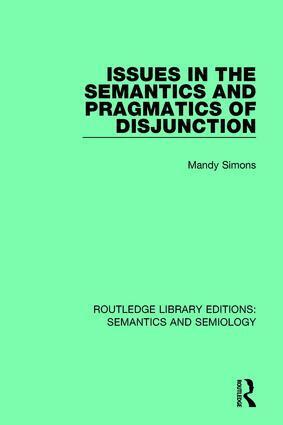
    Issues in the Semantics and Pragmatics of Disjunction

    AvMandy Simons

    Inbunden, Engelska, 2016

    Del i serien Routledge Library Editions: Semantics and Semiology

    1 510 kr

    Beställningsvara. Skickas inom 10-15 vardagar. Fri frakt över 249 kr.

    Fler format och utgåvor

    Häftad

    455 kr

    E-bok

    535 kr

    E-bok

    537 kr

    Beskrivning

    First published in 2000, this book is about sentences containing the word or, dealing primarily with sentences in which or conjoins clauses, but also some cases in which it conjoins expressions of other categories. The author aims to give an account of the discourse properties and felicity conditions of disjunction, and to use this account in explaining the behaviour of presupposition projection and of anaphora in disjunctive sentences. The author begins by giving an account of the discourse properties and felicity conditions of disjunction before turning to the presupposition projection problem. The final two chapters discuss anaphora and its interactions with disjunction.

    Produktinformation

    • Utgivningsdatum:2016-10-04
    • Mått:156 x 234 x undefined mm
    • Vikt:453 g
    • Format:Inbunden
    • Språk:Engelska
    • Serie:Routledge Library Editions: Semantics and Semiology
    • Antal sidor:276
    • Förlag:Taylor & Francis Ltd
    • ISBN:9781138697942

    Utforska kategorier

    • Språkvetenskap och lingvistik inom Språk och ordböcker

    Innehållsförteckning

    • 1. Introduction; 1.1. Overview 1.1.1. What this dissertation is about 1.1.2. Context change: Pragmatic vs. semantic approaches 1.2. The Stalnakerian Model of Presupposition and Assertion 1.3. Dynamic Semantics 1.3.1. The Fundamentals 1.3.2. File Change Semantics (FCS) and the CCP proposal 1.3.3. Discourse Representation Theory (DRT) 1.3.4. Dynamic Montague Grammar (DMG) Notes to Chapter One; 2. Disjunctive Sentences In Discourse; 2.1. Introduction 2.2. The Discourse Function and Felicity Conditions of Disjunction 2.2.1. The Basic Observations 2.2.2. Relation and Manner in the Stalnakerian Model 2.3. The Enriched Context Change Framework 2.3.1. Presentation 2.3.2. Disjunction and the Relevant Informativity Condition 2.3.3. Disjunction and Simplicity 2.3.4. Disjunction and Rooth’s Alternative Semantics 2.3.5. Summary 2.4. Some Exceptions 2.4.1. Floutings 2.4.2. Reasoning contexts 2.4.3. Metalinguistic or 2.5. The Exclusive Interpretation of or 2.5.1. Critique of the ambiguity account 2.5.2. Gazdar’s (1979) account 2.5.3. Exclusivity from exhaustiveness 2.5.4. Exclusivity from alternativeness 2.5.5. Summary 2.6. Conclusion Notes to Chapter Two; 3. Presupposition Projection; 3.1. Introduction 3.1.1. The Basic Question 3.1.2. The Theoretical Issues 3.2. The Data 3.3. The Satisfaction Account of Presupposition Projection 3.3.1. Basics of the Satisfaction Account 3.3.2. CCPs for disjunction 3.3.3. Critique 3.4. Towards a New Account 3.4.1. Gazdar’s cancellation theory 3.4.2. The accommodation view: Van der Sandt (1992) 3.4.3. Translating DRSs into Stalnakerian contexts 3.5. The Account in Action 3.5.1. Basic cases 3.5.2. Entailing disjunctions again 3.5.3. Beaver’s counterexample 3.6. Conclusion Notes to Chapter Three; 4. Internal Anaphora; 4.1. Introduction 4.2. Anaphora-based Accounts in Dynamic Semantic Theories 4.2.1. DMG: Groenendijk and Stokhof (1990) 4.2.2. DRT: Kamp and Reyle (1993) 4.2.3. A second DRT proposal: Krahmer and Muskens (1994) 4.2.4. Van der Sandt (1992) revisited 4.3. A Felicity-based Approach 4.3.1. Introduction to the account 4.3.2. The E-type account of anaphora 4.3.3. A felicity-based solution to the internal anaphora puzzle 4.3.4. Summary 4.4. Further Data 4.4.1. Narrow scope antecedents 4.4.2. Non-E-type unbound anaphora 4.4.3. Pleonastic pronouns 4.5. Conclusion Notes to Chapter Four; 5. External Anaphora; 5.1. Introduction 5.2. The Basic Data 5.2.1. Anaphora to a disjunction of NPs 5.2.2. Clausal disjunction 5.3. A First Reformulation of the E-type Account 5.4. A Compositional Structural E-type Account 5.4.1. Presentation 5.4.2. Comparison with Chapter Four account 5.4.3. Narrow scope antecedents 5.5. Application to the External Anaphora Data 5.5.1. Anaphora to a disjunction of NPs 5.5.2. Anaphora to clausal disjunctions 5.5.3. Summary 5.6. The Single-antecedent Reading 5.6.1. Derivation of single-antecedent readings 5.6.2. Maximal quantifier antecedents 5.6.3. Summary 5.7. Other Approaches to External Anaphora 5.8. Further Issues for the E-type Account 5.8.1. Inference-based anaphora 5.8.2. Interpretation of plural pronouns 5.8.3. Anaphora to NP disjuncts and conjuncts 5.9. Conclusion Notes to Chapter Five; Concluding Remarks; Grice, Stalnaker and Dynamic Semantics; Appendix; Bibliography; Index