• Fri frakt över 249 kr
  • •
  • Snabba leveranser
  • •
  • Billiga böcker
Kundservice

Du är på sajten för privatpersoner.

Företag, bibliotek eller offentlig verksamhet?

Du handlar på classic.bokus.com, där alla dina funktioner finns intakta.
Till classic.bokus.com
Bokus logotyp. Gå till startsidan.
  • Erbjudanden
  • Nyheter
  • Student
  • Topplistor
  • Barn & ungdom
  • Bokus Play
  • E-böcker
  • Pocketböcker
  • Spel & pussel

10% rabatt på allt med kod NYSTART10 →

Sidfot

Mina sidor

    Hjälp

    • Kundservice
    • Vanliga frågor och svar
    • Frakt och leverans
    • Retur vid ångerrätt
    • Reklamera vara
    • Betalning
    • Köpvillkor
    • Allmänna villkor
    • Information om webbplatsens tillgänglighet

    Om Bokus

    • Om oss
    • Pressrum
    • För studenter
    • För företag
    • För bibliotek och offentlig verksamhet
    • För leverantörer
    • Hållbarhet

    Populärt

    • Aktuella erbjudanden
    • Presentkort
    • Studentlitteratur
    • Nya böcker
    • Topplistor
    • Signerade böcker
    • Engelska böcker

    Inspiration

    • Boktips
    • BookTok
    • Populära bokserier
    • Barnbokskaraktärer
    • Populära författare
    Logotyp för Bokus
    Följ oss på Facebook (extern länk)Följ oss på Instagram (extern länk)Följ oss på YouTube (extern länk)Följ oss på TikTok (extern länk)
    bokus @ CookiesAnpassa cookiesIntegritetspolicyKöpvillkor
    Till Citymail hemsida (extern länk)Till Budbee hemsida (extern länk)Till Postnord hemsida (extern länk)Till Schenker hemsida (extern länk)Till Early Bird hemsida (extern länk)Till Walleys hemsida (extern länk)
    1. Kultur
    2. Arkitektur

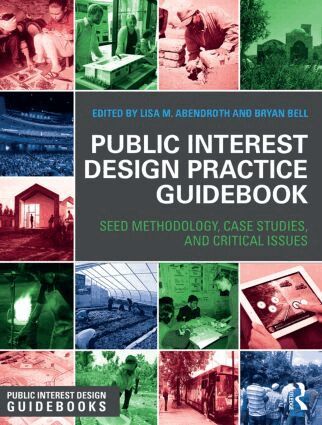
    Public Interest Design Practice Guidebook

    SEED Methodology, Case Studies, and Critical Issues

    AvLisa Abendroth,Bryan Bell

    Inbunden, Engelska, 2015

    Del i serien Public Interest Design Guidebooks

    3 045 kr

    Beställningsvara. Skickas inom 10-15 vardagar. Fri frakt över 249 kr.

    Beskrivning

    Public Interest Design Practice Guidebook: Seed Methodology, Case Studies, and Critical Issues is the first book to demonstrate that public interest design has emerged as a distinct profession. It provides clear professional standards of practice following SEED (Social Economic Environmental Design) methodology, the first step-by-step process supporting public interest designers. The book features an Issues Index composed of ninety critical social, economic, and environmental issues, illustrated with thirty case study projects representing eighteen countries and four continents, all cross-referenced, to show you how every human issue is a design issue.Contributions from Thomas Fisher, Heather Fleming and David Kaisel, Michael Cohen, Michael P. Murphy Jr. and Alan Ricks, and over twenty others cover topics such as professional responsibility, public interest design business development, design evaluation, and capacity building through scaling, along with many more. Themes including public participation, issue-based design, and assessment are referenced throughout the book and provide benchmarks toward an informed practice. This comprehensive manual also contains a glossary, an appendix of engagement methods, a case study locator atlas, and a reading list. Whether you are working in the field of architecture, urban planning, industrial design, landscape architecture, or communication design, this book empowers you to create community-centered environments, products, and systems.

    Produktinformation

    • Utgivningsdatum:2015-07-09
    • Mått:189 x 246 x 28 mm
    • Vikt:1 133 g
    • Format:Inbunden
    • Språk:Engelska
    • Serie:Public Interest Design Guidebooks
    • Antal sidor:364
    • Förlag:Taylor & Francis Ltd
    • ISBN:9781138810341

    Utforska kategorier

    • Arkitektur inom Kultur

    Mer om författaren

    Lisa M. Abendroth is a professor at Metropolitan State University of Denver in Colorado, USA. She is a SEED Network founding member, a SEED Evaluator coauthor, and a 2013 recipient of the SEED Award for Leadership in Public Interest Design. Bryan Bell is the founder of Design Corps in North Carolina, USA, and cofounder of the SEED (Social Economic Environmental Design) Network. Bell was awarded a National AIA Award and was a National Design Award Finalist. His work has been exhibited at the Venice Biennale and the Cooper Hewitt, Smithsonian Design Museum.

    Recensioner i media

    'Public Interest Design pulses with community, equity, place and democracy. Its legacy of knowledge and practices, seamlessly interweaving design with community, is its DNA. Now, at this morphogenic moment, when PID is more than ready to prosper and grow, comes the Public Interest Design Practice Guidebook. With its many cases, process tools and SEED methodology, this book will fuel and energize PID culture and practice. It will fortify PID’s role and value and without question, help shape and transform 21st century design.' - Paula Horrigan, Associate Professor, Cornell University, USA 'This book is written for those that seek a new kind of design practice. The kind of practice that values on-the-ground engagement and thinking about the systematic impact of design labor. A practice that does not dictate form but rather seeks a radically contextualized understanding of "Public". Those new practitioners will find the critical essays and case studies found in this book to be invaluable tools.' - Quilian Riano, Founder and Principal, DSGN AGNC, USA'Bryan Bell and Lisa Abendroth have dedicated their respective careers to igniting the spirit of public interest design that exists within all of us who are charged with creating the constructed legacy of our time. If you have ever had the inclination to work on behalf of others whose needs are far greater than our own, then you will find the instruction, wisdom and inspiration contained within this book invaluable.' - R. Steven Lewis, SEED Network founding member, USA

    Innehållsförteckning

    • Acknowledgements. Foreword Scott Moore y Medina, Jon Red Corn. Introduction. Part 1: Understanding Public Interest Design: Essays 1. The State of Public Interest Design Bryan Bell 2. What Social Justice Movements Can Teach Us About Public Interest Design Barbara Brown Wilson 3. Professional Responsibility and Ethics Thomas Fisher 4. Learning From Public Interest Practices Roberta Feldman, Sergio Palleroni, David Perkes 5. Designers Engaging in Business Development Heather Fleming, David Kaisel 6. Evaluating Impact Without Evidence Michael A. Cohen 7. Post Occupancy: Implementation and Evaluation Steven A. Moore Part 2: Practicing Public Interest Design: SEED Methodology 8. Social Economic Environmental Design Methodology 9. The SEED Evaluator and SEED Certification 10. Starting a Project: Public Participation and the Feedback Loop 11. Moving Forward Together: Engagement in Community Design and Development Ceara O'Leary, Dan Pitera 12. Paths to a Sustainable Future: Native American Community Building Jamie Blosser 13. Sustaining Collaboration: Extended Engagement 14. Storytelling for Social and Environmental Impact in Design Michael Haggerty 15. Amplifying Community Voice: Neighborhood Identity Development Brent A. Brown, Emily Schmidt 16. Doing More: Issue-Based Design and the Triple Bottom Line 17. Unthinking Sanitation for the Urban Poor Julia King, Dr. Renu Khosla 18. A Balanced Approach to the Demand for Classrooms Margarette Leite, Sergio Palleroni 19. Assessing Results: Defining and Measuring Success 20. Designing Solutions to Childhood Malnutrition Ramsey Ford, Kate Hanisian 21. Setting the Stage for Social, Economic and Environmental Achievement: Benchmarking the Durham Performing Arts Center Philip Szostak 22. Scaling a Project: Uniting Diverse Stakeholders 23. Lessons from Rwanda: Scaling Up Holistic Approaches to Health Facilities Michael P. Murphy Jr., Alan Ricks, Annie Moulton 24. Evolving the Sanitation Marketplace in Cambodia Yi Wei Part3: Documenting the Value of Public Interest Design: Case Studies and Issues Index 25. The Issues Index: Expanded Opportunity Through an Issues Approach 26. Case Studies and Issues Index. Glossary. Contributors Biographies. Reading List. Appendix A: Methods of Engagement. Appendix B: Issue Index Cross-Reference Guide. Appendix C: Case Study Locator Map. Image Credits. Index