• Fri frakt över 249 kr
  • •
  • Snabba leveranser
  • •
  • Billiga böcker
Kundservice

Du är på sajten för privatpersoner.

Företag, bibliotek eller offentlig verksamhet?

Du handlar på classic.bokus.com, där alla dina funktioner finns intakta.
Till classic.bokus.com
Bokus logotyp. Gå till startsidan.
  • Erbjudanden
  • Nyheter
  • Student
  • Topplistor
  • Barn & ungdom
  • Bokus Play
  • E-böcker
  • Pocketböcker
  • Spel & pussel

Må bättre, för mindre! Upp till 50% rabatt på hälsoböcker

Sidfot

Mina sidor

    Hjälp

    • Kundservice
    • Vanliga frågor och svar
    • Frakt och leverans
    • Retur vid ångerrätt
    • Reklamera vara
    • Betalning
    • Köpvillkor
    • Allmänna villkor
    • Information om webbplatsens tillgänglighet

    Om Bokus

    • Om oss
    • Pressrum
    • För studenter
    • För företag
    • För bibliotek och offentlig verksamhet
    • För leverantörer
    • Hållbarhet

    Populärt

    • Aktuella erbjudanden
    • Presentkort
    • Studentlitteratur
    • Nya böcker
    • Topplistor
    • Signerade böcker
    • Engelska böcker

    Inspiration

    • Boktips
    • BookTok
    • Populära bokserier
    • Barnbokskaraktärer
    • Populära författare
    Logotyp för Bokus
    Följ oss på Facebook (extern länk)Följ oss på Instagram (extern länk)Följ oss på YouTube (extern länk)Följ oss på TikTok (extern länk)
    bokus @ CookiesAnpassa cookiesIntegritetspolicyKöpvillkor
    Till Citymail hemsida (extern länk)Till Budbee hemsida (extern länk)Till Postnord hemsida (extern länk)Till Schenker hemsida (extern länk)Till Early Bird hemsida (extern länk)Till Walleys hemsida (extern länk)
    1. Skönlitteratur
    2. Litteraturvetenskap
    3. Litteraturvetenskap

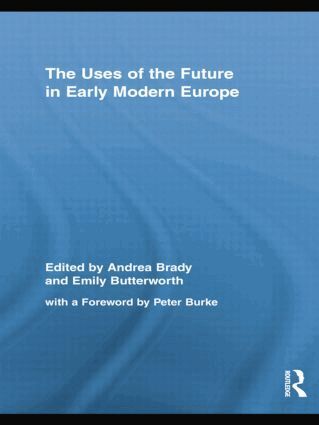
    Uses of the Future in Early Modern Europe

    AvAndrea Brady,Emily Butterworth

    Häftad, Engelska, 2015

    Del i serien Routledge Studies in Renaissance Literature and Culture

    1 025 kr

    Beställningsvara. Skickas inom 10-15 vardagar. Fri frakt över 249 kr.

    Beskrivning

    Is modernity synonymous with progress? Did the Renaissance really break with the cyclical, agrarian time of the Middle Ages, inaugurating a new concept of irreversible time in a secular culture defined by development? How does methodology affect scholarly responses to the idea of the future in the past? This collection of interdisciplinary essays from the fields of literary criticism, cultural studies, politics and intellectual history offers new answers to these commonplace questions. They explore elite and popular culture, women and men’s experiences, and the encounter between East and West, providing a comparative view on the range of personal, political and social practices with which early modern people planned for, imagined, manipulated or even rejected the future. Examining poetry, architecture, colonial exploration, technology, drama, satire, wills, childbirth and deathbed rituals, humanism, religious radicalism and republicanism, this collection provides new readings of canonical early modern texts and insights into popular culture.With a foreword by Peter Burke.

    Produktinformation

    • Utgivningsdatum:2015-04-23
    • Mått:152 x 229 x 15 mm
    • Vikt:362 g
    • Format:Häftad
    • Språk:Engelska
    • Serie:Routledge Studies in Renaissance Literature and Culture
    • Antal sidor:242
    • Förlag:Taylor & Francis Ltd
    • ISBN:9781138878433

    Utforska kategorier

    • Litteraturvetenskap inom Skönlitteratur

    Mer om författaren

    Andrea Brady is Lecturer in early modern literature at Queen Mary, University of London. She is the author of English Funerary Elegy in the Seventeenth Century (Palgrave Macmillan, 2006). Emily Butterworth teaches sixteenth-century French literature and thought at King’s College London. She is the author of Poisoned Words: Slander and Satire in Early Modern France (Oxford, 2006).

    Innehållsförteckning

    • List of Figures Foreword: The History of the Future, 1350-2000, Peter Burke Introduction, Andrea Brady and Emily Butterworth 1. In Pursuit of the Millennia: Robert Crowley’s Changing Concept of Apocalypticism, A. Wade Razzi 2. Montaigne’s Forays into the Undiscovered Country, Richard Scholar 3. ‘My Promise Sent Unto Myself’: Futurity and the Language of Obligation in Sidney’s Old Arcadia, J.K. Barret 4. Turkish Futures: Prophecy and the Other, Brinda Charry 5. ‘Provide for the Future, and Times Succeeding’: Walter Ralegh and the Progress of Time, Andrew Hiscock 6. France Antarctique and France Equinoctiale: Sixteenth- and Early Seventeenth-Century French Representations of a Colonial Future in Brazil, Michael Harrigan 7. Planning Ahead: A Future for Old Age in Dialogue of Comfort, Henry IV Parts One and Two and All’s Well That Ends Well, Nina Taunton 8. The Future Now: Chance, Time and Natural Divination in the Thought of Francis Bacon, A. P. Langman 9. Prophetic Architecture: Agrippa d’Aubigné in Paris, Phillip John Usher 10. Astrology, Ritual and Revolution in the Works of Tommaso Campanella (1568-1639), Peter J. Forshaw 11. Mocking the Future in French Renaissance Mock-Prognostications, Hugh Roberts 12. ‘Meteorologies and Extravagant Speculations’: The Future Legends of Early Modern English Natural Philosophy, Rob Iliffe Notes on Contributors Index