• Fri frakt över 249 kr
  • •
  • Snabba leveranser
  • •
  • Billiga böcker
Kundservice

Du är på sajten för privatpersoner.

Företag, bibliotek eller offentlig verksamhet?

Du handlar på classic.bokus.com, där alla dina funktioner finns intakta.
Till classic.bokus.com
Bokus logotyp. Gå till startsidan.
  • Erbjudanden
  • Nyheter
  • Student
  • Topplistor
  • Barn & ungdom
  • Bokus Play
  • E-böcker
  • Pocketböcker
  • Spel & pussel

10% rabatt på allt med kod: NYSTART10 →

Sidfot

Mina sidor

    Hjälp

    • Kundservice
    • Vanliga frågor och svar
    • Frakt och leverans
    • Retur vid ångerrätt
    • Reklamera vara
    • Betalning
    • Köpvillkor
    • Allmänna villkor
    • Information om webbplatsens tillgänglighet

    Om Bokus

    • Om oss
    • Pressrum
    • För studenter
    • För företag
    • För bibliotek och offentlig verksamhet
    • För leverantörer
    • Hållbarhet

    Populärt

    • Aktuella erbjudanden
    • Presentkort
    • Studentlitteratur
    • Nya böcker
    • Topplistor
    • Signerade böcker
    • Engelska böcker

    Inspiration

    • Boktips
    • BookTok
    • Populära bokserier
    • Barnbokskaraktärer
    • Populära författare
    Logotyp för Bokus
    Följ oss på Facebook (extern länk)Följ oss på Instagram (extern länk)Följ oss på YouTube (extern länk)Följ oss på TikTok (extern länk)
    bokus @ CookiesAnpassa cookiesIntegritetspolicyKöpvillkor
    Till Citymail hemsida (extern länk)Till Budbee hemsida (extern länk)Till Postnord hemsida (extern länk)Till Schenker hemsida (extern länk)Till Early Bird hemsida (extern länk)Till Walleys hemsida (extern länk)
    1. Filosofi och religion
    2. Filosofi
    3. Filosofiska discipliner

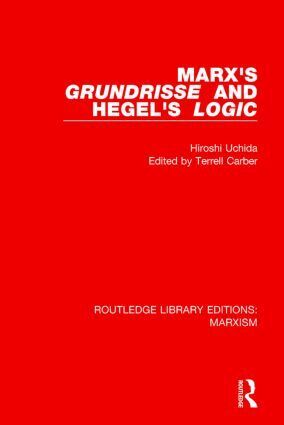
    Marx's 'Grundrisse' and Hegel's 'Logic'

    AvHiroshi Uchida,Terrell Carver

    Inbunden, Engelska, 2015

    Del i serien Routledge Library Editions: Marxism

    2 421 kr

    Beställningsvara. Skickas inom 10-15 vardagar. Fri frakt över 249 kr.

    Fler format och utgåvor

    Häftad

    667 kr

    Beskrivning

    Marx’s Grundrisse is acknowledged as the vital link between Marx’s early and late work. It is also a crucial text in elucidating Marx’s debt to the idealist philosopher G.W.F. Hegel. This book, first published in 1988, is the first full-length study of that relationship, in a thorough textual analysis which makes the connections explicit and also the Grundrisse’s relations to the works of Adam Smith and Aristotle. This book argues that Marx’s critique of political economy, and his critique of Hegel, are double interrelated. Not only did Marx adapt Hegelian logic in order to analyse the economic categories crucial to modern society but it is argued that those logical categories were themselves seen as reflections of the productive processes of contemporary commercial society. Uchida reveals a conceptual structure common to the apparently rarefied world of Hegelian conceptual logic and to the supposedly common-sensical world of economic science. Demonstrating this is a considerable achievement, and it allows us to consider precisely what is valuable today in Marx’s critical commentary on this conceptual structure and on the type of society in which it is manifested. Uchida’s subject, like Marx’s, is ‘the force of capital on modern life’.

    Produktinformation

    • Utgivningsdatum:2015-04-08
    • Mått:156 x 234 x undefined mm
    • Vikt:385 g
    • Format:Inbunden
    • Språk:Engelska
    • Serie:Routledge Library Editions: Marxism
    • Antal sidor:182
    • Förlag:Taylor & Francis Ltd
    • ISBN:9781138888500

    Utforska kategorier

    • Filosofiska discipliner inom Filosofi och religion

    Innehållsförteckning

    • 1. The Introduction to the Grundrisse and the Doctrine of the Notion 1.1. Production in General and ‘the life-process’ 1.2. Critique of Political Economy and Production in General 1.3. The Method of Political Economy and ‘Analytical Method, Synthetic Method, the Simple, and Classification’ 1.4. Mode of Production and Ideology, and ‘The Absolute Idea’ 2. The ‘Chapter on Money’ and the Doctrine of Being 2.1. Product, Commodity and Money, and Identity, Difference, Opposition and Contradiction’ 2.2. The Two Aspects of the Commodity and ‘Likeness and Unlikeness’ 2.3. The Commodity-Owner and ‘Ideality of Being-for-Itself’ 2.4. Money-Subject and ‘Substance as Subject’ 2.5. Price and ‘Quantum’ 2.6. Value-Form and the Process of Exchange, and ‘One and Many’ 2.7. Means of Circulation and ‘Measure’ 2.8. Treasure and ‘Contradiction Dissolves Itself’ 3. The ‘Chapter on Capital’ and the Doctrine of Essence, Part One: ‘Generality of Capital’ 3.1. The Transition from Money to Capital and ‘Positing Reflection’ 3.2. The Exchange Between Capital and Labour, the Labour-Process and the Valorisation-Process, and ‘Form, Substance, Matter and Content’ 3.3. Labour-Power as general Substance and Relation of Substantiality’ 3.4. Component Parts of Capital and ‘The Whole and the Parts’ 3.5. Manifestation as the Force of Capital and ‘Force and its Manifestation’ 3.6. Surplus Capital and ‘Actuality’ 3.7. The Conversion of the Law of Appropriation and ‘Absolute Necessity’ 3.8. The Reproduction of the Capital Relation and ‘Causality’ 3.9. First Critique of Hegel’s System 4. The ‘Chapter on Capital’ and the Doctrine of Essence, Part 2: ‘Particularity of Capital’ 4.1. Particularity of Capital and ‘Judgement’ 4.2. The General Determination and ‘the Categorical Judgement’ 4.3. The Particularising Determination and ‘the Hypothetical Judgement’ 4.4. Properties of Circulating Capital and Fixed Capital, and ‘Force and its Manifestation’ 4.5. The Conversion of the Law of Appropriation and ‘Causality’ 4.6. The Individual Determination and ‘the Disjunctive Judgement’ 4.7. Second Critique of Hegel’s System 5. The ‘Chapter on Capital’ and the Doctrine of Essence, Part 3: ‘Individuality of Capital’ 5.1. Profit and ‘Syllogism’ 5.2. Profit of Capital and ‘Positing Reflection, Ground, Identity and Difference’ 5.3. Productive Capital and ‘the Whole and its Parts’, ‘Force and Its Manifestation’ 5.4. Form of Production and Form of Distribution, and ‘Causality’ 5.5. Third Critique of Hegel’s System