• Fri frakt över 249 kr
  • •
  • Snabba leveranser
  • •
  • Billiga böcker
Kundservice

Du är på sajten för privatpersoner.

Företag, bibliotek eller offentlig verksamhet?

Du handlar på classic.bokus.com, där alla dina funktioner finns intakta.
Till classic.bokus.com
Bokus logotyp. Gå till startsidan.
  • Erbjudanden
  • Nyheter
  • Student
  • Topplistor
  • Barn & ungdom
  • Bokus Play
  • E-böcker
  • Pocketböcker
  • Spel & pussel

10% rabatt på allt med kod: NYSTART10 →

Sidfot

Mina sidor

    Hjälp

    • Kundservice
    • Vanliga frågor och svar
    • Frakt och leverans
    • Retur vid ångerrätt
    • Reklamera vara
    • Betalning
    • Köpvillkor
    • Allmänna villkor
    • Information om webbplatsens tillgänglighet

    Om Bokus

    • Om oss
    • Pressrum
    • För studenter
    • För företag
    • För bibliotek och offentlig verksamhet
    • För leverantörer
    • Hållbarhet

    Populärt

    • Aktuella erbjudanden
    • Presentkort
    • Studentlitteratur
    • Nya böcker
    • Topplistor
    • Signerade böcker
    • Engelska böcker

    Inspiration

    • Boktips
    • BookTok
    • Populära bokserier
    • Barnbokskaraktärer
    • Populära författare
    Logotyp för Bokus
    Följ oss på Facebook (extern länk)Följ oss på Instagram (extern länk)Följ oss på YouTube (extern länk)Följ oss på TikTok (extern länk)
    bokus @ CookiesAnpassa cookiesIntegritetspolicyKöpvillkor
    Till Citymail hemsida (extern länk)Till Budbee hemsida (extern länk)Till Postnord hemsida (extern länk)Till Schenker hemsida (extern länk)Till Early Bird hemsida (extern länk)Till Walleys hemsida (extern länk)
    1. Ekonomi och Ledarskap
    2. Företagsekonomi
    3. Affärsstrategi

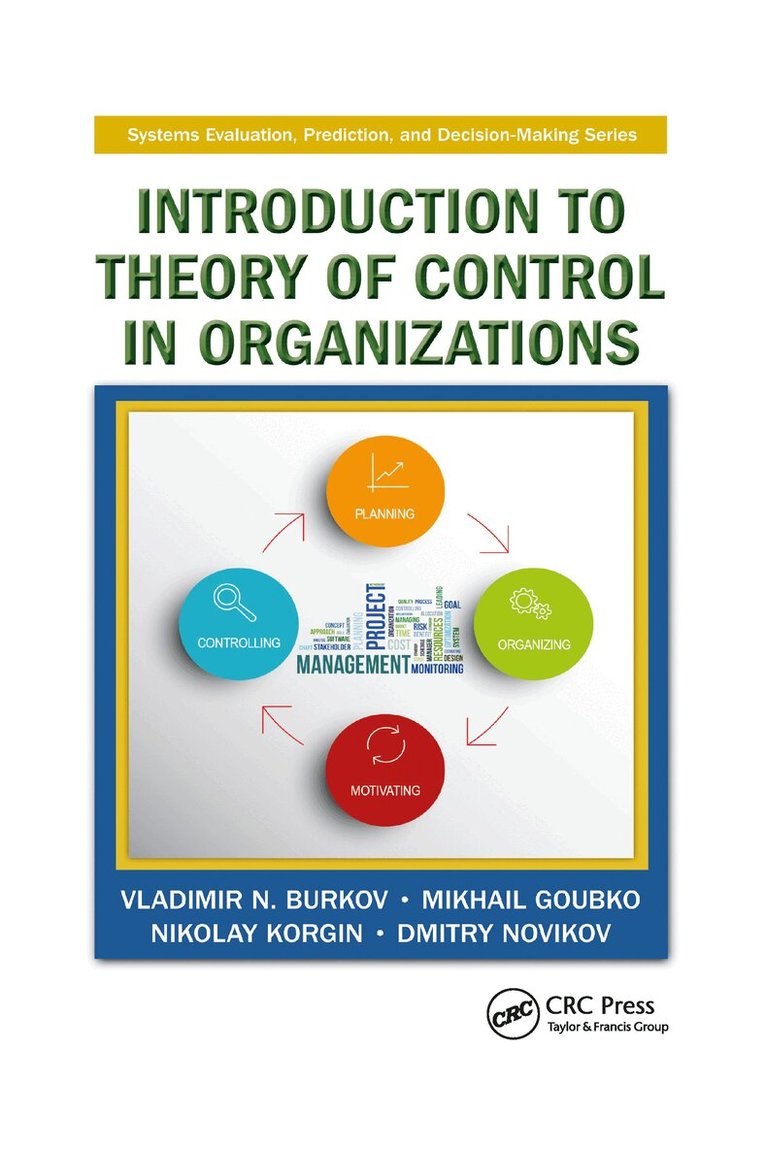
    Introduction to Theory of Control in Organizations

    AvVladimir N. Burkov,Mikhail Goubko

    Häftad, Engelska, 2019

    Del i serien Systems Evaluation, Prediction, and Decision-Making

    845 kr

    Beställningsvara. Skickas inom 10-15 vardagar. Fri frakt över 249 kr.

    Fler format och utgåvor

    Inbunden

    1 510 kr

    Beskrivning

    Introduction to Theory of Control in Organizations explains how methodologies from systems analysis and control theory, including game and graph theory, can be applied to improve organizational management. The theory presented extends the traditional approach to management science by introducing the optimization and game-theoretical tools required to account for the special nature of human beings being viewed as control objects.The book introduces a version of mechanism design that has been customized to solve the problems that today’s managers must contend with. All mathematical models and mechanisms studied are motivated by the most common problems encountered by managers in firms and non-profit organizations.Requiring no prior knowledge of game theory or mechanism design, the book includes a systematic introduction to the underlying methodology of modern theory of control in organizations. The authors use formal methods to construct robust and efficient decision-making procedures which support all aspects and stages of management activity over all decision horizons—from operational to strategic management.The mathematical and methodological backgrounds of the organizational mechanisms discussed are not limited to game theory but also include systems analysis, control theory, operations research, and discrete mathematics.The book includes a set of exercises in each chapter—from simple to advanced—that provide the reader with the understanding required to integrate advanced methods of optimization, game theory, and mechanism design into daily managerial practice.

    Produktinformation

    • Utgivningsdatum:2019-11-08
    • Mått:156 x 234 x 19 mm
    • Vikt:640 g
    • Format:Häftad
    • Språk:Engelska
    • Serie:Systems Evaluation, Prediction, and Decision-Making
    • Antal sidor:348
    • Förlag:Taylor & Francis Ltd
    • ISBN:9781138894266

    Utforska kategorier

    • Affärsstrategi inom Ekonomi och Ledarskap
    • Ledarskapsböcker inom Ekonomi och Ledarskap

    Mer om författaren

    Vladimir Burkov, Doctor of Sc., Professor, Full member of Russian Academy of Natural Sciences.In 1960s Vladimir Burkov was the father of the academic school of control in organizations. Now he is the author of dozens books on control theory, game theory, graph theory, discrete optimization, and management, a vice-president of IPMI-SOVNET, and the manager of many successful consulting projects. V. Burkov is a head of the department at the V.A. Trapeznikov Institute of Control Sciences of Russian Academy of Sciences, the leading academic center of Russian control theory.Mikhail Goubko, Doctor of Sc., Professor of Moscow Institute of Physics and Technology.Mikhail Goubko belongs to the core of the academic school of control in organizations. He studies mathematical methods of complex systems' structure optimization and their applications in different fields. Works at the V.A. Trapeznikov Institute of Control Sciences of Russian Academy of Sciences.Nikolay Korgin, Doctor of Sc., Professor of Moscow Institute of Physics and Technology.Nikolay Korgin belongs to the core of the academic school of control in organizations. His interests include mechanism design and experimental game theory along with their applications in management. He has rich experience in research and teaching the theory of control in organizations. Works at the V.A. Trapeznikov Institute of Control Sciences of Russian Academy of Sciences.Dmitry Novikov, Doctor of Sc., Professor, Head of Control Sciences Department at the Moscow Institute of Physics and Technology, Corresponding member of Russian Academy of Sciences.Dmitry Novikov is the leader of the theory of control in organizations. He is the author of dozens of books and hundreds of papers on different aspects of control and management. D. Novikov is a deputy director of the V.A. Trapeznikov Institute of Control Sciences of Russian Academy of Sciences.

    Innehållsförteckning

    • Introduction. Control and Mechanisms in Organizations. Examples of Control Mechanisms. Incentive Mechanisms. Planning Mechanisms. Informational Control Mechanisms. Mechanisms of Organizational Structure Design. Conclusion. Topics for Self-Study. Literature.