• Fri frakt över 249 kr
  • •
  • Snabba leveranser
  • •
  • Billiga böcker
Kundservice

Du är på sajten för privatpersoner.

Företag, bibliotek eller offentlig verksamhet?

Du handlar på classic.bokus.com, där alla dina funktioner finns intakta.
Till classic.bokus.com
Bokus logotyp. Gå till startsidan.
  • Erbjudanden
  • Nyheter
  • Student
  • Topplistor
  • Barn & ungdom
  • Bokus Play
  • E-böcker
  • Pocketböcker
  • Spel & pussel

10% studentrabatt med kod TERM26

Sidfot

Mina sidor

    Hjälp

    • Kundservice
    • Vanliga frågor och svar
    • Frakt och leverans
    • Retur vid ångerrätt
    • Reklamera vara
    • Betalning
    • Köpvillkor
    • Allmänna villkor
    • Information om webbplatsens tillgänglighet

    Om Bokus

    • Om oss
    • Pressrum
    • För studenter
    • För företag
    • För bibliotek och offentlig verksamhet
    • För leverantörer
    • Hållbarhet

    Populärt

    • Aktuella erbjudanden
    • Presentkort
    • Studentlitteratur
    • Nya böcker
    • Topplistor
    • Signerade böcker
    • Engelska böcker

    Inspiration

    • Boktips
    • BookTok
    • Populära bokserier
    • Barnbokskaraktärer
    • Populära författare
    Logotyp för Bokus
    Följ oss på Facebook (extern länk)Följ oss på Instagram (extern länk)Följ oss på YouTube (extern länk)Följ oss på TikTok (extern länk)
    bokus @ CookiesAnpassa cookiesIntegritetspolicyKöpvillkor
    Till Citymail hemsida (extern länk)Till Budbee hemsida (extern länk)Till Postnord hemsida (extern länk)Till Schenker hemsida (extern länk)Till Early Bird hemsida (extern länk)Till Walleys hemsida (extern länk)
    1. Kultur
    2. Arkitektur

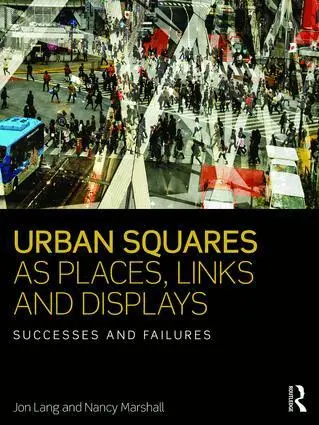
    Urban Squares as Places, Links and Displays

    Successes and Failures

    AvJon Lang,Nancy Marshall

    Häftad, Engelska, 2016

    923 kr

    Beställningsvara. Skickas inom 10-15 vardagar. Fri frakt över 249 kr.

    Fler format och utgåvor

    Inbunden

    3 059 kr

    Beskrivning

    To attract investment and tourists and to enhance the quality of life of their citizens, municipal authorities are paying considerable attention to the quality of the public domain of their cities – including their urban squares. Politicians find them good places for rallies. Children consider squares to be playgrounds, the elderly as places to catch-up with each other, and for many others squares are simply a place to pause for a moment.Urban Squares as Places, Links and Displays: Successes and Failures discusses how people experience squares and the nature of the people who use them. It presents a ‘typology of squares’ based on the dimensions of ownership, the square’s instrumental functions, and a series of their basic physical attributes including size, degree of enclosure, configuration and organization of the space within them and finally based on their aesthetic attributes – their meanings. Twenty case studies illustrate what works and what does not work in different cities around the world. It discusses the qualities of lively squares and quieter, more restorative places as well as what contributes to making urban squares less desirable as destinations for the general public. The book closes with the policy implications, stressing the importance and difficulties of designing good public places.Urban Squares offers how-to guidance along with a strong theoretical framework making it ideal for architects, city planners and landscape architects working on the design and upgrade of squares.

    Produktinformation

    • Utgivningsdatum:2016-08-29
    • Mått:189 x 246 x 19 mm
    • Vikt:846 g
    • Format:Häftad
    • Språk:Engelska
    • Antal sidor:310
    • Förlag:Taylor & Francis Ltd
    • ISBN:9781138959293

    Utforska kategorier

    • Arkitektur inom Kultur
    • Regional planering inom Naturvetenskap och teknik

    Mer om författaren

    Jon Lang is an Emeritus Professor at the University of New South Wales in Sydney Australia where he headed the School of Architecture from 1998 to 2004. He is also the director for urban design of ERG/Environmental Research Group Inc. in Philadelphia, Pennsylvania. Born in Kolkata, India he received his early education in that city and in Kalimpong. He has a bachelor’s degree in architecture from the University of the Witwatersrand in Johannesburg and a doctorate from Cornell University in Ithaca, New York. He taught at the University of Pennsylvania from 1970 to 1990, heading its Urban Design Program in the 1980s, before settling in Australia. He has authored books on urban design, architecture in India, the relationship between people and the built environment and on architectural theory. He has served on international urban design juries and worked as a consultant throughout much of Asia as well as the United States and Latin America. He received the Reid and Malik Medal from the Institution of Civil Engineers (UK) in 2011.Nancy Marshall is a Senior Lecturer at the University of New South Wales in Sydney Australia where she was Associate Dean/Education from 2009 to 2013. She has taught theory and practice in the Planning Program there since 2004 and won the UNSW Vice-Chancellor’s Award for Teaching Excellence in 2007. Born and raised in Calgary Canada, she received her undergraduate and postgraduate degrees from the University of Calgary and her PhD from the University of New South Wales. Prior to coming to Australia she worked as a planning consultant in Canada specializing in public involvement in urban planning and design. Her work as a planner at the local government level included efforts to more efficiently deliver high quality parks and civic spaces. She has been greatly involved in the affairs of planning – serving as a national, senior editor of the Canadian Institute of Planning’s journal Plan Canada from 1997 to 2002 and a member of Calgary’s Subdivision and Development Appeal Board from 1994 to 1997. She is currently a corporate member of the Planning Institute of Australia.

    Recensioner i media

    "El libro pasa revista a muchos casos de plazas urbanas significativas en cuanto al diseño y la vida urbana de las ciudades a nivel mundial, como la de San Marcos, en Venecia (2017, pp. 240-244), que puede considerarse para el lector geógrafo, urbanista, arquitecto, ingeniero, etcétera, como una especie de guía para entender el papel de las plazas urbanas hoy e, incluso, para desarrollar posteriores investigaciones en este campo de estudio." —Federico Camerin, Investigaciones Geográficas, April 2019"The book reviews many cases of urban squares in terms of design and life of cities around the world, such as the of San Marcos, in Venice, which can be considered for the geographer reader, urban planner, architect, engineer, etc., as a kind of guide to understand the role of urban spaces today, and even to develop further research in this field of study." —Federico Camerin, Investigaciones Geográficas, April 2019

    Innehållsförteckning

    • Prologue: The Concern Part 1: Introduction 1. Experiencing Public Open Spaces2. Squares as Places, Links and Displays3. Sociocultural ConsiderationsPart 2: Types of Urban Squares and their Design 4. Public, Quasi-public and Semi-public Squares5. Types based on Instrumental Functions: 6. Types based on Size7. Types based on Degree of Enclosure 8. Types based on Configurations9. Types based on Internal Designs10. Types based on Symbolic Functions11. Types based on Design ParadigmsPart 3: Learning from Case Studies12. A Score of Case Studies Rittenhouse House Square, Philadelphia Sproul Plaza, University of California at Berkeley Paley Park, New York Cours Honoréd-Estiennne d’Orves, Marseille La Place des Terreaux, Lyon Federation Square, Melbourne Paternoster Square, London Robson Square, Vancouver Olympic Plaza, Calgary Trafalgar Square, London The Capitol Square, Chandigarh Oxford Square, Sydney Pershing Square, Los Angeles Schouwburgplein, Rotterdam The Guggenheim Museum forecourt, Bilbao North and South Shanghai Railway Station Squares, Shanghai Jacob K. Javits Federal Building Plaza, New York Granary Square, London Times Square, New York Piazza San Marco, Venice Part 4: What Works and What Doesn’t Work13. The Qualities of Lively Urban Squares14. The Qualities of Quiet Urban SquaresEpilogue