• Fri frakt över 249 kr
  • •
  • Snabba leveranser
  • •
  • Billiga böcker
Kundservice

Du är på sajten för privatpersoner.

Företag, bibliotek eller offentlig verksamhet?

Du handlar på classic.bokus.com, där alla dina funktioner finns intakta.
Till classic.bokus.com
Bokus logotyp. Gå till startsidan.
  • Erbjudanden
  • Student
  • Topplistor
  • Barn & ungdom
  • Bokus Play
  • E-böcker
  • Ljudböcker
  • Pocketböcker
  • Spel & pussel

10% rabatt på allt med kod NYSTART10 →

Sidfot

Mina sidor

    Hjälp

    • Kundservice
    • Vanliga frågor och svar
    • Frakt och leverans
    • Retur vid ångerrätt
    • Reklamera vara
    • Betalning
    • Köpvillkor
    • Allmänna villkor
    • Information om webbplatsens tillgänglighet

    Om Bokus

    • Om oss
    • Pressrum
    • För studenter
    • För företag
    • För bibliotek och offentlig verksamhet
    • För leverantörer
    • Hållbarhet

    Populärt

    • Aktuella erbjudanden
    • Presentkort
    • Studentlitteratur
    • Nya böcker
    • Topplistor
    • Signerade böcker
    • Engelska böcker

    Inspiration

    • Boktips
    • BookTok
    • Populära bokserier
    • Barnbokskaraktärer
    • Populära författare
    Logotyp för Bokus
    Följ oss på Facebook (extern länk)Följ oss på Instagram (extern länk)Följ oss på YouTube (extern länk)Följ oss på TikTok (extern länk)
    bokus @ CookiesAnpassa cookiesIntegritetspolicyKöpvillkor
    Till Citymail hemsida (extern länk)Till Budbee hemsida (extern länk)Till Postnord hemsida (extern länk)Till Schenker hemsida (extern länk)Till Early Bird hemsida (extern länk)Till Walleys hemsida (extern länk)
    1. Data och IT
    2. Programmeringsböcker

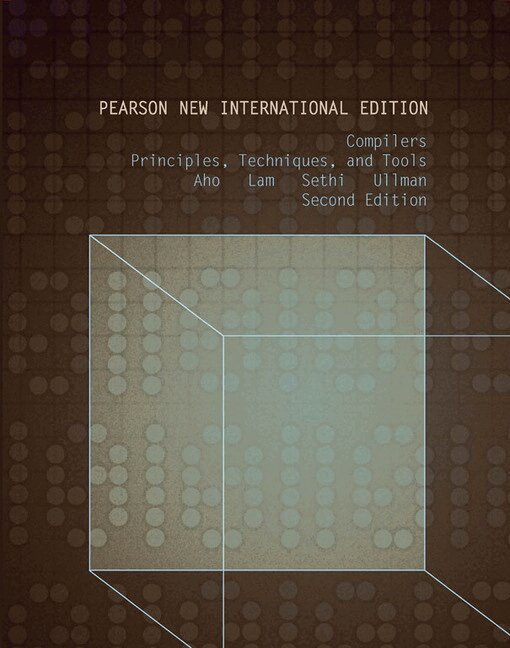
    Compilers: Principles, Techniques, and Tools

    Pearson New International Edition

    AvAlfred Aho,Monica Lam

    Häftad, Engelska, 2013

    1 213 kr

    Beställningsvara. Skickas inom 7-10 vardagar. Fri frakt över 249 kr.

    Beskrivning

    Compilers: Principles, Techniques and Tools, is known to professors, students, and developers worldwide as the "Dragon Book," . Every chapter has been revised to reflect developments in software engineering, programming languages, and computer architecture that have occurred since 1986, when the last edition published. The authors, recognising that few readers will ever go on to construct a compiler, retain their focus on the broader set of problems faced in software design and software development.

    Produktinformation

    • Utgivningsdatum:2013-08-02
    • Mått:220 x 280 x 30 mm
    • Vikt:1 744 g
    • Format:Häftad
    • Språk:Engelska
    • Antal sidor:952
    • Upplaga:2
    • Förlag:Pearson Education
    • ISBN:9781292024349

    Utforska kategorier

    • Programmeringsböcker inom Data och IT

    Innehållsförteckning

    • 1  Introduction 1.1 Language Processors 1.2 The Structure of a Compiler 1.3 The Evolution of Programming Languages 1.4 The Science of Building a Compiler 1.5 Applications of Compiler Technology 1.6 Programming Language Basics 1.7 Summary of Chapter 1 1.8 References for Chapter 1  2 A Simple Syntax-Directed Translator  2.1 Introduction 2.2 Syntax Definition  2.3 Syntax-Directed Translation 2.4 Parsing 2.5 A Translator for Simple Expressions  2.6 Lexical Analysis  2.7 Symbol Tables 2.8 Intermediate Code Generation 2.9 Summary of Chapter 2  3 Lexical Analysis 3.1 The Role of the Lexical Analyzer 3.2 Input Buffering  3.3 Specification of Tokens 3.4 Recognition of Tokens 3.5 The Lexical-Analyzer Generator Lex 3.6 Finite Automata 3.7 From Regular Expressions to Automata 3.8 Design of a Lexical-Analyzer Generator 3.9 Optimization of DFA-Based Pattern Matchers  3.10 Summary of Chapter 3 3.11 References for Chapter 3  4 Syntax Analysis 4.1 Introduction 4.2 Context-Free Grammars 4.3 Writing a Grammar 4.4 Top-Down Parsing  4.5 Bottom-Up Parsing 4.6 Introduction to LR Parsing: Simple LR 4.7 More Powerful LR Parsers 4.8 Using Ambiguous Grammars 4.9 Parser Generators 4.10 Summary of Chapter 4  4.11 References for Chapter 4  5 Syntax-Directed Translation 5.1 Syntax-Directed Definitions 5.2 Evaluation Orders for SDD's  5.3 Applications of Syntax-Directed Translation 5.4 Syntax-Directed Translation Schemes 5.5 Implementing L-Attributed SDD's  5.6 Summary of Chapter 5 5.7 References for Chapter 5    6 Intermediate-Code Generation 6.1 Variants of Syntax Trees  6.2 Three-Address Code 6.3 Types and Declarations 6.4 Translation of Expressions  6.5 Type Checking  6.6 Control Flow 6.7 Backpatching 6.8 Switch-Statements 6.9 Intermediate Code for Procedures  6.10 Summary of Chapter 6 6.11 References for Chapter 6  7 Run-Time Environments 7.1 Storage Organization  7.2 Stack Allocation of Space 7.3 Access to Nonlocal Data on the Stack  7.4 Heap Management  7.5 Introduction to Garbage Collection  7.6 Introduction to Trace-Based Collection 7.7 Short-Pause Garbage Collection 7.8 Advanced Topics in Garbage Collection 7.9 Summary of Chapter 7 7.10 References for Chapter 7  8 Code Generation 8.1 Issues in the Design of a Code Generator 8.2 The Target Language 8.3 Addresses in the Target Code  8.4 Basic Blocks and Flow Graphs 8.5 Optimization of Basic Blocks 8.6 A Simple Code Generator 8.7 Peephole Optimization  8.8 Register Allocation and Assignment  8.9 Instruction Selection by Tree Rewriting  8.10 Optimal Code Generation for Expressions 8.11 Dynamic Programming Code-Generation 8.12 Summary of Chapter 8  8.13 References for Chapter 8    9 Machine-Independent Optimizations9.1 The Principal Sources of Optimization 9.2 Introduction to Data-Flow Analysis 9.3 Foundations of Data-Flow Analysis  9.4 Constant Propagation  9.5 Partial-Redundancy Elimination 9.6 Loops in Flow Graphs 9.7 Region-Based Analysis 9.8 Symbolic Analysis 9.9 Summary of Chapter 9 9.10 References for Chapter 9  <