• Fri frakt över 249 kr
  • •
  • Snabba leveranser
  • •
  • Billiga böcker
Kundservice

Du är på sajten för privatpersoner.

Företag, bibliotek eller offentlig verksamhet?

Du handlar på classic.bokus.com, där alla dina funktioner finns intakta.
Till classic.bokus.com
Bokus logotyp. Gå till startsidan.
  • Erbjudanden
  • Student
  • Topplistor
  • Barn & ungdom
  • Bokus Play
  • E-böcker
  • Ljudböcker
  • Pocketböcker
  • Spel & pussel

10% rabatt på allt med kod NYSTART10 →

Sidfot

Mina sidor

    Hjälp

    • Kundservice
    • Vanliga frågor och svar
    • Frakt och leverans
    • Retur vid ångerrätt
    • Reklamera vara
    • Betalning
    • Köpvillkor
    • Allmänna villkor
    • Information om webbplatsens tillgänglighet

    Om Bokus

    • Om oss
    • Pressrum
    • För studenter
    • För företag
    • För bibliotek och offentlig verksamhet
    • För leverantörer
    • Hållbarhet

    Populärt

    • Aktuella erbjudanden
    • Presentkort
    • Studentlitteratur
    • Nya böcker
    • Topplistor
    • Signerade böcker
    • Engelska böcker

    Inspiration

    • Boktips
    • BookTok
    • Populära bokserier
    • Barnbokskaraktärer
    • Populära författare
    Logotyp för Bokus
    Följ oss på Facebook (extern länk)Följ oss på Instagram (extern länk)Följ oss på YouTube (extern länk)Följ oss på TikTok (extern länk)
    bokus @ CookiesAnpassa cookiesIntegritetspolicyKöpvillkor
    Till Citymail hemsida (extern länk)Till Budbee hemsida (extern länk)Till Postnord hemsida (extern länk)Till Schenker hemsida (extern länk)Till Early Bird hemsida (extern länk)Till Walleys hemsida (extern länk)
    1. Data och IT
    2. Databaser

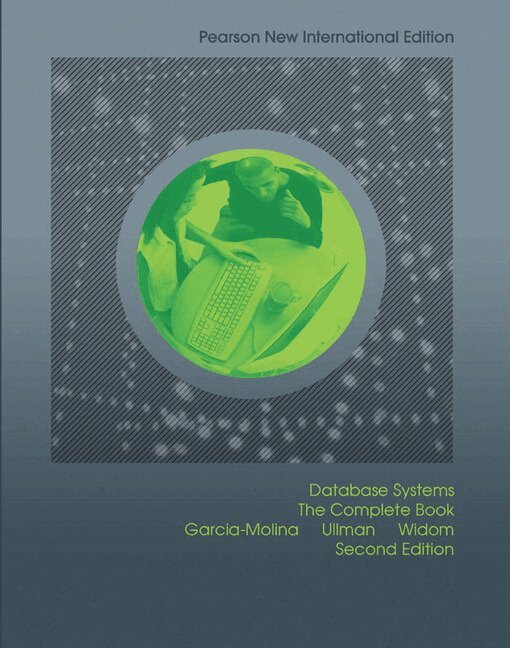
    Database Systems: The Complete Book

    Pearson New International Edition

    AvHector Garcia-Molina,Jeffrey Ullman

    Häftad, Engelska, 2013

    1 229 kr

    Beställningsvara. Skickas inom 7-10 vardagar. Fri frakt över 249 kr.

    Beskrivning

    For Database Systems and Database Design and Application courses offered at the junior, senior and graduate levels in Computer Science departments.

    Written by well-known computer scientists, this introduction to database systems offers a comprehensive approach, focusing on database design, database use, and implementation of database applications and database management systems.

    The first half of the book provides in-depth coverage of databases from the point of view of the database designer, user, and application programmer. It covers the latest database standards SQL:1999, SQL/PSM, SQL/CLI, JDBC, ODL, and XML, with broader coverage of SQL than most other texts. The second half of the book provides in-depth coverage of databases from the point of view of the DBMS implementor. It focuses on storage structures, query processing, and transaction management. The book covers the main techniques in these areas with broader coverage of query optimisation than most other texts, along with advanced topics including multidimensional and bitmap indexes, distributed transactions, and information integration techniques.

    Produktinformation

    • Utgivningsdatum:2013-07-24
    • Mått:224 x 284 x 60 mm
    • Vikt:2 660 g
    • Format:Häftad
    • Språk:Engelska
    • Antal sidor:1 140
    • Upplaga:2
    • Förlag:Pearson Education
    • ISBN:9781292024479

    Utforska kategorier

    • Databaser inom Data och IT

    Mer om författaren

    Hector Garcia-Molina is the L. Bosack and S. Lerner Professor of Computer Science and Electrical Engineering at Stanford University. His research interests include digital libraries, information integration, and database applications on the Internet. He was a recipient of the SIGMOD Innovations Award and a member of PITAC (President's Information-Technology Advisory Council). He currently serves on the Board of Directors of Oracle Corp. Jeffrey D. Ullman is the Stanford W. Ascherman Professor of Computer Science (emeritus) at Stanford University. He is the author or co-author of 16 books, including Elements of ML Programming. His research interests include data mining, information integration, and electronic education. He is a member of the National Academy of Engineering, and recipient of a Guggenheim Fellowship, the Karl V. Karlstom Outstanding Educator Award, the SIGMOD Contributions and Edgar F. Codd Innovations Awards, and the Knuth Prize.Jennifer Widom is Professor of Computer Science and Electrical Engineering at Stanford University. Her research interests span many aspects of nontraditional data management. She is an ACM Fellow and a member of the National Academy of Engineering, she received the ACM SIGMOD Edgar F. Codd Innovations award in 2007 and was a Guggenheim Fellow in 2000, and she has served on a variety of program committees, advisory boards, and editorial boards.

    Innehållsförteckning

    • TABLE OF CONTENTS  1 The Worlds of Database Systems1.1 The Evolution of Database Systems1.1.1 Early Database Management Systems1.1.2 Relational Database Systems1.1.3 Smaller and Smaller Systems1.1.4 Bigger and Bigger Systems1.1.5 Information Integration1.2 Overview of a Database Management System1.2.1 Data-Definition Language Commands1.2.2 Overview of Query Processing1.2.3 Storage and Buffer Management1.2.4 Transaction Processing1.2.5 The Query Processor1.3 Outline of Database-System Studies1.4 References for Chapter 1  PART I: Relational Database Modeling  2 The Relational Model of Data2.1 An Overview of Data Models2.1.1 What is a Data Model?2.1.2 Important Data Models2.1.3 The Relational Model in Brief2.1.4 The Semistructured Model in Brief2.1.5 Other Data Models2.1.6 Comparison of Modeling Approaches2.2 Basics of the Relational Model2.2.1 Attributes2.2.2 Schemas2.2.3 Tuples2.2.4 Domains2.2.5 Equivalent Representations of a Relation2.2.6 Relation Instances2.2.7 Keys of Relations2.2.8 An Example Database Schema2.2.9 Exercises for Section 2.22.3 Defining a Relation Schema in SQL2.3.1 Relations in SQL2.3.2 Data Types2.3.3 Simple Table Declarations2.3.4 Modifying Relation Schemas2.3.5 Default Values2.3.6 Declaring Keys2.3.7 Exercises for Section 2.32.4 An Algebraic Query Language2.4.1 Why Do We Need a Special Query Language?2.4.2 What is an Algebra?2.4.3 Overview of Relational Algebra2.4.4 Set Operations on Relations2.4.5 Projection2.4.6 Selection2.4.7 Cartesian Product2.4.8 Natural Joins2.4.9 Theta-Joins2.4.10 Combining Operations to Form Queries2.4.11 Naming and Renaming2.4.12 Relationships Among Operations2.4.13 A Linear Notation for Algebraic Expressions2.4.14 Exercises for Section 2.42.5 Constraints on Relations2.5.1 Relational Algebra as a Constraint Language2.5.2 Referential Integrity Constraints2.5.3 Key Constraints2.5.4 Additional Constraint Examples2.5.5 Exercises for Section 2.52.6 Summary of Chapter 22.7 References for Chapter 23 Design Theory for Relational Databases3.1 Functional Dependencies3.1.1 Definition of Functional Dependency3.1.2 Keys of Relations3.1.3 Superkeys3.1.4 Exercises for Section 3.13.2 Rules About Functional Dependencies3.2.1 Reasoning About Functional Dependencies3.2.2 The Splitting/Combining Rule3.2.3 Trivial Functional Dependencies3.2.4 Computing the Closure of Attributes3.2.5 Why the Closure Algorithm Works3.2.6 The Transitive Rule3.2.7 Closing Sets of Function