Häftad, Engelska, 2018
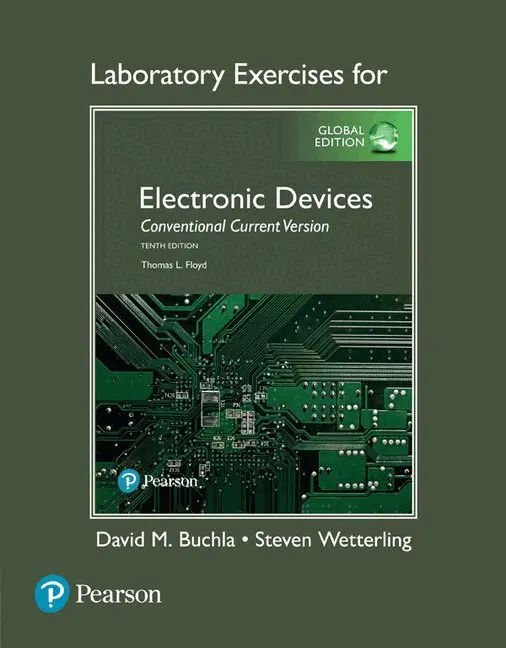
Lab manual for Electronic Devices, Global Edition
Av Thomas Floyd
1090 kr
Beställningsvara. Skickas inom 3-6 vardagar. Fri frakt över 249 kr.
Beskrivning
This laboratory manual is carefully coordinated to the text Electronic Devices, Tenth edition, Global edition, by Thomas L. Floyd. The seventeen experiments correspond to the chapters in the text (except the first experiment references Chapters 1 and the first part of Chapter 2). All of the experiments are subdivided into two or three “Parts.” With one exception (Experiment 12-B), the Parts for the all experiments are completely independent of each other. The instructor can assign any or all Parts of these experiments, and in any order. This format provides flexibility depending on the schedule, laboratory time available, and course objectives. In addition, experiments 12 through 16 provide two options for experiments. These five experiments are divided into two major sections identified as A or B. The A experiments continue with the format of previous experiments; they are constructed with discrete components on standard protoboards as used in most electronic teaching laboratories. The A experiments can be assigned in programs where traditional devices are emphasized. Each B experiment has a similar format to the corresponding A experiment, but uses a programmable Analog Signal Processor (ASP) that is controlled by (free) Computer Aided Design (CAD) software from the Anadigm company (www.anadigm.com). These experiments support the Programmable Analog Design feature in the textbook. The B experiments are also subdivided into independent Parts, but Experiment 12-B, Part 1, is a software tutorial and should be performed before any other B experiments. This is an
excellent way to introduce the ASP technology because no other hardware is required other
than a computer running the downloaded software. In addition to Experiment 12-B, the first 13 steps of Experiment 15-B, Part 2, are also tutorial in nature for the AnadigmFilter program. This is an amazing active filter design tool that is easy to learn and is included with the AnadigmDesigner2 (AD2) CAD software. The ASP is part of a Programmable Analog Module (PAM) circuit board from the Servenger company (www.servenger.com) that interfaces to a personal computer.
The PAM is controlled by the AD2 CAD software from the Anadigm company website. Except for Experiment 12-B, Part 1, it is assumed that the PAM is connected to the PC and AnadigmDesigner2 is running. Experiment 16-B, Part 3, also requires a spreadsheet program such as Microsoft® Excel®. The PAM is described in detail in the Quick Start Guide (Appendix B). Instructors may choose to mix A and B experiments with no loss in continuity, depending on course objectives and time. We recommend that Experiment 12-B,Part 1, be assigned if you want students to have an introduction to the ASP without requiring a hardware purchase.
A text feature is the Device Application (DA) at the end of most chapters. All of the DAs have a related laboratory exercise using a similar circuit that is sometimes simplified to make laboratory
time as efficient as possible. The same text icon identifies the related DA exercise in the lab manual.
One issue is the trend of industry to smaller surface-mount devices, which are very difficult to work with and are not practical for most lab work. For example, almost all varactors are supplied as surface mount devices now. In reviewing each experiment, we have found components that can illustrate the device function with a traditional one. The traditional through-hole MV2109 varactor is listed as obsolete, but will be available for the foreseeable future from Electronix Express (www.elexp.com), so it is called out in Experiment 3. All components are available from Electronix Express (www.elexp.com) as a kit of parts (see list in Appendix A). The format for each experiment has not changed from the last edition and is as follows:
· Introducti
Produktinformation
- Utgivningsdatum: 2018-06-26
- Mått: 215 x 275 x 16 mm
- Vikt: 680 g
- Format: Häftad
- Språk: Engelska
- Antal sidor: 272
- Upplaga: 10
- Förlag: Pearson Education
- ISBN: 9781292249346
Utforska kategorier
Betyg & recensioner
0 recensioner
Inga recensioner tillgängliga.