• Fri frakt över 249 kr
  • •
  • Snabba leveranser
  • •
  • Billiga böcker
Kundservice

Du är på sajten för privatpersoner.

Företag, bibliotek eller offentlig verksamhet?

Du handlar på classic.bokus.com, där alla dina funktioner finns intakta.
Till classic.bokus.com
Bokus logotyp. Gå till startsidan.
  • Erbjudanden
  • Nyheter
  • Student
  • Topplistor
  • Barn & ungdom
  • Bokus Play
  • E-böcker
  • Pocketböcker
  • Spel & pussel

10% rabatt på allt med kod NYSTART10 →

Sidfot

Mina sidor

    Hjälp

    • Kundservice
    • Vanliga frågor och svar
    • Frakt och leverans
    • Retur vid ångerrätt
    • Reklamera vara
    • Betalning
    • Köpvillkor
    • Allmänna villkor
    • Information om webbplatsens tillgänglighet

    Om Bokus

    • Om oss
    • Pressrum
    • För studenter
    • För företag
    • För bibliotek och offentlig verksamhet
    • För leverantörer
    • Hållbarhet

    Populärt

    • Aktuella erbjudanden
    • Presentkort
    • Studentlitteratur
    • Nya böcker
    • Topplistor
    • Signerade böcker
    • Engelska böcker

    Inspiration

    • Boktips
    • BookTok
    • Populära bokserier
    • Barnbokskaraktärer
    • Populära författare
    Logotyp för Bokus
    Följ oss på Facebook (extern länk)Följ oss på Instagram (extern länk)Följ oss på YouTube (extern länk)Följ oss på TikTok (extern länk)
    bokus @ CookiesAnpassa cookiesIntegritetspolicyKöpvillkor
    Till Citymail hemsida (extern länk)Till Budbee hemsida (extern länk)Till Postnord hemsida (extern länk)Till Schenker hemsida (extern länk)Till Early Bird hemsida (extern länk)Till Walleys hemsida (extern länk)
    1. Psykologi och pedagogik
    2. Psykologi
    3. Psykologisk metod

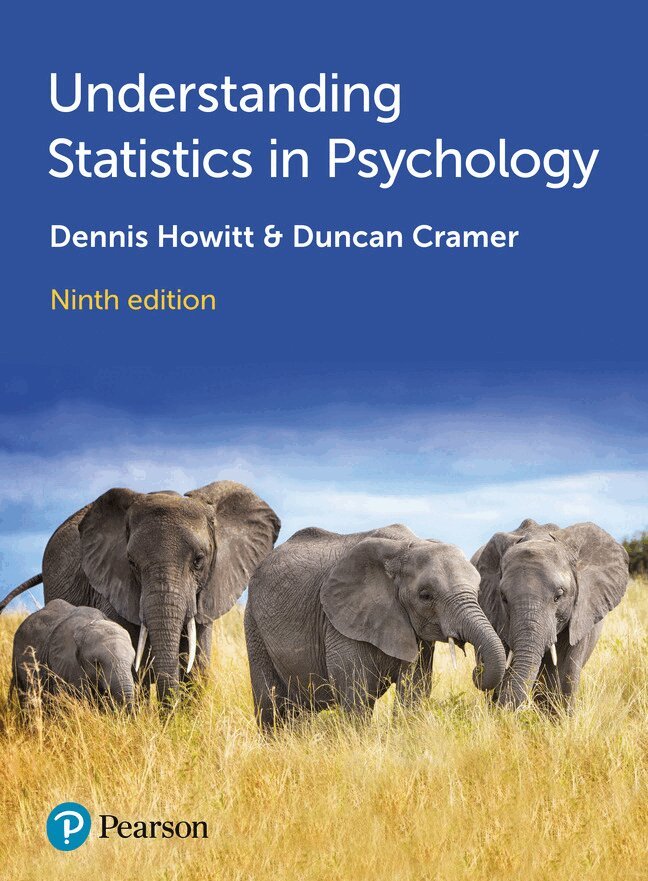
    Understanding Statistics in Psychology

    AvDennis Howitt,Duncan Cramer

    Häftad, Engelska, 2024

    Del i serien Pearson Education Limited

    813 kr

    Beställningsvara. Skickas inom 7-10 vardagar. Fri frakt över 249 kr.

    Beskrivning

    Become confident with the most common statistical techniques so that you can grasp the fundamentals and transition from a student to a professional researcher

    Now in its ninth edition, Understanding Statistics in Psychology, by Dennis Howitt and Duncan Cramer continues to provide an accessible introduction to the intimidating subject of statistics in psychology for students of all years and abilities.

    Clear explanations and diagrams break down the statistical techniques that are used in modern psychological research and updated examples of real-life studies bring the topic to life by showing you how statistics are used in practice.

    The new software-agnostic approach of this edition means that you will gain a solid understanding of statistics which can be applied to whichever statistical package you are using to analyse your data. The modular structure of this text and its small accessible chapters also mean that it is easy to dip in and out of, concentrating on the techniques that are the most relevant for you and your own research projects.

    This text does not just focus on how to analyse data but also contains clear and detailed guidance of the whole research process, from how to choose the appropriate tests, to interpreting your findings and successfully writing up your research.

    Produktinformation

    • Utgivningsdatum:2024-11-28
    • Mått:195 x 265 x 25 mm
    • Vikt:1 300 g
    • Format:Häftad
    • Språk:Engelska
    • Serie:Pearson Education Limited
    • Antal sidor:680
    • Upplaga:9
    • Förlag:Pearson Education
    • ISBN:9781292465180

    Utforska kategorier

    • Psykologisk metod inom Psykologi och pedagogik

    Mer om författaren

    Dennis Howitt is a reader in Psychology at Loughborough University, a chartered forensic psychologist and fellow of the British Psychological Society, with a specific interest in the study of mass communications and the application of psychology to social issues.Duncan Cramer is an emeritus professor at Loughborough University with a specific interest in topics such as mental health, personality, personal relationships, organizational commitment, psychotherapy and counselling.

    Innehållsförteckning

    • Preface Why statistics?Part 1 Descriptive statistics Some basics: Variability and measurementDescribing variables: Tables and diagramsDescribing variables numerically: Averages, variation and spreadShapes of distributions of scoresStandard deviation and z-scores: Standard unit of measurement in statisticsRelationships between two or more variables: Diagrams and tablesCorrelation coefficients: Pearson’s correlation and Spearman's rhoRegression: Prediction with precisionPart 2 Significance testing Samples from populationsStatistical significance for the correlation coefficient: Practical introduction to statistical inferenceStandard error: Standard deviation of the means of samplesRelated or paired-samples t-test: Comparing two samples of related/correlated/paired scoresUnrelated or independent-samples t-test: Comparing two samples of unrelated/uncorrelated/independent scoresWhat you need to write about your statistical analysisConfidence intervalsEffect size in statistical analysis: Do my findings matter?Chi-square: Differences between samples of frequency dataProbabilityOne- versus two-tailed or -sided significance testingRanking tests: Nonparametric statisticsPart 3 Introduction to analysis of variance Variance ratio test: F-ratio to compare two variancesAnalysis of variance (ANOVA): One-way unrelated or uncorrelated ANOVAANOVA for correlated scores or repeated measuresTwo-way or factorial ANOVA for unrelated/uncorrelated scores: Two studies for the price of one?Multiple comparisons in ANOVA: A priori and post hoc testsMixed-design ANOVA: Related and unrelated variables togetherAnalysis of covariance (ANCOVA): Controlling for additional variablesMultivariate analysis of variance (MANOVA)Discriminant (function) analysis – especially in MANOVAStatistics and analysis of experimentsPart 4 More advanced correlational statistics Partial correlation: Spurious correlation, third or confounding variables, suppressor variablesFactor analysis: Simplifying complex dataMultiple regression and multiple correlationPath analysisAnalysis of a questionnaire/survey projectPart 5 Assorted advanced techniques Meta-analysis: Combining and exploring statistical findings from previous researchReliability in scales and measurement: Consistency and agreementInfluence of moderator variables on relationships between two variablesStatistical power analysis: Getting the sample size rightPart 6 Advanced qualitative or nominal techniques Log-linear methods: Analysis of complex contingency tablesMultinomial logistic regression: Distinguishing between several different categories or groupsBinomial logistic regressionPart 7 Bringing things together Data mining and Big DataTowards a masterplanAppendicesGlossaryReferencesIndex