• Fri frakt över 249 kr
  • •
  • Snabba leveranser
  • •
  • Billiga böcker
Kundservice

Du är på sajten för privatpersoner.

Företag, bibliotek eller offentlig verksamhet?

Du handlar på classic.bokus.com, där alla dina funktioner finns intakta.
Till classic.bokus.com
Bokus logotyp. Gå till startsidan.
  • Erbjudanden
  • Nyheter
  • Student
  • Topplistor
  • Barn & ungdom
  • Bokus Play
  • E-böcker
  • Pocketböcker
  • Spel & pussel

10% rabatt på allt med kod: NYSTART10 →

Sidfot

Mina sidor

    Hjälp

    • Kundservice
    • Vanliga frågor och svar
    • Frakt och leverans
    • Retur vid ångerrätt
    • Reklamera vara
    • Betalning
    • Köpvillkor
    • Allmänna villkor
    • Information om webbplatsens tillgänglighet

    Om Bokus

    • Om oss
    • Pressrum
    • För studenter
    • För företag
    • För bibliotek och offentlig verksamhet
    • För leverantörer
    • Hållbarhet

    Populärt

    • Aktuella erbjudanden
    • Presentkort
    • Studentlitteratur
    • Nya böcker
    • Topplistor
    • Signerade böcker
    • Engelska böcker

    Inspiration

    • Boktips
    • BookTok
    • Populära bokserier
    • Barnbokskaraktärer
    • Populära författare
    Logotyp för Bokus
    Följ oss på Facebook (extern länk)Följ oss på Instagram (extern länk)Följ oss på YouTube (extern länk)Följ oss på TikTok (extern länk)
    bokus @ CookiesAnpassa cookiesIntegritetspolicyKöpvillkor
    Till Citymail hemsida (extern länk)Till Budbee hemsida (extern länk)Till Postnord hemsida (extern länk)Till Schenker hemsida (extern länk)Till Early Bird hemsida (extern länk)Till Walleys hemsida (extern länk)
    1. Psykologi och pedagogik
    2. Pedagogik

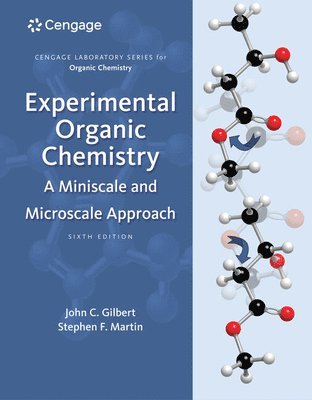
    Experimental Organic Chemistry: A Miniscale & Microscale Approach

    A Miniscale & Microscale Approach

    AvJohn Gilbert,Stephen Martin

    Inbunden, Engelska, 2015

    1 201 kr

    Tillfälligt slut

    Beskrivning

    Perform chemistry experiments with skill and confidence in your organic chemistry lab course with this easy-to-understand lab manual. EXPERIMENTAL ORGANIC CHEMISTRY: A MINISCALE AND MICROSCALE APPROACH, Sixth Edition first covers equipment, record keeping, and safety in the laboratory, then walks you step by step through the laboratory techniques you'll need to perform all experiments. Individual chapters show you how to use the techniques to synthesize compounds and analyze their properties, complete multi-step syntheses of organic compounds, and solve structures of unknown compounds. New experiments in Chapter 17 and 18 demonstrate the potential of chiral agents in fostering enantioselectivity and of performing solvent-free reactions. A bioorganic experiment in Chapter 24 gives you an opportunity to accomplish a mechanistically interesting and synthetically important coupling of two a-amino acids to produce a dipeptide.

    Produktinformation

    • Utgivningsdatum:2015-01-01
    • Mått:223 x 40 x 281 mm
    • Vikt:2 220 g
    • Format:Inbunden
    • Språk:Engelska
    • Antal sidor:960
    • Upplaga:6
    • Förlag:Cengage Learning
    • ISBN:9781305080461

    Utforska kategorier

    • Pedagogik inom Psykologi och pedagogik

    Mer om författaren

    Jack Gilbert joined the faculty of the University of Texas at Austin in 1965 and moved to Santa Clara University in 2007, where he is Professor of Chemistry & Biochemistry. He received the Advisory Council Teaching Excellence Award at UT the 2002–2003 academic year, as well as many other recognitions in teaching. While at UT, he co-authored several editions of the first laboratory textbook in organic chemistry that emphasized reactions mechanisms, as well as laboratory techniques, including spectroscopy. He continues to update the textbook, now with the able assistance of Steve Martin. Stephen Martin received his B. S. degree in chemistry from the University of New Mexico in 1968 and his Ph.D. degree from Princeton University in 1972. After postdoctoral years at the University of Munich and MIT, he joined the faculty at The University of Texas at Austin in 1974, where he currently holds the M. June and J. Virgil Waggoner Regents Chair in Chemistry. His research interests lie broadly in organic and bioorganic chemistry. In the former area, his endeavors involve developing and applying new methods and strategies to the syntheses of biologically active natural and non-natural products, especially those containing nitrogen and oxygen heterocyclic subunits. In the biological arena, he is studying fundamental aspects of molecular recognition in biological systems with a particular focus on how making specific structural changes in a ligand, particularly with respect to preorganization and nonpolar surface area, affect energetics and dynamics in protein-ligand interactions. He has received a number of awards including a NIH Career Development Award, an American Cyanamid Academic Award, an Alexander von Humboldt Award, an Arthur C. Cope Scholar Award, a Japanese Society for the Promotion of Science Award, a Wyeth Research Award, and the International Society of Heterocyclic Chemistry Senior Award. He is a fellow of the American Association for the Advancement of Science and has served as a consultant for a number of pharmaceutical and biotechnology companies. He is the regional editor of “Tetrahedron for the Americas.” He has delivered numerous invited lectures at national and international meetings, academic institutions, and industrial companies, and has published over 300 scientific papers in primary journals together with several reviews and articles in books. He is also co-author of “Experimental Organic Chemistry: A Miniscale and Microscale Approach.”

    Innehållsförteckning

    • 1. Introduction, Record Keeping, and Laboratory Safety.2. Techniques and Apparatus.3. Solids: Recrystallization and Melting Points.4. Liquids: Distillation and Boiling Points.5. Extraction.6. Chromatography.7. Stereoisomers.8. Spectral Methods.9. Alkanes.10. Alkenes.11. Alkynes.12. Dienes: The Diels-Alder Reaction.13. Kinetic and Thermodynamic Control of a Reaction.14. Nucleophilic Aliphatic Substitution: Preparation of Alkyl Halides.15. Electrophilic Aromatic Substitution.16. Oxidation of Alcohols and Carbonyl Compounds.17. Reduction Reactions of Double Bonds: Alkenes, Carbonyl Compounds, and lmines.18. Reactions of Carbonyl Compounds.19. Organometallic Chemistry.20. Carboxylic Acids and Their Derivatives.21. Multistep Organic Synthesis.22. Polymers.23. Carbohydrates.24. Amino Acids and Peptides.25. Identifying Organic Compounds (ONLINE ONLY).26. The Literature of Organic Chemistry (ONLINE ONLY).