• Fri frakt över 249 kr
  • •
  • Snabba leveranser
  • •
  • Billiga böcker
Kundservice

Du är på sajten för privatpersoner.

Företag, bibliotek eller offentlig verksamhet?

Du handlar på classic.bokus.com, där alla dina funktioner finns intakta.
Till classic.bokus.com
Bokus logotyp. Gå till startsidan.
  • Erbjudanden
  • Nyheter
  • Student
  • Topplistor
  • Barn & ungdom
  • Bokus Play
  • E-böcker
  • Pocketböcker
  • Spel & pussel

10% rabatt på allt med kod: NYSTART10 →

Sidfot

Mina sidor

    Hjälp

    • Kundservice
    • Vanliga frågor och svar
    • Frakt och leverans
    • Retur vid ångerrätt
    • Reklamera vara
    • Betalning
    • Köpvillkor
    • Allmänna villkor
    • Information om webbplatsens tillgänglighet

    Om Bokus

    • Om oss
    • Pressrum
    • För studenter
    • För företag
    • För bibliotek och offentlig verksamhet
    • För leverantörer
    • Hållbarhet

    Populärt

    • Aktuella erbjudanden
    • Presentkort
    • Studentlitteratur
    • Nya böcker
    • Topplistor
    • Signerade böcker
    • Engelska böcker

    Inspiration

    • Boktips
    • BookTok
    • Populära bokserier
    • Barnbokskaraktärer
    • Populära författare
    Logotyp för Bokus
    Följ oss på Facebook (extern länk)Följ oss på Instagram (extern länk)Följ oss på YouTube (extern länk)Följ oss på TikTok (extern länk)
    bokus @ CookiesAnpassa cookiesIntegritetspolicyKöpvillkor
    Till Citymail hemsida (extern länk)Till Budbee hemsida (extern länk)Till Postnord hemsida (extern länk)Till Schenker hemsida (extern länk)Till Early Bird hemsida (extern länk)Till Walleys hemsida (extern länk)
    1. Juridik
    2. Rättsvetenskap

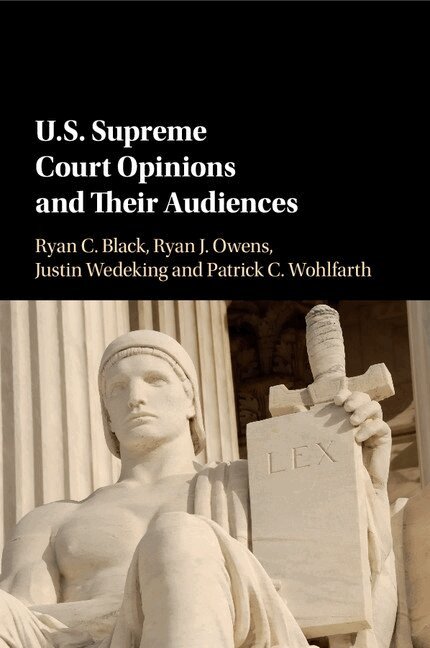
    US Supreme Court Opinions and their Audiences

    AvRyan C. Black,Ryan J. Owens

    Häftad, Engelska, 2017

    302 kr

    Beställningsvara. Skickas inom 10-15 vardagar. Fri frakt över 249 kr.

    Fler format och utgåvor

    Inbunden

    1 240 kr

    Beskrivning

    This book is the first study specifically to investigate the extent to which US Supreme Court justices alter the clarity of their opinions based on expected reactions from their audiences. The authors examine this dynamic by creating a unique measure of opinion clarity and then testing whether the Court writes clearer opinions when it faces ideologically hostile and ideologically scattered lower federal courts; when it decides cases involving poorly performing federal agencies; when it decides cases involving states with less professionalized legislatures and governors; and when it rules against public opinion. The data shows the Court writes clearer opinions in every one of these contexts, and demonstrates that actors are more likely to comply with clearer Court opinions.

    Produktinformation

    • Utgivningsdatum:2017-05-11
    • Mått:152 x 228 x 11 mm
    • Vikt:300 g
    • Format:Häftad
    • Språk:Engelska
    • Antal sidor:196
    • Förlag:Cambridge University Press
    • ISBN:9781316502105

    Utforska kategorier

    • Rättsvetenskap inom Juridik

    Mer om författaren

    Ryan C. Black is Associate Professor of Political Science at Michigan State University. Ryan J. Owens is Professor of Political Science at the University of Wisconsin, Madison. Justin Wedeking is Associate Professor of Political Science at the University of Kentucky. Patrick C. Wohlfarth is Assistant Professor of Government and Politics at the University of Maryland, College Park.

    Recensioner i media

    'The authors present a careful, creative, and wide-ranging inquiry into the causes and effects of clarity in Supreme Court opinions. Their striking findings about the conditions that lead to greater clarity have important implications for our understanding of how justices think about the writing of opinions.' Larry Baum, Ohio State University

    Innehållsförteckning

    • 1. Introduction; 2. A theory: using opinion clarity to enhance compliance and manage public support; 3. Estimating the clarity of Supreme Court opinions; 4. Supreme Court opinions and Federal Circuit Courts; 5. Supreme Court opinions and Federal Agency implementors; 6. Supreme Court opinions and the States; 7. Supreme Court opinions and the secondary population; 8. Establishing compliance as a function of clarity; 9. Conclusion.