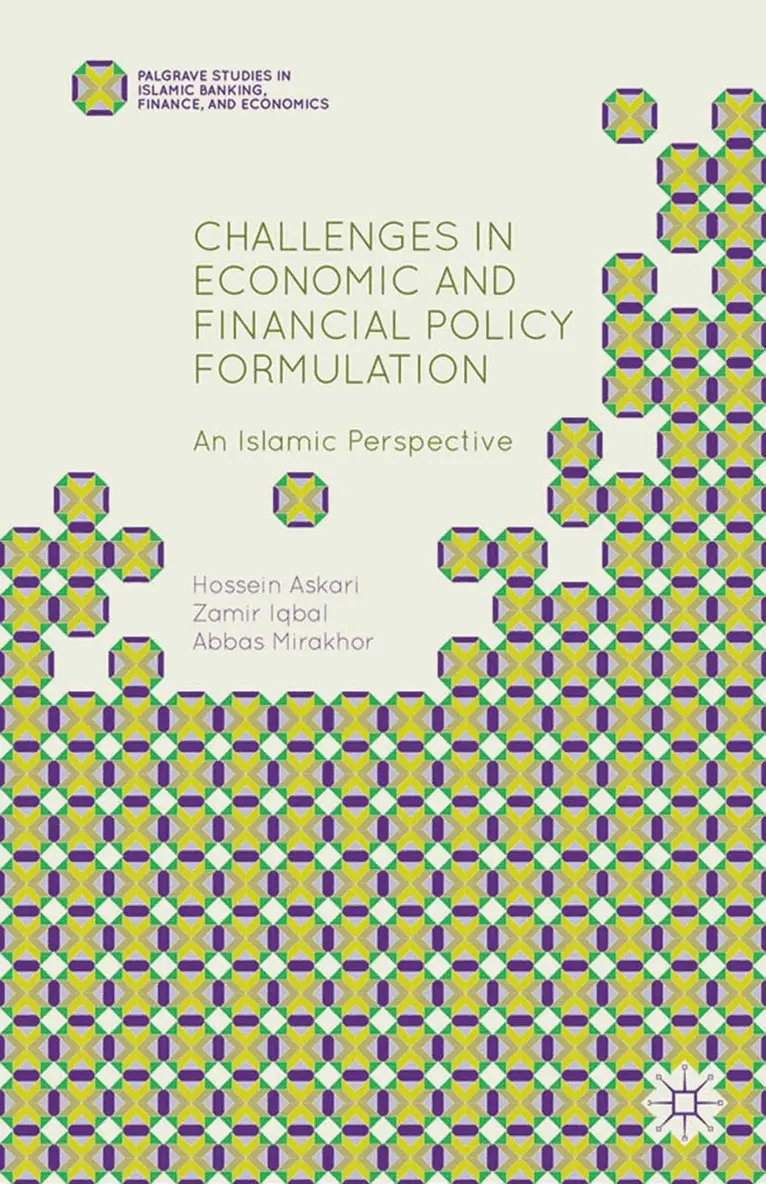
534 kr
Beställningsvara. Skickas inom 10-15 vardagar. Fri frakt över 249 kr.
Fler format och utgåvor
Beskrivning
Produktinformation
- Utgivningsdatum:2014-12-18
- Mått:140 x 216 x 18 mm
- Vikt:405 g
- Format:Häftad
- Språk:Engelska
- Serie:Palgrave Studies in Islamic Banking, Finance, and Economics
- Antal sidor:303
- Upplaga:14001
- Förlag:Palgrave Macmillan
- ISBN:9781349482634
Utforska kategorier
Mer om författaren
Author Hossein Askari: Hossein Askari is Iran Professor of International Business and International Affairs, George Washington University, USA.Author Zamir Iqbal: Dr. Zamir Iqbal serves as Lead Specialist at the Financial Systems Global Practice of the World Bank. He heads the World Bank Global Center for Islamic Finance Development in Istanbul.Author Abbas Mirakhor: Abbas Mirakhor is the First Holder of INCEIF s Chair in Islamic Finance at INCEIF - The Global University of Islamic Finance, Malaysia. He was the Executive Director and Dean of the Executive Board of the International Monetary Fund. He received his PhD from Kansas State University, USA.
Recensioner i media
"This book has succinctly described the fundamental bases for economic and finance policies required to achieve socio-economic justice as perceived by Islam. It emphasizes rule compliance and risk sharing to attain equitable distribution, financial stability, and financial inclusion. It is thought provoking and exciting as it offers a new policy framework for the present crisis-laden world. It is a groundbreaking publication and hence is a must-read for both experts and novices." - Syed Othman Alhabshi, Chief Academic Officer, INCEIF - The Global University of Islamic Finance, Malaysia "Askari, Iqbql, and Mirakhor have produced a comprehensive yet accessible guide to the proper role of the state in an economic system designed in accordance with the tenets of Islam. This is a tour de force not only on Islamic teachings on supervisory mechanisms required for taming unfettered markets, but a comprehensive guide to the evolution of thinking on macro- and developmental economics." - Dariush Zahedi, Director, Berkeley Program on Entrepreneurship and Development in the Middle East, University of California, Berkeley, USA "My congratulations to the authors for their valuable contribution to the subject of Islamic economics and finance. In the aftermath of the global economic and financial crisis there has been an intense debate about the strengths and weaknesses of conventional thinking about economic and financial policy making. While global growth and the explosion of activity in the finance industry has been a welcome sign, there has also been an awakening that market-based economies ought to promote fair and just societies, and for this to happen more reflection is critical on their ideological underpinnings as well as on rules-based management and regulations. In this context, the insights and perspectives offered in this book will benefit conventional thinking and debates, helping others to reflect more deeply on alternate approaches to promoting a fair and just society and a sounder approach to risk-sharing, which is well embedded in the discipline of Islamic economic and finance." - Shamshad Akhtar, Under-Secretary-General of the United Nations and Executive-Secretary of the United Nations Economic and Social Commission for Asia and the Pacific "Islamic finance has been under the spotlight as one of the mostly discussed items within global economic agenda especially after the 2007 financial crisis. Both the underlying principles of and the tools employed by Islamic finance can contribute to the reduction of systemic risks and to the reshaping of the global financial architecture during the post-crisis era. This book, as a masterpiece in its area fills a big gap and provides insight to policy makers, practitioners and academicians by presenting a well-established framework of macroeconomic policy from an Islamic finance point of view." - Ibrahim M. Turhan, CEO, Borsa Istanbul, Turkey
Innehållsförteckning
- 1. Introduction: The Significance of Policy 2. Institutional Perspective of Islamic Economics 3. Economic and Social Justice: A Policy Objective in Islam 4. Risk Sharing Finance and the Role of Public Policy 5. Lessons from Financial Crisis: A Policy Failure? 6. Financial and Capital Market Policies 7. Fiscal and Monetary Policy in Islam 8. Developing Social Capital 9. Financial Inclusion: Implications for Public Policy 10. Environmental and Natural Resource Policies in Islam 11. Benchmarking Islamic Finance Enabling Policies 12. Policy Challenges: Building Institutions
Mer från samma serie
Public Finance and Islamic Capital Markets
Syed Aun R. Rizvi, Obiyathulla I. Bacha, Abbas Mirakhor
1 419 kr
Financing the Development of Old Waqf Properties
Magda Ismail Abdel Mohsin, Hisham Dafterdar, Murat Cizakca, Syed Othman Alhabshi, Shaikh Hamzah Abdul Razak, Seyed Kazem Sadr, Thamina Anwar, Mohammed Obaidullah
1 062 kr
Public Finance and Islamic Capital Markets
Syed Aun R. Rizvi, Obiyathulla I. Bacha, Abbas Mirakhor
1 419 kr
Enhancing Financial Inclusion through Islamic Finance, Volume I
Abdelrahman Elzahi Saaid Ali, Khalifa Mohamed Ali, Muhammad Khaleequzzaman
1 062 kr
Enhancing Financial Inclusion through Islamic Finance, Volume I
Abdelrahman Elzahi Saaid Ali, Khalifa Mohamed Ali, Muhammad Khaleequzzaman
1 062 kr
Du kanske också är intresserad av
Challenges in Economic and Financial Policy Formulation
H. Askari, Z. Iqbal, A. Mirakhor
534 kr
Revisiting Islamic Economics
Nabil El Maghrebi, Abbas Mirakhor, Tarık Akın, Zamir Iqbal
1 378 kr
Revisiting Islamic Economics
Nabil El Maghrebi, Abbas Mirakhor, Tarık Akın, Zamir Iqbal
1 378 kr
Public Finance and Islamic Capital Markets
Syed Aun R. Rizvi, Obiyathulla I. Bacha, Abbas Mirakhor
1 419 kr