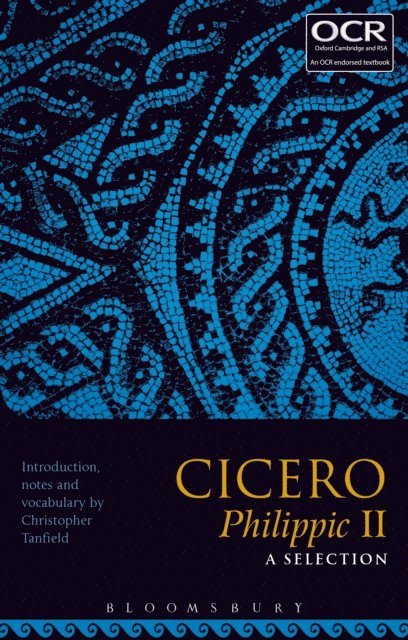
E-bok, Engelska, 2018
Cicero Philippic II: A Selection
341 kr
Läs direkt i Bokus Reader – eller ladda ned till din enhet (PDF kräver ofta zoom och scroll på små skärmar).
Beskrivning
This is the endorsed publication from OCR and Bloomsbury for the Latin AS and A-Level (Group 1) prescription of Cicero''s Philippic II sections 44–50 (… viri tui similis esses) and 78 (C. Caesari ex Hispania redeunti…)–92, and the A-Level (Group 2) prescription of sections 100–119, giving full Latin text, commentary and vocabulary, with a detailed introduction that also covers the prescribed text to be read in English for A Level.
It is 44 BC. Following Caesar''s assassination, his supporters are looking for a new leader. Caesar''s deputy, Antony, and the 18-year-old Octavian, the future Augustus, are vying with each other to fill the role; each seems more concerned with personal power than the good of Rome. Cicero returns to the city to try to save it with the one weapon at his disposal: his oratory.
In this speech, the longest of the Philippics (so-called after a series of speeches made against Philip of Macedon), Cicero starts by defending his own career and then – the part we read - demolishes Antony''s. A masterpiece of invective, it ensures Antony''s bitter hostility and Cicero''s eventual elimination.
Resources are available on the Companion Website www.bloomsbury.com/ocr-editions-2019-2021
It is 44 BC. Following Caesar''s assassination, his supporters are looking for a new leader. Caesar''s deputy, Antony, and the 18-year-old Octavian, the future Augustus, are vying with each other to fill the role; each seems more concerned with personal power than the good of Rome. Cicero returns to the city to try to save it with the one weapon at his disposal: his oratory.
In this speech, the longest of the Philippics (so-called after a series of speeches made against Philip of Macedon), Cicero starts by defending his own career and then – the part we read - demolishes Antony''s. A masterpiece of invective, it ensures Antony''s bitter hostility and Cicero''s eventual elimination.
Resources are available on the Companion Website www.bloomsbury.com/ocr-editions-2019-2021
Produktinformation
- Utgivningsdatum: 2018-05-03
- Språk: Engelska
- Antal sidor: 192
- Filformat: PDF
- Kopieringsskydd: LCP
- ISBN: 9781350010253
- Förlag: Bloomsbury Publishing PLC
Utforska kategorier
Betyg & recensioner
0 recensioner
Inga recensioner tillgängliga.