• Fri frakt över 249 kr
  • •
  • Snabba leveranser
  • •
  • Billiga böcker
Kundservice

Du är på sajten för privatpersoner.

Företag, bibliotek eller offentlig verksamhet?

Du handlar på classic.bokus.com, där alla dina funktioner finns intakta.
Till classic.bokus.com
Bokus logotyp. Gå till startsidan.
  • Erbjudanden
  • Nyheter
  • Student
  • Topplistor
  • Barn & ungdom
  • Bokus Play
  • E-böcker
  • Pocketböcker
  • Spel & pussel

10% rabatt på allt med kod: NYSTART10 →

Sidfot

Mina sidor

    Hjälp

    • Kundservice
    • Vanliga frågor och svar
    • Frakt och leverans
    • Retur vid ångerrätt
    • Reklamera vara
    • Betalning
    • Köpvillkor
    • Allmänna villkor
    • Information om webbplatsens tillgänglighet

    Om Bokus

    • Om oss
    • Pressrum
    • För studenter
    • För företag
    • För bibliotek och offentlig verksamhet
    • För leverantörer
    • Hållbarhet

    Populärt

    • Aktuella erbjudanden
    • Presentkort
    • Studentlitteratur
    • Nya böcker
    • Topplistor
    • Signerade böcker
    • Engelska böcker

    Inspiration

    • Boktips
    • BookTok
    • Populära bokserier
    • Barnbokskaraktärer
    • Populära författare
    Logotyp för Bokus
    Följ oss på Facebook (extern länk)Följ oss på Instagram (extern länk)Följ oss på YouTube (extern länk)Följ oss på TikTok (extern länk)
    bokus @ CookiesAnpassa cookiesIntegritetspolicyKöpvillkor
    Till Citymail hemsida (extern länk)Till Budbee hemsida (extern länk)Till Postnord hemsida (extern länk)Till Schenker hemsida (extern länk)Till Early Bird hemsida (extern länk)Till Walleys hemsida (extern länk)
    1. Skönlitteratur
    2. Dramatik

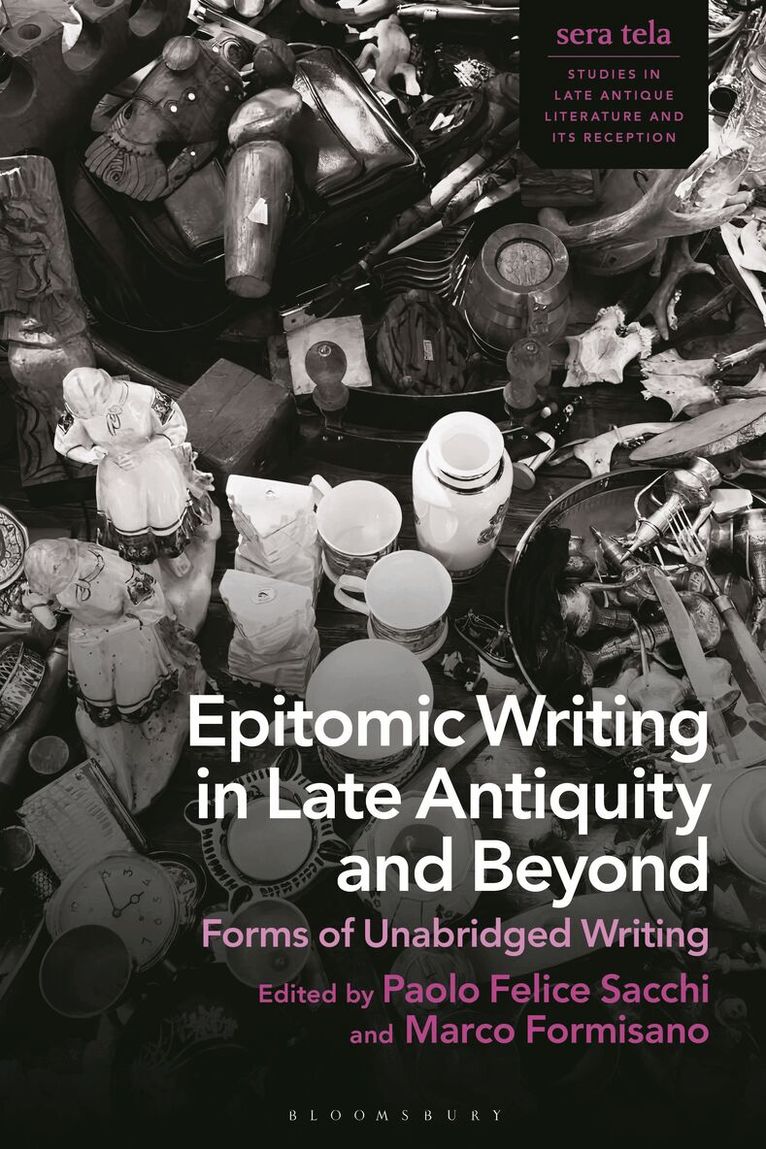
    Epitomic Writing in Late Antiquity and Beyond

    Forms of Unabridged Writing

    AvPaolo Felice Sacchi,Marco Formisano

    Häftad, Engelska, 2024

    Del i serien sera tela: Studies in Late Antique Literature and Its Reception

    487 kr

    Beställningsvara. Skickas inom 10-15 vardagar. Fri frakt över 249 kr.

    Beskrivning

    This volume makes a powerful argument for epitome (combining textual dismemberment and re-composition) as a broad hermeneutic field encompassing multifarious historical, conceptual and aesthetical concerns. The contributors gather from across the globe to present case studies of the 'summing up' of cultural artefacts, literary and artistic, in epitomic writing, and as a collective they demonstrate the importance of this genre that has been largely overlooked by scholars.The volume is divided into five sections: the first showcases the broad range of fields from which epitomic analysis can be made, from classics to postmodernism to cultural memory studies; the second focuses in on epitome as dismemberment in writing from late antiquity to the modern day; the third considers a 'productive negativity' of epitomic writings and how they are useful tools for investigating the very borders and paradoxes of language; the fourth brings this to bear on materiality; the fifth considers re-composition as a counterpart to dismemberment and problematises it.Across the volume, examples are taken from important late antique writers such as Ausonius, Clement of Alexandria, Macrobius, Nepos, Nonius Marcellus and Symphosius, and from modern authors such as Antonin Artaud, Barthes, Nabokov and Pascal Quignard. Epitomic writings about art from decorated tabulae to sarcophagi are also included, as are epitomic images themselves in the form of manuscript illustrations that sum up their text.

    Produktinformation

    • Utgivningsdatum:2024-04-18
    • Mått:154 x 232 x 18 mm
    • Vikt:480 g
    • Format:Häftad
    • Språk:Engelska
    • Serie:sera tela: Studies in Late Antique Literature and Its Reception
    • Antal sidor:316
    • Förlag:Bloomsbury Publishing PLC
    • ISBN:9781350281974

    Utforska kategorier

    • Dramatik inom Skönlitteratur
    • Forntidens historia inom Historia och arkeologi
    • Litteraturvetenskap inom Skönlitteratur

    Mer om författaren

    Paolo Felice Sacchi is a researcher at Ghent University, Belgium.Marco Formisano is Professor of Latin Literature at Ghent University, Belgium. He has published extensively on late antique literature, both prose and poetry, Greek and Roman technical and scientific texts, early Christian martyr acts and classical reception. His publications include Un-learning the Classics: Studies in Late Latin Textuality.

    Innehållsförteckning

    • PrefaceIntroduction Paolo F. Sacchi and Marco Formisano (Ghent University, Belgium)I. Epitomic Dimensions1. Pascal Quignard’s Little Treatises: (Anti)odern Epitomes? Irena Kristeva (University of Sofia, Bulgaria)2. Ausonius Epitomist: Encyclopaedism and Ordering Knowledge in Late Antique Gaul Brian P. Sowers (City University of New York, USA)3. Cato Capitulatim: Nepos the Censor Jared Hudson (Harvard University, USA)4. Epitome and Its Surroundings Between Written and Figural Domain Paolo Liverani (University of Florence, Italy)5. Sarcinatorem esse summum: Nonius Marcellus and the Modern Editor as Textual Frankensteins M. Payne (Leiden University, the Netherlands)II. From the All to the Fragments?6. The Dismembered Truth: Pentheus Dismembered as an Image of the Stromateis Antoine Paris (University of Paris-Sorbonne/ University of Montréal, France/Canada)7. Barthes' Dream at the Collège de France: From Critical Fragments to Literary Re-compositions Mohammad Reza Fallah Nejad (University of Ahvaz, Iran)III. Aenigma and Silence8. Epitomizing Silence: the Apophthegmata Patrum as an Impossible Encyclopaedia of Unknowing Jesús Hernández Lobato (University of Salamanca, Spain)9. Dionysius’ Imaginary Library Virginia Burrus (Syracuse University, USA)10. The Kaleidoscopic World of Symphosius’ Aenigmata Philip Hardie (Cambridge University, UK)IV. Materiality11. 'Disfigured' Writing? The Case of A. Artaud's 503 Notebooks Ana Kiffer (Pontifical Catholic University of Rio, Brazil)12. Visual Epitome in Late Antique Art Jas Elsner (University of Oxford, UK)V. From the Fragments to the All?13. The Aeneid More or Less: The Argumenta of the ‘Twelve Wise Men’ Scott McGill (Rice University, USA)14. A Stubborn Chronophobia. Re-composition, Time and Memory in Pliny the Younger’s Epistulae and Vladimir Nabokov’s Speak Memory Tim Noens (Ghent Univeristy, Belgium)