• Fri frakt över 249 kr
  • •
  • Snabba leveranser
  • •
  • Billiga böcker
Kundservice

Du är på sajten för privatpersoner.

Företag, bibliotek eller offentlig verksamhet?

Du handlar på classic.bokus.com, där alla dina funktioner finns intakta.
Till classic.bokus.com
Bokus logotyp. Gå till startsidan.
  • Erbjudanden
  • Nyheter
  • Student
  • Topplistor
  • Barn & ungdom
  • Bokus Play
  • E-böcker
  • Pocketböcker
  • Spel & pussel

10% studentrabatt med kod TERM26

Sidfot

Mina sidor

    Hjälp

    • Kundservice
    • Vanliga frågor och svar
    • Frakt och leverans
    • Retur vid ångerrätt
    • Reklamera vara
    • Betalning
    • Köpvillkor
    • Allmänna villkor
    • Information om webbplatsens tillgänglighet

    Om Bokus

    • Om oss
    • Pressrum
    • För studenter
    • För företag
    • För bibliotek och offentlig verksamhet
    • För leverantörer
    • Hållbarhet

    Populärt

    • Aktuella erbjudanden
    • Presentkort
    • Studentlitteratur
    • Nya böcker
    • Topplistor
    • Signerade böcker
    • Engelska böcker

    Inspiration

    • Boktips
    • BookTok
    • Populära bokserier
    • Barnbokskaraktärer
    • Populära författare
    Logotyp för Bokus
    Följ oss på Facebook (extern länk)Följ oss på Instagram (extern länk)Följ oss på YouTube (extern länk)Följ oss på TikTok (extern länk)
    bokus @ CookiesAnpassa cookiesIntegritetspolicyKöpvillkor
    Till Citymail hemsida (extern länk)Till Budbee hemsida (extern länk)Till Postnord hemsida (extern länk)Till Schenker hemsida (extern länk)Till Early Bird hemsida (extern länk)Till Walleys hemsida (extern länk)
    1. Historia och arkeologi
    2. Historia
    3. Allmän historia och världshistoria

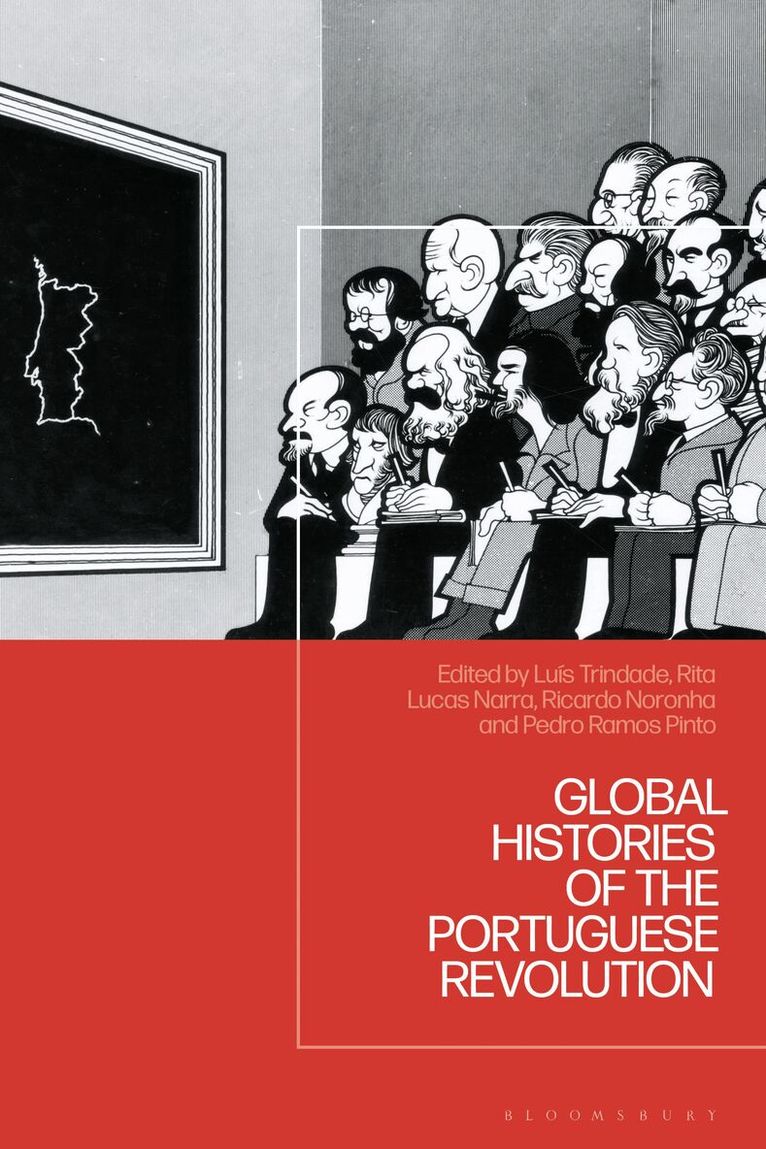
    Global Histories of the Portuguese Revolution

    AvLuís Trindade,Rita Lucas Narra

    Häftad, Engelska, 2026

    416 kr

    Slutsåld

    Beskrivning

    The Portuguese revolution marked the closure of the country’s five-centuries of imperial history as well as its 48-year authoritarian period, a dramatic moment of political radicalization and social conflict that took place against the backdrop of rapid social transformation in an increasingly globalised world. This collection goes beyond the limits of national history to locate the revolution at the intersection of transnational historical phenomena such as the long 1960s, the Cold War, the emergence of the ‘Third World’ and postwar modernization.Foregrounding the complex geographies and chronologies of semi-peripheral Portugal, this book combines its status as the centre of a global Empire with its subaltern position in Europe. Offering a new, global, approach to this still understudied event, chapters explore transnational socialist and grassroots forms of solidarity, processes of global communication and Cultural Revolution, decolonization, feminism, and socio-economic transformations to offer a non-Eurocentric global history from within Europe itself.

    Produktinformation

    • Utgivningsdatum:2026-12-24
    • Mått:156 x 234 x 25 mm
    • Vikt:454 g
    • Format:Häftad
    • Språk:Engelska
    • Antal sidor:264
    • Förlag:Bloomsbury Publishing PLC
    • ISBN:9781350498716

    Utforska kategorier

    • Allmän historia och världshistoria inom Historia och arkeologi
    • Revolutioner och uppror inom Historia och arkeologi
    • Kalla krig och ombudskrig inom Historia och arkeologi

    Mer om författaren

    Luís Trindade is Assistant Professor in Contemporary History at University of Coimbra, Portugal where he is also vice-coordinator of the Centre for Interdisciplinary Studies. Between 2007 and 2019 he taught at Birkbeck, University of London, UK, and he has published on the histories of Marxism, cinema and mass culture in twentieth century Portugal.Rita Lucas Narra is a PhD candidate at Instituto de História Contemporânea, Lisbon, Portugal. Her research focuses on the formation of the idea of the Third World, and its perception in Portugal during the second half of the 20th century.Ricardo Noronha is Researcher at Instituto de História Contemporânea, Lisbon, Portugal. After researching on the development of a Neoliberal intellectual field in Portugal during the last quarter of the Twentieth Century, he is currently working on the topic of economic planning between 1945 and 1980.Pedro Ramos Pinto is Associate Professor in International Economic History at the University of Cambridge, UK. He is the author of Lisbon Rising: Urban Social Movements in the Portuguese Revolution, 1974-1975, as well as a number of publications on the topics of protest and social mobilisation in Portugal before, during and since the Revolution.

    Recensioner i media

    This book will change the way historians think about Portuguese revolution by highlighting its interconnectedness and contribution to global processes. It will also show how the (largely unfulfilled) promise of the Portuguese revolution affected the New Left across Europe.

    Innehållsförteckning

    • Introduction: Rediscovering the global in the Portuguese Revolution - Rita Lucas Narra, Ricardo Noronha, Luís Trindade, and Pedro Ramos Pinto (New University of Lisbon, Portugal and University of Cambridge UK)Section I. Making a Revolution in an Age of Revolutions1. ‘Only technically European’: the Portuguese Revolution and the spectre of the Third World – Rita Lucas Narra (New University of Lisbon, Portugal)2. South by Southwest: Global Socialism and the Political Economy of the Portuguese Revolution (1974-1975) – Ricardo Noronha (New University of Lisbon, Portugal)3. Cuba and the Portuguese Revolution: affinities, proximities, ruptures – Raquel Ribeiro (University of Edinburgh, UK)4. Last hopes: the Portuguese Revolution and the crisis of the revolutionary left in the 1970s – Pedro Ramos Pinto (University of Cambridge, UK)Section II. Revolutionary Subjectivities5. Portuguese Women during the Carnation Revolution: national context and global connections – Giulia Strippoli (New University of Lisbon, Portugal)6. ‘The Freest Country in the World’: The Portuguese Revolution and the deep history of emancipation – Luís Trindade (New University of Lisbon, Portugal)7. The contained and retained sexual revolution – Isabel Freire (University of Lisbon, Portugal)Section III. Between Global Cold War and Decolonisation 8. The colonial war and the end of Portuguese colonialism: trajectories and impacts – Miguel Cardina (University of Coimbra, Portugal)9. ‘We have with us the majority of the countries of the world’: Portugal and the New Information and Communication Order – Rita Luís (New University of Lisbon, Portugal)10. European Social Democracy and the Portuguese Revolution: a two-way influence – Alan Granadino (Complutense University of Madrid, Spain)11. Momentous but unexceptional: writing the returnees back into the Portuguese Revolution – Christoph Kalter (University of Agder, Norway)Afterword: The Portuguese Revolution: Highpoint and Endpoint of a Transnational Mobilization Cycle (1956-1976) – Gerd-Rainer Horn (SciencesPo, Paris, France)