• Fri frakt över 249 kr
  • •
  • Snabba leveranser
  • •
  • Billiga böcker
Kundservice

Du är på sajten för privatpersoner.

Företag, bibliotek eller offentlig verksamhet?

Du handlar på classic.bokus.com, där alla dina funktioner finns intakta.
Till classic.bokus.com
Bokus logotyp. Gå till startsidan.
  • Erbjudanden
  • Nyheter
  • Student
  • Topplistor
  • Barn & ungdom
  • Bokus Play
  • E-böcker
  • Pocketböcker
  • Spel & pussel

10% rabatt på allt med kod: NYSTART10 →

Sidfot

Mina sidor

    Hjälp

    • Kundservice
    • Vanliga frågor och svar
    • Frakt och leverans
    • Retur vid ångerrätt
    • Reklamera vara
    • Betalning
    • Köpvillkor
    • Allmänna villkor
    • Information om webbplatsens tillgänglighet

    Om Bokus

    • Om oss
    • Pressrum
    • För studenter
    • För företag
    • För bibliotek och offentlig verksamhet
    • För leverantörer
    • Hållbarhet

    Populärt

    • Aktuella erbjudanden
    • Presentkort
    • Studentlitteratur
    • Nya böcker
    • Topplistor
    • Signerade böcker
    • Engelska böcker

    Inspiration

    • Boktips
    • BookTok
    • Populära bokserier
    • Barnbokskaraktärer
    • Populära författare
    Logotyp för Bokus
    Följ oss på Facebook (extern länk)Följ oss på Instagram (extern länk)Följ oss på YouTube (extern länk)Följ oss på TikTok (extern länk)
    bokus @ CookiesAnpassa cookiesIntegritetspolicyKöpvillkor
    Till Citymail hemsida (extern länk)Till Budbee hemsida (extern länk)Till Postnord hemsida (extern länk)Till Schenker hemsida (extern länk)Till Early Bird hemsida (extern länk)Till Walleys hemsida (extern länk)
    1. Språk och ordböcker
    2. Språkvetenskap och lingvistik

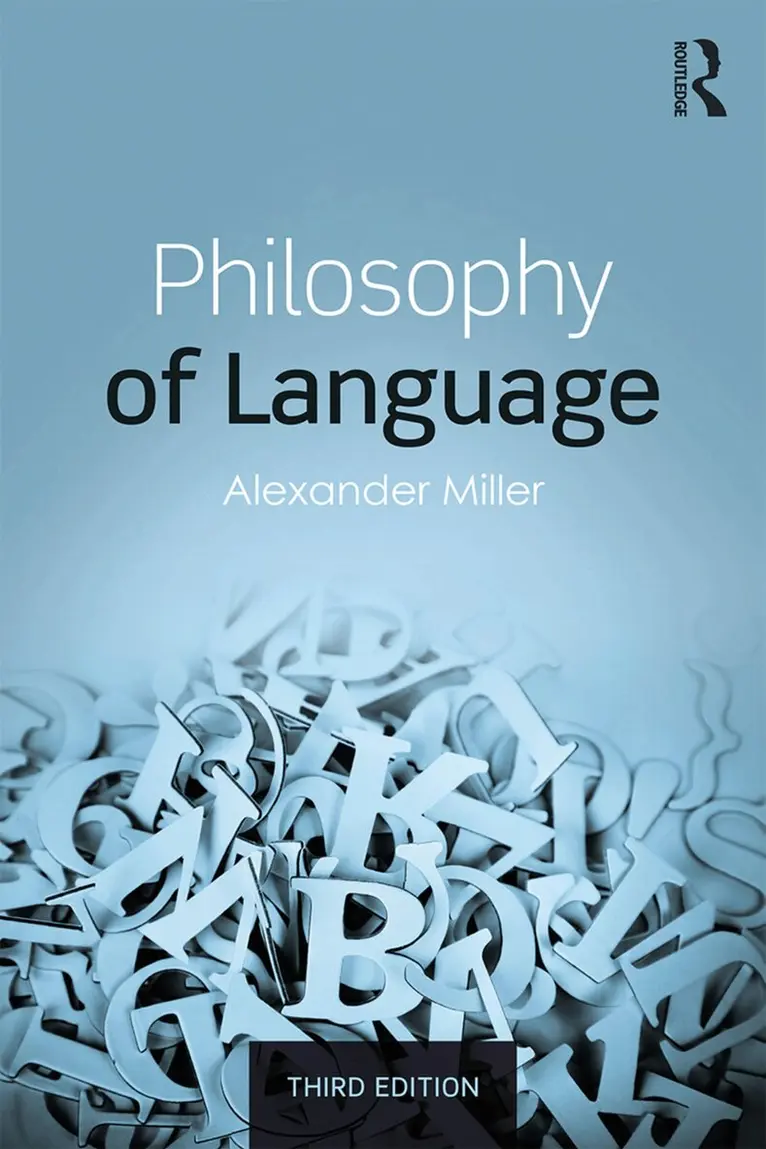
    Philosophy of Language

    AvAlexender Miller

    E-bok
    Engelska, 2018

    721 kr

    Läs direkt i Bokus Reader – eller ladda ned till din enhet

    Fler format och utgåvor

    Inbunden

    2 423 kr

    Häftad

    611 kr

    E-bok

    721 kr

    Beskrivning

    Philosophy of Language provides a comprehensive, meticulous survey of twentieth-century and contemporary philosophical theories of meaning. Interweaving the historical development of the subject with a thematic overview of the different approaches to meaning, the book provides students with the tools necessary to understand contemporary analytic philosophy. Beginning with a systematic look at Frege’s foundational theories on sense and reference, Alexander Miller goes on to offer a clear exposition of the development of subsequent arguments in the philosophy of language. Communicating a sense of active philosophical debate, the author confronts the views of the early theorists, taking in Frege, Russell, and logical positivism and going on to discuss the scepticism of Quine, Kripke, and Wittgenstein. The work of philosophers such as Davidson, Dummett, Searle, Fodor, McGinn, Wright, Grice, and Tarski is also examined in depth.The third edition has been fully revised for enhanced clarity and includes:· a short introduction for students, outlining the importance of the philosophy of language and the aims of the book;· two substantial new sections on Philip Pettit’s "ethocentric" account of rule-following and on Hannah Ginsborg’s "partial reductionism" about rule-following and meaning;· the addition of chapter summaries and study questions throughout, designed to promote greater understanding and engagement;· updated guides to further reading at the end of every chapter.This well-established and sophisticated introduction to the philosophy of language is an unrivalled guide to one of the liveliest and most challenging areas of philosophy and is suitable for use on undergraduate degrees and in postgraduate study.

    Produktinformation

    • Utgivningsdatum:2018-01-17
    • Språk:Engelska
    • Filformat:EPUB
    • Kopieringsskydd:LCP
    • ISBN:9781351265508
    • Förlag:Taylor & Francis Ltd
    • Upplaga:3

    Utforska kategorier

    • Språkvetenskap och lingvistik inom Språk och ordböcker
    • Filosofi inom Filosofi och religion

    Mer om författaren

    Alexander Miller is Professor of Philosophy at the University of Otago, New Zealand. He is author of Contemporary Metaethics: An Introduction (Polity Press, second edition, 2013), co-editor of Rule-Following and Meaning (Acumen, 2002) and co-editor of A Companion to the Philosophy of Language (second edition, Wiley-Blackwell, 2017).

    Recensioner i media

    "This book has been on my reading list for philosophy of language since the first edition; I’m delighted to see this new edition, with additions, such as study questions, and updated suggestions for further reading that will enhance its value for students."Michael Beaney, Humboldt University, Germany, and King’s College London, UK"The third edition of Philosophy of Language provides an exceptionally lucid and accessible overview of both the history of the subject and contemporary debates. Miller covers the topics that are likely to appear on any undergraduate syllabus but he does so with a refreshing twist, emphasising the meta-semantic question, 'what constitutes meaning?’. Miller delves into fundamental questions concerning the connections between language, mind and reality, and conveys the centrality of the study of language to philosophy. The book will be an invaluable resource for introducing undergraduates to the subject." Anandi Hattiangadi, Stockholm University, Sweden

    Innehållsförteckning

    • Preface to the first editionPreface to second edition Preface to the third edition Acknowledgements, first edition Acknowledgements, second editionAcknowledgements, third editionIntroduction1 Frege: Semantic value and reference 1.1 Frege’s logical language 1.2 Syntax 1.3 Semantics and truth 1.4 Sentences and proper names 1.5 Function and object 1.6 Predicates, connectives and quantifiers 1.7 A semantic theory for a simple language Chapter summaryStudy questionsFurther Reading 2 Frege and Russell: Sense and definite descriptions 2.1 The introduction of sense 2.2 The nature of sense 2.3 The objectivity of sense: Frege’s critique of Locke 2.4 Four problems with Frege’s notion of sense 2.5 Kripke on naming and necessity 2.6 A theory of sense? 2.7 Force and tone 2.8 Russell on names and descriptions 2.9 Scope distinctions 2.10 Russell’s attack on sense 2.11 Russell on communication 2.12 Strawson and Donnellan on referring and definite descriptions 2.13 Kripke’s causal-historical theory of reference 2.14 Appendix: Frege’s theses on sense and semantic value Chapter summaryStudy questionsFurther reading3 Sense and verificationism: Logical positivism 3.1 From the Tractatus to the verification principle 3.2 The formulation of the verification principle 3.3 Foster on the nature of the verification principle 3.4 The a priori and the linguistic theory of necessity3.5 Carnap on internal and external questions 3.6 Logical positivism and ethical language 3.7 Moderate holismChapter summaryStudy questionsFurther reading 4 Scepticism about sense (I): Quine on analyticity and translation 4.1 Quine’s attack on the analytic-synthetic distinction: Introduction 4.2 The argument of "Two Dogmas" (part I) 4.3 Criticism of "Two Dogmas" (part I)4.4 The argument of "Two Dogmas" (part II) 4.5 Criticism of "Two Dogmas" (part II) 4.6 Quine on the indeterminacy of translation: Introduction4.7 The argument from below 4.8 Evans and Hookway on the argument from below 4.9 The argument from above 4.10 Conclusion Chapter summaryStudy questionsFurther Reading5 Scepticism about sense (II):Kripke’s Wittgenstein and the skeptical paradox5.1 The sceptical paradox 5.2 The sceptical solution and the argument against solitary language 5.3 Boghossian’s argument against the sceptical solution 5.4 Wright’s objections to the sceptical solution 5.5 Zalabardo’s objection to the sceptical solution 5.6 The normativity of meaning? 5.7 "Factualist" interpretations of Kripke’s Wittgenstein Chapter summaryStudy questionsFurther reading6 Saving sense: Responses to the sceptical paradox 6.1 Linguistic meaning and mental content 6.2 Sophisticated dispositionalism 6.3 Lewis-style reductionism and ultra-sophisticated dispositionalism 6.4 Fodor's "asymmetric dependency" account of meaning6.5 McGinn on normativity and the ability conception of understanding 6.6 Wright’s judgement-dependent conception of meaning 6.7 Pettit’s "ethocentric" account6.8 Wittgenstein’s dissolution of the sceptical paradox? 6.9 Ginsborg’s "partial reductionism" Chapter summaryStudy questionsFurther Reading7 Sense, intention and speech acts: Grice’s programme 7.1 Homeric struggles: Two approaches to sense 7.2 Grice on speaker’s-meaning and sentence-meaning 7.3 Searle’s modifications: Illocutionary and perlocutionary intentions 7.4 Objections to Gricean analyses 7.5 Response to Blackburn 7.6 Strawson on referring revisited Chapter summaryStudy questionsFurther Reading8 Sense and Truth: Tarski and Davidson 8.1 Davidson and Frege8.2 Davidson’s adequacy conditions for theories of meaning8.3 Intensional and extensional theories of meaning8.4 Extensional adequacy and Tarski’s Convention (T)8.5 Tarskian truth-theories8.6 Truth and translation: Two problems for Davidson8.7 Radical interpretation and the principle of charity8.8 Holism and T-theorems8.9 Conclusion: Theories of meaning and natural languageChapter summaryStudy questionsFurther Reading9 Sense, world and metaphysics 9.1 Realism 9.2 Non-cognitivism and the Frege-Geach problem 9.3 Realism and verification-transcendent truth 9.4 Acquisition, manifestation and rule-following: the arguments against verification-transcendent truth 9.5 Twin-Earth, meaning, mind, and world 9.6 Grades of objectivity: Wright on anti-realism 9.7 Two threats of quietism Chapter summaryStudy questionsFurther readingBibliography Index