• Fri frakt över 249 kr
  • •
  • Snabba leveranser
  • •
  • Billiga böcker
Kundservice

Du är på sajten för privatpersoner.

Företag, bibliotek eller offentlig verksamhet?

Du handlar på classic.bokus.com, där alla dina funktioner finns intakta.
Till classic.bokus.com
Bokus logotyp. Gå till startsidan.
  • Erbjudanden
  • Nyheter
  • Student
  • Topplistor
  • Barn & ungdom
  • Bokus Play
  • E-böcker
  • Pocketböcker
  • Spel & pussel

10% rabatt på allt med kod NYSTART10 →

Sidfot

Mina sidor

    Hjälp

    • Kundservice
    • Vanliga frågor och svar
    • Frakt och leverans
    • Retur vid ångerrätt
    • Reklamera vara
    • Betalning
    • Köpvillkor
    • Allmänna villkor
    • Information om webbplatsens tillgänglighet

    Om Bokus

    • Om oss
    • Pressrum
    • För studenter
    • För företag
    • För bibliotek och offentlig verksamhet
    • För leverantörer
    • Hållbarhet

    Populärt

    • Aktuella erbjudanden
    • Presentkort
    • Studentlitteratur
    • Nya böcker
    • Topplistor
    • Signerade böcker
    • Engelska böcker

    Inspiration

    • Boktips
    • BookTok
    • Populära bokserier
    • Barnbokskaraktärer
    • Populära författare
    Logotyp för Bokus
    Följ oss på Facebook (extern länk)Följ oss på Instagram (extern länk)Följ oss på YouTube (extern länk)Följ oss på TikTok (extern länk)
    bokus @ CookiesAnpassa cookiesIntegritetspolicyKöpvillkor
    Till Citymail hemsida (extern länk)Till Budbee hemsida (extern länk)Till Postnord hemsida (extern länk)Till Schenker hemsida (extern länk)Till Early Bird hemsida (extern länk)Till Walleys hemsida (extern länk)
    1. Läromedel
    2. Läromedel: matematik och naturvetenskap
    3. Läromedel: naturorienterande ämnen

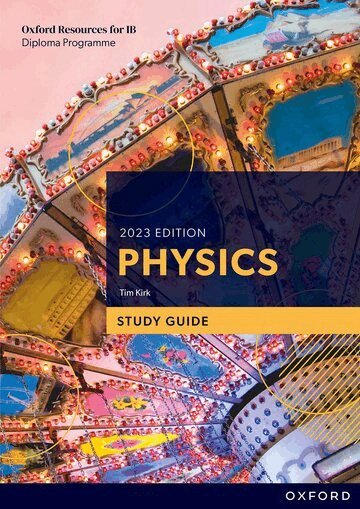
    Oxford Resources for IB DP Physics: Study Guide

    AvTim Kirk

    Häftad, Engelska, 2023

    Del i serien Oxford Resources for IB DP Physics

    576 kr

    Beställningsvara. Skickas inom 5-8 vardagar. Fri frakt över 249 kr.

    Beskrivning

    Please note this title is suitable for any student studying:Exam Board: International Baccalaureate (IB)Level and subject: Diploma Programme (DP) PhysicsFirst teaching: 2023First exams: 2025The Oxford Resources for IB DP Physics: Study Guide is an accessible, student-friendly resource fully aligned to and focused on the knowledge contents of the 2023 DP Physics subject guide. It is designed to be used alongside the Course Book to help students focus on crucial concepts and skills to build confidence, reinforce essential theory, and cement understanding of SL and HL ideas in an easy-to-digest bitesize format. Concise explanations, diagrams, and practical notes engage learners and provide a supportive framework for developing subject comprehension and encouraging a good approach to revision. Clear and accessible language throughout supports EAL learners.

    Produktinformation

    • Utgivningsdatum:2023-10-05
    • Mått:210 x 297 x 10 mm
    • Vikt:578 g
    • Format:Häftad
    • Språk:Engelska
    • Serie:Oxford Resources for IB DP Physics
    • Antal sidor:216
    • Upplaga:1
    • Förlag:OUP OXFORD
    • ISBN:9781382016698

    Utforska kategorier

    • Läromedel: naturorienterande ämnen inom Läromedel

    Recensioner i media

    Your IB study guides are lifelines for many of our students! That resource is jam-packed with relevant info.

    Innehållsförteckning

    • Contents A.1 Kinematics Motion Graphical representation of motion Uniformly accelerated motion Projectile motion Fluid resistance and free-fall End of topic questions A.2 Forces and momentum Forces and free-body diagrams Newton’s first law Equilibrium and force types Viscosity and buoyancy Newton’s second law Newton’s third law Mass and weight Solid friction Momentum and impulse Elastic and inelastic collisions Uniform circular motion Angular velocity and vertical circular motion End of topic questions A.3 Work, energy and power Energy and power Work Energy and power generation — Sankey diagrams Energy sources End of topic questions A.4 Rigid body mechanics Translational and rotational motion Translational and rotational relationships Translational and rotational equilibrium Equilibrium examples Moment of inertia Rotational dynamics Solving rotational problems End of topic questions A.5 Galilean and special relativity Reference frames Special relativity Simultaneity Lorentz transformations Velocity addition Invariant quantities Time dilation Length contraction and evidence to support special relativity Spacetime diagrams End of topic questions B.1 Thermal energy transfers Thermal concepts Heat and internal energy Specific heat capacity Phases (states) of matter and latent heat Thermal energy transfer Radiation Mathematics of conduction Radiation: Wien’s law and the Stefan–Boltzmann law Stellar spectra Luminosity End of topic questions B.2 Greenhouse effect Equilibrium temperature of a planet Solar power The greenhouse effect Global warming End of topic questions B.3 Gas laws The gas laws Molecular model of an ideal gas End of topic questions B.4 Thermodynamics Thermodynamic systems and concepts Work done by an ideal gas The first law of thermodynamics Second law of thermodynamics and entropy Heat engines and heat pumps End of topic questions B.5 Current and circuits Electric current Internal resistance and cells Electric circuits Resistors in series and parallel Potential divider circuits and sensors Resistivity End of topic questions C.1 Simple harmonic motion Oscillations Simple harmonic motion Graphs of simple harmonic motion Phase angle and energy equations End of topic questions C.2 Wave model Travelling waves Wave characteristics Electromagnetic spectrum End of topic questions C.3 Wave phenomena Wavefronts and reflection Snell’s law and refractive index Refraction and critical angle Diffraction Superposition Two-source interference of waves Mathematics of diffraction Young’s double slit experiment Multiple-slit diffraction End of topic questions C.4 Standing waves and resonance Nature and production of standing (stationary) waves Boundary conditions Forced oscillations and resonance End of topic questions C.5 Doppler effect The Doppler effect Examples and applications of the Doppler effect Mathematics of the Doppler effect End of topic questions D.1 Gravitational fields Kepler’s laws and Newton’s law of gravitation Gravitational field strength Kepler’s three laws derived from Newton’s law of gravitation Gravitational potential energy and potential Gravitational potential gradient and equipotentials Energy of an orbiting satellite End of topic questions D.2 Electric and magnetic fields Electric charge and Coulomb’s law Electric fields Millikan’s experiment—quantization of electric charge Magnetic force and fields Electric potential energy and potential Electric and gravitational potentials compared Electric and gravitational fields compared End of topic questions D.3 Motion in electromagnetic fields Motion of a charged particle in an electric field Magnetic forces Motion of a charged particle in perpendicularly oriented uniform electric and magnetic fields Examples of the magnetic field due to currents End of topic questions D.4 Induction Induced electromotive force (emf) Lenz’s law and Faraday’s law Using induction End of topic questions E.1 Structure of the atom Structure of matter Emission and absorption spectra The nucleus Atomic spectra and atomic energy states Bohr model of the atom End of topic questions E.2 Quantum physics Photoelectric effect Matter waves The Compton effect End of topic questions E.3 Radioactive decay Nuclear stability Nuclear reactions Fission and fusion Fundamental forces Radioactivity Half-life Uses of radioactivity Evidence for the strong nuclear force Nuclear energy levels and radioactive decay End of topic questions E.4 Structure of the atom Nuclear power—process Nuclear power—safety and risks End of topic questions E.5 Fusion and stars The nature of stars Nuclear fusion Red giant stars The Hertzsprung–Russell diagram Stellar evolution Stellar parallax End of topic questions T.1 Experimental techniques Safety and measuring variables T.2 Technology Applying technology to collect and process data T.3 Mathematics Algebra, trigonometry, rates of change and averages Estimations, variables, relationships and scale diagrams Vectors and scalars Range of magnitudes of quantities in our universe The SI system of fundamental and derived units SI units Dimensional analysis and significant figures Uncertainties and error in experimental measurement Uncertainties in calculated results Tables and graphs Graphs Graphical analysis and determination of relationships Graphical analysis—logarithmic functions Uncertainties in graphs I.1 Exploring and designing Exploring and designing Controlling variables I.2 Calculating and processing data Collecting and processing data Interpreting results I.3 Concluding and evaluating Concluding and evaluating End of topic questions—Tools in the study of physics Answers Index