• Fri frakt över 249 kr
  • •
  • Snabba leveranser
  • •
  • Billiga böcker
Kundservice

Du är på sajten för privatpersoner.

Företag, bibliotek eller offentlig verksamhet?

Du handlar på classic.bokus.com, där alla dina funktioner finns intakta.
Till classic.bokus.com
Bokus logotyp. Gå till startsidan.
  • Erbjudanden
  • Nyheter
  • Student
  • Topplistor
  • Barn & ungdom
  • Bokus Play
  • E-böcker
  • Pocketböcker
  • Spel & pussel

10% rabatt på allt med kod: NYSTART10 →

Sidfot

Mina sidor

    Hjälp

    • Kundservice
    • Vanliga frågor och svar
    • Frakt och leverans
    • Retur vid ångerrätt
    • Reklamera vara
    • Betalning
    • Köpvillkor
    • Allmänna villkor
    • Information om webbplatsens tillgänglighet

    Om Bokus

    • Om oss
    • Pressrum
    • För studenter
    • För företag
    • För bibliotek och offentlig verksamhet
    • För leverantörer
    • Hållbarhet

    Populärt

    • Aktuella erbjudanden
    • Presentkort
    • Studentlitteratur
    • Nya böcker
    • Topplistor
    • Signerade böcker
    • Engelska böcker

    Inspiration

    • Boktips
    • BookTok
    • Populära bokserier
    • Barnbokskaraktärer
    • Populära författare
    Logotyp för Bokus
    Följ oss på Facebook (extern länk)Följ oss på Instagram (extern länk)Följ oss på YouTube (extern länk)Följ oss på TikTok (extern länk)
    bokus @ CookiesAnpassa cookiesIntegritetspolicyKöpvillkor
    Till Citymail hemsida (extern länk)Till Budbee hemsida (extern länk)Till Postnord hemsida (extern länk)Till Schenker hemsida (extern länk)Till Early Bird hemsida (extern länk)Till Walleys hemsida (extern länk)
    1. Data och IT
    2. Informationsteknik: allmänt

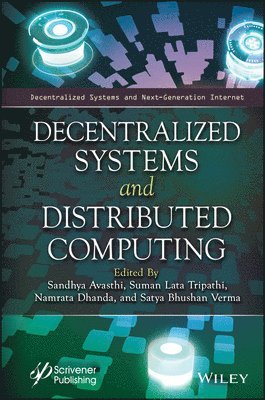
    Decentralized Systems and Distributed Computing

    AvSandhya Avasthi,Sandhya Avasthi

    Inbunden, Engelska, 2025

    Del i serien Wiley-Scrivener

    2 140 kr

    Beställningsvara. Skickas inom 5-8 vardagar. Fri frakt över 249 kr.

    Beskrivning

    This book provides a comprehensive exploration of next-generation internet, distributed systems, and distributed computing, offering valuable insights into their impact on society and the future of technology. The use of distributed systems is a big step forward in IT and computer science. As the number of tasks that depend on each other grows, a single machine can no longer handle all of them. Distributed computing is better than traditional computer settings in several ways. Distributed systems reduce the risks of a single point of failure, making them more reliable and able to handle mistakes. Most modern distributed systems are made to be scalable, which means that processing power can be added on the fly to improve performance. The internet of the future is meant to give us freedom and choices, encourage diversity and decentralization, and make it easier for people to be creative and do research. By making the internet more three-dimensional and immersive, the metaverse could introduce more ways to use it. Some people have expressed negative things about the metaverse, and there is much uncertainty regarding its future. Analysts in the field have pondered if the metaverse will differ much from our current digital experiences, and if so, whether people will be willing to spend hours per day exploring virtual space while wearing a headset. This book will look at the different aspects of the next-generation internet, distributed systems, distributed computing, and their effects on society as a whole.

    Produktinformation

    • Utgivningsdatum:2025-07-02
    • Mått:152 x 229 x 22 mm
    • Vikt:680 g
    • Format:Inbunden
    • Språk:Engelska
    • Serie:Wiley-Scrivener
    • Antal sidor:400
    • Förlag:John Wiley & Sons Inc
    • ISBN:9781394204366

    Utforska kategorier

    • Informationsteknik: allmänt inom Data och IT

    Mer om författaren

    Sandhya Avasthi, PhD, is an assistant professor in the Computer Science and Engineering Department at ABES Engineering College, Dr. Abdul Kalam Technical University, Ghaziabad, India. She has more than 17 years of teaching experience and is an active researcher in the field of machine learning and data mining. She has published numerous research articles in international journals, conference proceedings, and book chapters. She is associated as senior member the Institute of Electrical and Electronics Engineers and the Association for Computing Machinery and is continuously involved in different professional activities along with academic work. Suman Lata Tripathi, PhD, is a professor at Lovely Professional University with more than 17 years of experience in academics. She has published more than 89 research papers, as well as 13 Indian patents and 4 copyrights. She has organized several workshops, summer internships, and expert lectures for students and has worked as a session chair, conference steering committee member, editorial board member, and peer reviewer in national and international journals and conferences. She has edited and authored more than 14 books and one book series in different areas of electronics and electrical engineering. Namrata Dhanda, PhD, is a professor in the Department of Computer Science and Engineering at Amity University, Uttar Pradesh, Lucknow. She has over 21 years of experience teaching graduate and post-graduate students. Currently, she is guiding a large number of PhD scholars working in the domains of machine learning, data science, and big data analytics. Additionally, she has more than 50 papers published in reputed journals, national and international conferences, and book chapters. Satya Bhushan Verma, PhD, is working as an associate professor and head of the Department of Computer Science and Engineering, Institute of Technology in Shri Ramswaroop Memorial University Lucknow-Deva Road, India. He has five years of teaching experience at the undergraduate and post graduate levels, as well as research experience. Additionally, he has been actively involved in a number of international committees as an abstract reviewer, workshop reviewer, and panel reviewer and has published several research papers in various journals, conferences, and symposia of national and international recognition.

    Innehållsförteckning

    • Preface xix1 Introduction to Next-Generation Internet and Distributed Systems 1Swapnil Gupta, Rajat Verma and Namrata Dhanda1.1 Introduction 21.2 Traditional Network 41.3 Next-Generation Internet 51.4 Network Middleware 81.5 Software-Defined Network (SDN) 91.6 Edge Cloud-Based Next-Generation Internet 111.7 Network Architecture 131.8 Security and Safety 201.9 Distributed Systems 201.10 Distributed System Design 221.11 Distributed System Monitoring 231.12 Security in Distributed Systems 251.13 Blockchain and Distributed Systems 251.14 Blockchain-Based Distributed Control Systems 271.15 Blockchain for Distributed System Security 291.16 Conclusion and Future Scope 302 Decentralized System in Education and Research 35Prashant Verma, Deepaks M. Ratnani, Shikha Verma and Sandhya Avasthi2.1 Introduction 362.2 History of Decentralization in the Education System 382.3 Advantages and Challenges of Decentralization of the Education System 392.4 Impact of Decentralization in Education and Research 422.5 Current Approaches 442.6 Development Trend Towards Education and Research 462.7 Future Scope and Recommendations 472.8 Conclusion 483 Architecture of Blockchain-Enabled Decentralized Systems 53Rohit Kumar, Sandhya Avasthi and Suman Lata Tripathi3.1 Introduction 543.2 What is a Decentralized System? 543.3 Blockchain 573.4 Smart Contracts and Its Examples 593.5 Blockchain-Enabled Decentralized System 603.6 Architecture for the Blockchain-Enabled Decentralized System 643.7 Decentralized Todo App with Blockchain 673.8 Blockchain-Enabled Decentralized System Development and Challenges 713.9 Future of the Blockchain-Enabled Decentralized System 723.10 Conclusion 734 Mobile Edge Computing for Decentralized Systems 75Swati Gupta and Puneet Garg4.1 Introduction 764.2 Edge Computing 794.3 Benefits of Edge Computing 814.4 Classification of Attacks in a 5G IoT System 834.5 Decentralized Dynamic Computation Offloading Method 844.6 Conclusion 855 Blockchain in Education 89Shahnaz Fatima and Guru Dev Singh5.1 Introduction 895.2 Benefits of Blockchain in Education 915.3 Challenges of Blockchain in Education 995.4 Use Cases of Blockchain in Education 1065.5 Conclusion 1106 Pattern Recognition Applications in Distributed Systems and Distributed Machine Learning 117Kalyani S., Swarup K. S., Sandhya Avasthi and Tanushree Sanwal6.1 Introduction 1186.2 Data Generation and Preprocessing 1206.3 Feature Selection 1216.4 Design of Classifier 1306.5 Designing Machine Learning Models for Distributed Environment 1386.6 Role of Distributed Computing in Pattern Recognition 1396.7 Conclusion 1417 Next-Generation Distributed Computing for Cancer Detection 145Kapil Kumar Gupta, Namrata Dhanda and Neeraj Kumar7.1 Introduction 1467.2 Research Motivation 1477.3 Cancer Statistics 1487.4 Modern Cancer Diagnosis and Treatment Methods 1497.5 Methodology 1527.6 Technical Challenges 1537.7 Future Directions 1547.8 Conclusion 1568 Benefits and Challenges of Decentralization in Education for Resource Optimization and Improved Performance 163Ankita Singh, Shobhit Sinha, Satya Bhushan Verma and Bipin Kumar Singh8.1 Introduction 1648.2 The Centralization and Decentralization Concepts 1678.3 Decentralized Systems in Education and Research: Policies and Practices 1698.4 Building Capacity Across and Between Levels Within Education Systems 1748.5 Developing Accountability Measures and Systems in Implementing a Decentralized Education Policy 1758.6 Developing Local-Level Capacity Across All Education System Levels and Sectors 1768.7 Education Policies in India to Achieve Decentralization in Education Systems 1788.8 Research and Development Policies in India and Promoting Decentralization in R&D 1809 Blockchain in Data Security and Transparency in Business Transactions 189Rajat Verma and Namrata Dhanda9.1 Introduction 1909.2 Dimensions and Requirements of Data Security 1919.3 Security Issues in Conventional Data Security 1939.4 Diversity of Attacks in Conventional Data Security 1959.5 Blockchain: The Complete Solution 1969.6 The Decentralized and Immutable Approach 1989.7 Comparison of ECC and RSA 1999.8 Digital Signature Algorithm 2009.9 Blockchain Technology Ensures Transparency 2019.10 Blockchain Solutions for Traditional Data Security 2019.11 Blockchain Types 2039.12 Conclusion 20510 A Comparative Study of Ad Hoc and Wireless Sensor Networks 215Ankita Kumari and Ajita Pathak10.1 Introduction 21510.2 Ad Hoc Network 21710.3 Wireless Sensor and Network 22110.4 Challenges, Applications, and Limitations 22510.5 Conclusion 22611 Content Filtering-Based Movie Recommendation System Using Deep Learning 229Atul Srivastava and Abhi Raj Singh11.1 Introduction 23011.2 Related Work 23211.3 Method and Material 23511.4 Experiments and Results 23611.5 Possible Extension of Proposed Model into Distributed Environment 23911.6 Conclusion 24012 Mobile Edge Computing: A Paradigm Shift in Computing 243Priti Kumari, Vandana Dubey, Parmeet Kaur and Sarika Shrivastava12.1 Introduction 24312.2 Why is MEC Important? 24512.3 Background 24612.4 Characteristics 24712.5 Reference Architecture 24812.6 Mobile Edge Computing Key Enablers 25312.7 Advantages of Mobile Edge Computing 25412.8 Potential Research Directions 25512.9 Challenges and Issues 25712.10 Conclusion 25913 Descriptive Analysis of the Potential of 5G Technologies in Empowering Decentralized Systems 263Megha Agarwal, Shahnawaz Alam, Dewansh, Avni Singh and Snehil Singh13.1 Introduction 26413.2 Building 5G Network 26713.3 Blockchain on 5G Networks 26813.4 Real-World Impact of 5G 26913.5 Future of 5G 27313.6 Limitations 27414 Merging Blockchain and Deep Learning for Authentication and Security Architectures 277Abhay Kumar Yadav and Satya Bhushan Verma14.1 Introduction 27814.2 Merger of Blockchain and DL 27914.3 Application of Blockchain-Based DL Models 28314.4 Study of Existing Integrated Models 28614.5 Challenges and Issues 28814.6 Conclusion 28915 5G Embedded Decentralized Systems for Secure and Efficient Data Sharing 295Asjad Suhail Akhtar, Garima Srivastava, Shikha Singh and Sachin Kumar15.1 Overview of Decentralized Systems 29515.2 5G Technology 30015.3 5G for Decentralized Systems 30515.4 Use Cases and Applications 31015.5 Challenges and Opportunities 31215.6 Conclusion 31416 Artificial Intelligence in a Distributed System of the Future 317Kadambri Agarwal, Ojasw Khare, Aastha Sharma, Ayushi Prakash and Abhishek Kumar Shukla16.1 Introduction 31816.2 AI in the Industrial Sector 31916.3 AI in the Economic Sector 32216.4 Environment Sector 32416.5 Robotics Skill 32516.6 Interaction Between the Human and the Machine 32816.7 Recent Projects in AI 32916.8 Terminologies Regarding AI for the Next Generation 33016.9 Real-Time Project and Future Implementation 33216.10 Conclusion 33317 The Metaverse and Mental Health: The Future 337Vandana Yadav and Namrata Dhanda17.1 Introduction 33817.2 How Has Technology and the Internet Already Impacted Mental Health? 33917.3 Importance of Researching the Metaverse's Effects on Mental Health 34117.4 Potential Positive Mental Health Effects of the Metaverse 34217.5 Possible Detrimental Effects of the Metaverse on Mental Health 34517.6 Considerations for Designing the Metaverse with Mental Health in Mind 34817.7 The Future of Mental Health and Metaverse 34917.8 Conclusion 35118 Decentralization in Education Governance: A Case Study of India 355Mani Dublish and Anita Pati Mishra18.1 Introduction 35618.2 Central Organizations 35718.3 Decentralized Systems 35918.4 Distributed Systems 36018.5 Use of a Distributed Database in the Education System 36318.6 Decentralized Education and Contemporary Solution 36418.7 Conclusion 368References 369Index 371