• Fri frakt över 249 kr
  • •
  • Snabba leveranser
  • •
  • Billiga böcker
Kundservice

Du är på sajten för privatpersoner.

Företag, bibliotek eller offentlig verksamhet?

Du handlar på classic.bokus.com, där alla dina funktioner finns intakta.
Till classic.bokus.com
Bokus logotyp. Gå till startsidan.
  • Erbjudanden
  • Nyheter
  • Student
  • Topplistor
  • Barn & ungdom
  • Bokus Play
  • E-böcker
  • Pocketböcker
  • Spel & pussel

10% rabatt på allt med kod: NYSTART10 →

Sidfot

Mina sidor

    Hjälp

    • Kundservice
    • Vanliga frågor och svar
    • Frakt och leverans
    • Retur vid ångerrätt
    • Reklamera vara
    • Betalning
    • Köpvillkor
    • Allmänna villkor
    • Information om webbplatsens tillgänglighet

    Om Bokus

    • Om oss
    • Pressrum
    • För studenter
    • För företag
    • För bibliotek och offentlig verksamhet
    • För leverantörer
    • Hållbarhet

    Populärt

    • Aktuella erbjudanden
    • Presentkort
    • Studentlitteratur
    • Nya böcker
    • Topplistor
    • Signerade böcker
    • Engelska böcker

    Inspiration

    • Boktips
    • BookTok
    • Populära bokserier
    • Barnbokskaraktärer
    • Populära författare
    Logotyp för Bokus
    Följ oss på Facebook (extern länk)Följ oss på Instagram (extern länk)Följ oss på YouTube (extern länk)Följ oss på TikTok (extern länk)
    bokus @ CookiesAnpassa cookiesIntegritetspolicyKöpvillkor
    Till Citymail hemsida (extern länk)Till Budbee hemsida (extern länk)Till Postnord hemsida (extern länk)Till Schenker hemsida (extern länk)Till Early Bird hemsida (extern länk)Till Walleys hemsida (extern länk)
    1. Naturvetenskap och teknik
    2. Teknik och industri
    3. Elektronik och kommunikationer

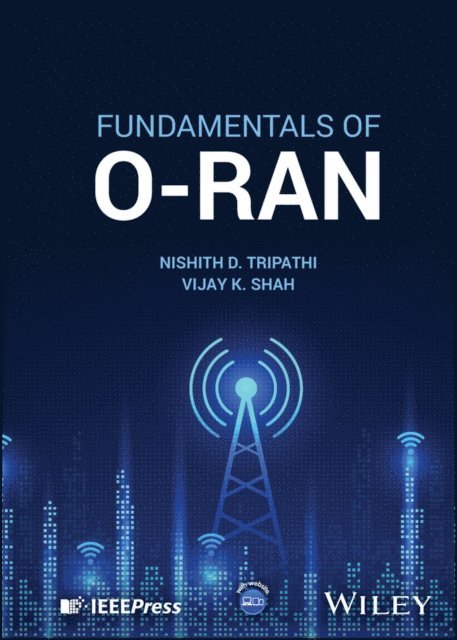
    Fundamentals of O-RAN

    AvNishith D. Tripathi,Vijay K. Shah

    Inbunden, Engelska, 2025

    1 415 kr

    Beställningsvara. Skickas inom 5-8 vardagar. Fri frakt över 249 kr.

    Beskrivning

    Comprehensive reference on O-RAN technology, covering its history, architecture, security, ecosystem, and more, with didactic resources included throughout Discussing both basic and advanced concepts, Fundamentals of O-RAN delivers a comprehensive summary of O-RAN, covering its history, architecture, control loops and microservices (i.e., xApps and rApps), security, ecosystem, R&D initiatives, and challenges and evolution toward 6G. The book not only includes key theoretical principles of O-RAN, but also provides a framework for the reader to carry out guided hands-on exercises through online auxiliary materials. Homework problems and review questions are included in online auxiliary materials to reinforce learning. The book includes instructions on how to create xApps, which are expected to be one of the most promising aspects of O-RAN; for example, by working with an end-to-end O-RAN system using a network slicing functionality where the rApp provides slicing specified policies to the xApp which then allocates the base station’s spectrum resources based on the slicing policy to each user (belonging to a certain slice). Readers will also gain an understanding of cellular networks, particularly radio access networks, software virtualization, and software-defined networking concepts, and the knowledge needed to design, build, and test a 5G O-RAN system. Some of the sample topics explored in Fundamentals of O-RAN include: RAN evolution from black box 4G RAN to software-based and virtualized RAN (vRAN)Components of the O-RAN architecture including SMO, Non-RT RIC, Near-RT RIC, O-CU-CP, O-CU-UP, O-DU, O-RU, and O-CloudxApp design and prototyping from scratch using open cellular software, srsRAN and O-RAN Software Community (OSC) software.Examination of various security dimensions inherent in the O-RAN architecture.Testing and integration, covering Open Test and Integration Centers (OTICs), global PlugFests, certification and badging, and end-to-end test specificationsWork Groups (WGs), including WG1 to WG11, and focus groups, with information on how to obtain WG specificationsFundamentals of O-RAN is an essential reference for the workforce of tomorrow’s cellular industry, including graduate students, teachers, researchers, faculty members, engineers, and employees involved in the field of wireless networks, especially radio networks.

    Produktinformation

    • Utgivningsdatum:2025-01-28
    • Mått:263 x 184 x 30 mm
    • Vikt:907 g
    • Format:Inbunden
    • Språk:Engelska
    • Antal sidor:336
    • Förlag:John Wiley & Sons Inc
    • ISBN:9781394206803

    Utforska kategorier

    • Elektronik och kommunikationer inom Naturvetenskap och teknik

    Mer om författaren

    Dr. Nishith D. Tripathi is a Research Associate Professor at Virginia Tech. Dr. Tripathi has 24 years of industry experience at Nortel Networks, Huawei Technologies, Award Solutions, and Samsung Research America. He is a co-author of five books related to cellular communications, AI, 5G, and NTN. Dr. Vijay K. Shah is an Assistant Professor at North Carolina State University. Prior to joining NC State, he was an Assistant Professor at George Mason University (GMU) and a Research Assistant Professor at Virginia Tech.

    Innehållsförteckning

    • About the Authors xiiiPreface xvAcknowledgments xixAcronyms xxiAbout the Companion Website xxxi1 Introduction to O-RAN 11.1 Evolution of Cellular Technologies 11.2 Components of Cellular Systems 31.3 Evolution of the RAN 41.3.1 Horizontal Disaggregation of RAN: A Protocol Perspective 51.4 Introduction to the O-RAN ALLIANCE and the O-RAN Architecture 71.4.1 O-RAN ALLIANCE: A Brief Overview 71.4.2 The O-RAN Architecture in a Nutshell 81.4.3 Groups in the O-RAN ALLIANCE 101.5 Driving Forces Behind O-RAN 101.6 O-RAN Ecosystem 121.7 O-RAN Use Cases 141.7.1 Context-Based Dynamic HO Management for V2X 141.7.2 Flight Path-Based Dynamic UAV Radio Resource Allocation 151.7.3 Radio Resource Allocation for UAV Application Scenario 151.7.4 QoE Optimization 161.7.5 Traffic Steering 161.7.6 Massive MIMO Beamforming Optimization 161.7.7 RAN Sharing 171.7.8 QoS-Based Resource Optimization 171.7.9 RAN Slice SLA Assurance 171.7.10 Multivendor Slices 181.7.11 3GPP 4G/5G Dynamic Spectrum Sharing (DSS) 181.7.12 NSSI Resource Allocation Optimization 181.7.13 Local Indoor Positioning in RAN 191.7.14 Massive MIMO SU/MU-MIMO Grouping Optimization 191.7.15 O-RAN Signaling Storm Protection 191.7.16 Congestion Prediction and Management 201.7.17 Industrial IoT Optimization 201.7.18 BBU Pooling to Achieve RAN Elasticity 211.7.19 Integrated SON Function 221.7.20 Shared O-RU 221.7.21 Energy Saving 231.7.22 MU-MIMO Optimization 231.7.23 Sharing Non-RT RIC Data with the Core 231.7.24 Industrial Vision SLA Assurance 251.7.25 Non-Public Network (NPN) RAN-Sharing via Midhaul for Multioperator Coverage 251.7.26 Interference Detection and Optimization 251.8 O-RAN: Accomplishments, Technical Priorities, and Potential Future Work 261.8.1 O-RAN Accomplishments 261.8.2 O-RAN Technical Priorities 261.8.3 Role of O-RAN Beyond 5G 271.9 Major Takeaways of the Chapter 27References 282 O-RAN Architecture 312.1 O-RAN Logical Architecture 312.2 O-RAN Components: A Closer Look 342.2.1 SMO and Non-RT RIC: A Closer Look 342.2.1.1 SMO Support for FCAPS to O-RAN Network Functions 342.2.1.2 SMO: O-Cloud Management, Orchestration, and Workflow Management 352.2.1.3 Non-RT RIC 352.2.1.4 Logical Functions in the Non-RT RIC Framework or the SMO Framework 382.2.2 Near-RT RIC 392.2.3 O-CU-CP 422.2.4 O-CU-UP 432.2.5 O-DU 442.2.6 O-RU 452.2.7 O-eNB 462.2.8 O-Cloud 472.3 O-RAN Interfaces: A Closer Look 492.3.1 O1 Interface 492.3.2 O2 Interface 522.3.3 A1 Interface 532.3.3.1 A1 Policies and A1 Policy Management 532.3.3.2 A1 Enrichment Information (EI) and A1 EI Service 542.3.3.3 ml Model Management Service 542.3.3.4 A1 Interface Protocol Stack 542.3.4 E2 Interface 552.3.5 Open FH Interface 582.3.5.1 M-Plane: A Closer Look 582.3.5.2 CUS-Plane: A Closer Look 602.3.6 O-Cloud Notification Interface 632.3.7 CTI (Cooperative Transport Interface) 632.3.8 3GPP Interfaces Relevant to O-RAN 652.4 Functional Split 7.2x 662.5 Inside O-RAN Domain: Functional Distribution Between O-RAN and Other SDOs 682.6 O-RAN Deployment Scenarios 682.6.1 Hierarchical Cloud Architecture 682.6.2 O-RAN Cloud Deployment Scenarios 692.6.3 Example Mapping of O-RU Functions to Hierarchical O-RAN Cloud Architecture 702.7 Major Takeaways of the Chapter 71References 723 O-RAN Applications: xApps and rApps 753.1 O-RAN Control Loops 753.2 Near-RT Control Loop: Near-RT RIC and xApps 763.2.1 Near-RT Internal Components of the Near-RT RIC 763.2.2 Open-Source Near-RT RIC Implementations 783.3 Near-RT RIC xApps: Enabling RAN Customization 793.3.1 Defining xApps 793.3.2 Embracing Evolving Standards 803.4 E2 Interface: Empowering RAN Control and Data Exchange 813.4.1 E2 Application Protocol (E2AP) 823.4.2 E2 Service Models 843.5 xApp Use Cases 863.5.1 KPIMON xApp 863.5.2 RAN Slicing xApp 883.5.2.1 RAN Slicing Configuration and Resource Allocation 893.5.2.2 Throughput Performance 893.6 Machine Learning (ML)-Based xApps 903.6.1 AI/ML Workflow 903.6.1.1 Data Collection and Processing 913.6.1.2 Training 913.6.1.3 Validation and Publishing 913.6.1.4 Deployment 913.6.1.5 AI/ML Execution and Inference 913.6.1.6 Continuous Operations 913.6.2 Example ML-Based xApp Use Cases 923.7 xApp Workflow 933.8 xApp Development: A Closer Look 943.8.1 Undeployment/Removal of xApps 1013.9 Non-RT Closed Loop: Non-RT RIC and rApps 1023.9.1 Requirements for the Non-RT RIC Framework 1023.9.2 Non-RT RIC Architecture 1033.9.2.1 A1 Interface: General Principles 1043.9.2.2 Role of the A1 Interface 1053.9.2.3 A1-P Management Service (A1-P) 1063.9.2.4 A1 Enrichment Information Service (A1-EI) 1063.9.2.5 A1 ML Model Management Service (A1-ML) 1073.9.3 R1 Interface 1083.9.3.1 R1 Service Definitions 1093.9.4 Service Management and Orchestration 1123.9.5 rApp Use Cases 1133.9.5.1 Traffic Steering Use Case 1133.9.5.2 QoE Use Case 1143.9.5.3 Operational Flow 1143.10 Real-Time RIC Closed Loop: RT RIC and μApps/dApps 1153.10.1 Resource Block (RB) Scheduling μApp 1173.10.1.1 Workflow for a RB Scheduling μApp 1173.10.1.2 Other Features and Future Directions 1173.10.2 Beam Management dApp Use Case 1183.10.2.1 Key Elements and Their Functions 1183.10.2.2 Operational Flow for Beam Management 1183.11 Multi-time-scale RIC Framework 1193.11.1 Use Case: SPARC for Multi-Site Spectrum Management 1203.11.2 Key Elements and Operational Flow for SPARC Framework 1203.12 Major Takeaways of the Chapter 121References 1224 O-RAN Security 1254.1 Motivation for O-RAN Security 1254.1.1 Vulnerabilities of O-RAN Compared to Non-O-RAN Implementations 1264.1.2 Scope of O-RAN Security Specifications 1274.1.2.1 Within O-RAN Security Scope 1274.1.2.2 Outside O-RAN Security Scope 1284.1.3 Critical Assets 1284.1.3.1 Critical Data Assets 1294.1.3.2 Critical Component Assets 1294.1.4 Protection Levels 1304.2 Methodology of O-RAN Security Analysis 1304.2.1 Stage 1: Risk Identification 1304.2.2 Stage 2: Risk Assessment 1334.2.3 Stage 3: Risk Treatment 1334.3 Threat Model 1344.3.1 Building Blocks of the Threat Model 1344.3.2 An Overview of O-RAN Security Threats 1354.3.2.1 Threats Against O-RAN System 1354.3.2.2 Threats Against O-Cloud 1384.3.2.3 Threats to Open-Source Code 1414.3.2.4 Physical Threats 1414.3.2.5 Threats Against 5G Radio Networks 1424.3.2.6 Threats Against ML System 1424.3.2.7 Protocol Stack Threats 1434.3.3 O-RAN Threat Agents 1434.3.4 Potential Security Vulnerabilities of O-RAN 1454.4 Risk Assessment 1454.4.1 Key Elements of Risk Assessment 1464.4.2 O-RAN Risk Assessment Analysis: A Brief Overview 1484.5 Security Principles, Security Requirements, and Security Controls in O-RAN 1524.5.1 O-RAN Security Principles 1524.5.2 Security Requirements for O-RAN 1574.5.3 Security Controls for O-RAN 1594.6 O-RAN Security Protocols 1614.6.1 Security Protocols in a Nutshell 1614.6.2 SSH 1614.6.3 TLS 1624.6.4 DTLS 1624.6.5 NETCONF over Secure Transport 1634.6.6 IPsec 1634.6.7 CMPv 2 1644.6.8 OAuth 2.0 1654.7 O-RAN Security Testing 1654.7.1 Tools for O-RAN Security Testing 1664.7.2 Test Report Template 1664.7.3 Security Testing Framework 1684.7.3.1 Security Protocol Validation 1684.7.3.2 Common Network Security Tests and System Security Tests for O-RAN Components 1714.7.3.3 Software Security Evaluation 1744.7.3.4 Open Fronthaul Security Validation 1754.7.3.5 Validation of O-RAN-Component-Specific Security Protection Mechanisms 1754.7.3.6 Security Testing of xApps and rApps 1774.7.3.7 Validation of Miscellaneous Components 1784.8 Major Takeaways of the Chapter 178References 1795 O-RAN Ecosystem 1815.1 Internal and External O-RAN Ecosystems 1815.2 Internal O-RAN Ecosystem 1825.2.1 Work Groups of O-RAN Specification Efforts 1825.2.1.1 WG1 Work Products 1835.2.1.2 WG2 Work Products 1835.2.1.3 WG3 Work Products 1845.2.1.4 WG4 Work Products 1845.2.1.5 WG5 Work Products 1845.2.1.6 WG6 Work Products 1845.2.1.7 WG7 Work Products 1845.2.1.8 WG8 Work Products 1855.2.1.9 WG9 Work Products 1855.2.1.10 WG10 Work Products 1855.2.1.11 WG11 Work Products 1865.2.2 Focus and Research Groups of O-RAN 1865.2.3 Testing and Integration Entities 1915.2.4 O-RAN Demonstrators and O-RAN Field Trials and Development Entities 1945.2.5 O-RAN Software Community 1955.3 External Ecosystem 1965.3.1 Standards Developing Organizations (SDOs) 1975.3.2 Commercial Developers of xApps and rApps 1985.3.3 System Integrators 1995.3.4 Service Providers 2005.3.5 Government Entities 2005.3.6 Industry Organizations 2005.3.7 Academic Institutions 2005.4 O-RAN: A Deployment Perspective 2015.5 Major Takeaways of the Chapter 203References 2036 O-RAN Testing and Integration 2076.1 O-RAN Testing and Integration in a Nutshell 2076.2 Test Specifications 2086.2.1 Conformance and Interoperability Testing 2086.2.1.1 O-RAN A1 Interface: Test Specification 2086.2.1.2 O-RAN E2 Interface Test Specification 2116.2.1.3 O-RAN Fronthaul Conformance Test Specification 2136.2.1.4 O-RAN Fronthaul Interoperability Test Specification 2166.2.1.5 O-RAN WG5 Interoperability Test Specification 2176.2.1.6 O-RAN Cloud Conformance Test Specification 2186.2.1.7 O-RAN O-Cloud Interoperability Test (IOT) Specification 2196.2.1.8 O-RAN Stack Interoperability Test Specification 2206.2.2 End-to-End Testing 2206.2.2.1 O-RAN End-to-End Test Specification 2216.2.2.2 Functional Tests 2246.2.2.3 Performance Tests 2246.2.2.4 Service Tests 2256.2.2.5 Load and Stress Tests 2256.2.2.6 RIC-Enabled E2E Use Case Tests 2256.3 Open Testing and Integration Centers 2266.4 Global PlugFests 2276.5 Certification and Badging 2286.6 Major Takeaways of the Chapter 229References 2307 O-RAN Research and Development Initiatives 2337.1 Industry-Led Initiatives 2337.1.1 O-ran Alliance 2337.1.1.1 O-RAN Specifications 2337.1.1.2 O-RAN Software 2337.1.1.3 O-RAN Demonstrations 2347.1.1.4 Testing and Integration of O-RAN Implementations 2347.1.2 Telecom Infra Project (TIP) 2347.1.2.1 Component Subgroup 2357.1.2.2 Segment Subgroup 2377.1.3 Open Networking Foundation (ONF) 2377.1.4 Cloud Service Providers 2417.1.5 Major Telecom Vendors 2417.1.6 Major Telecom Operators 2447.1.6.1 North America 2457.1.6.2 Japan 2467.1.6.3 India 2467.1.6.4 Thailand 2477.1.6.5 Indonesia 2477.1.6.6 Malaysia 2477.1.6.7 Australia 2477.1.6.8 Europe 2477.1.6.9 South America 2487.1.6.10 Africa 2487.1.6.11 Middle-East 2497.1.7 Major Testing Vendors 2497.2 Government-Led Initiatives 2517.2.1 NTIA Wireless Innovation Fund 2517.2.2 The RIC Forum 2517.2.3 DoD Innovate Beyond 5G Program 2517.2.4 DoD and National Spectrum Consortium Effort on O-RAN Acceleration 2527.2.5 DoD and OUSD 5G Challenge 2527.2.6 National Defense Authorization Act (NDAA) 2527.3 Academia-Led Initiatives 2537.3.1 Open AI Cellular (OAIC) Platform 2537.3.2 Colosseum 2557.3.3 OpenRAN Gym 2567.3.4 ColO-RAN Platform 2567.3.5 Powder 2577.3.6 Commonwealth Cyber Initiative (CCI) xG Testbed 2587.3.7 AERPAW Testbed 2597.3.8 ARA Testbed 2607.3.9 5GENESIS Consortium 2607.3.10 5G-EmPOWER 2617.4 Major Takeaways of the Chapter 261References 2618 O-RAN Challenges and Evolution of O-RAN Toward 6G 2658.1 O-RAN Challenges and Solutions 2658.1.1 O-RAN Challenges and Solutions: An Overview 2658.1.2 O-RAN Challenges and Solutions: A Closer Look 2668.1.2.1 Orchestration and OAM 2668.1.2.2 Performance 2678.1.2.3 Security 2698.1.2.4 Product Development 2708.1.2.5 Total Cost of Ownership 2708.1.2.6 Interoperability 2718.1.2.7 RAN Product Performance 2718.1.2.8 Multivendor Operational Complexity 2728.2 6G:A Concise Introduction 2738.2.1 6G Usage Scenarios 2738.2.1.1 Immersive Communications 2748.2.1.2 Massive Communication 2748.2.1.3 HRLLC 2748.2.1.4 Ubiquitous Connectivity 2748.2.1.5 Integrated AI and Communication 2748.2.1.6 Integrated Sensing and Communication 2748.2.2 6G Capabilities and Performance Targets 2748.2.3 6G Technology Enablers 2768.2.3.1 Component Technologies 2768.2.3.2 Radio Technologies 2778.2.3.3 System and Network Architectures 2778.2.3.4 OAM and Service Enablement 2778.2.3.5 Trustworthiness 2778.3 O-RAN in 6G 2778.3.1 Use Cases 2788.3.2 Domains for 6G Architecture 2798.3.3 O-RAN Architecture Work Areas 2798.3.4 New Air Interface 2798.3.5 O-RAN Components in the 6G Network 2808.3.6 Priorities of Network Layers 2808.3.7 Tools 2808.3.8 Security 2808.3.9 Resilience 2808.4 Major Takeaways of the Chapter 281References 282Appendix A Energy Efficiency in Open Radio Access Networks 283Index 291