• Fri frakt över 249 kr
  • •
  • Snabba leveranser
  • •
  • Billiga böcker
Kundservice

Du är på sajten för privatpersoner.

Företag, bibliotek eller offentlig verksamhet?

Du handlar på classic.bokus.com, där alla dina funktioner finns intakta.
Till classic.bokus.com
Bokus logotyp. Gå till startsidan.
  • Erbjudanden
  • Nyheter
  • Student
  • Topplistor
  • Barn & ungdom
  • Bokus Play
  • E-böcker
  • Pocketböcker
  • Spel & pussel

10% studentrabatt med kod TERM26

Sidfot

Mina sidor

    Hjälp

    • Kundservice
    • Vanliga frågor och svar
    • Frakt och leverans
    • Retur vid ångerrätt
    • Reklamera vara
    • Betalning
    • Köpvillkor
    • Allmänna villkor
    • Information om webbplatsens tillgänglighet

    Om Bokus

    • Om oss
    • Pressrum
    • För studenter
    • För företag
    • För bibliotek och offentlig verksamhet
    • För leverantörer
    • Hållbarhet

    Populärt

    • Aktuella erbjudanden
    • Presentkort
    • Studentlitteratur
    • Nya böcker
    • Topplistor
    • Signerade böcker
    • Engelska böcker

    Inspiration

    • Boktips
    • BookTok
    • Populära bokserier
    • Barnbokskaraktärer
    • Populära författare
    Logotyp för Bokus
    Följ oss på Facebook (extern länk)Följ oss på Instagram (extern länk)Följ oss på YouTube (extern länk)Följ oss på TikTok (extern länk)
    bokus @ CookiesAnpassa cookiesIntegritetspolicyKöpvillkor
    Till Citymail hemsida (extern länk)Till Budbee hemsida (extern länk)Till Postnord hemsida (extern länk)Till Schenker hemsida (extern länk)Till Early Bird hemsida (extern länk)Till Walleys hemsida (extern länk)
    1. Ekonomi och Ledarskap
    2. Företagsekonomi
    3. Redovisning och finansiering
    4. Finansiering

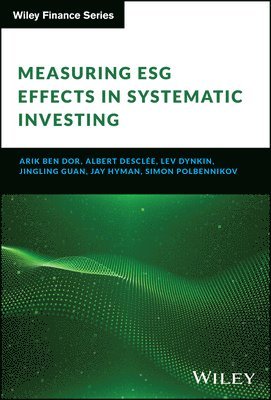
    Measuring ESG Effects in Systematic Investing

    AvArik Ben Dor,Albert Desclee

    Inbunden, Engelska, 2024

    Del i serien Wiley Finance Series

    1 111 kr

    Beställningsvara. Skickas inom 5-8 vardagar. Fri frakt över 249 kr.

    Beskrivning

    A unique perspective on the implications of incorporating ESG considerations in systematic investing In Measuring ESG in Systematic Investing, a team of authors from Barclays’ top-ranked Quantitative Portfolio Strategy group (ranked #1 by Institutional Investor in its 2022 Global Fixed Income Research Survey in both the US and Europe) delivers an insightful and practical discussion of how to reflect ESG considerations in systematic investing. The authors offer a cross-asset class perspective—incorporating both credit and equity markets in the United States, Europe, and China—a unique coverage scope amongst books on this subject. They discuss the interaction between ESG ratings and various other security characteristics, suggest a methodology for isolating the ESG-specific risk premia, analyse the impact of an ESG tilt on systematic strategies and risk factors, and identify several ESG-based signals that are predictive of future performance.You’ll also discover: Analysis of companies in the process of improving their ESG ranking (“ESG improvers”) vs. firms with best-in-class ESG ratingsA study using natural language processing (NLP) to predict changes in corporate ESG rankings from company job postings for sustainability-related positionsIn-depth explorations of ESG equity fund performance and flows and the information content of ESG ratings dispersion across several providersPerfect for portfolio managers including non-quantitative, fundamental investors, risk managers, and research analysts at financial institutions such as asset managers, pension funds, banks, sovereign wealth funds, hedge funds, and insurance companies, Measuring ESG in Systematic Investing is also a must-read resource for academics with a research interest in the performance and risk implications of ESG investing.

    Produktinformation

    • Utgivningsdatum:2024-04-11
    • Mått:160 x 234 x 31 mm
    • Vikt:612 g
    • Format:Inbunden
    • Språk:Engelska
    • Serie:Wiley Finance Series
    • Antal sidor:416
    • Förlag:John Wiley & Sons Inc
    • ISBN:9781394214785

    Utforska kategorier

    • Finansiering inom Ekonomi och Ledarskap

    Mer om författaren

    LEV DYNKIN, PHD is the founder and Global Head of the Quantitative Portfolio Strategy (QPS) Group at Barclays Research. Lev and QPS joined Barclays in 2008 from Lehman Brothers, where they had been a part of Global Research since 1987 and helped launch the Lehman fixed income indices. QPS was ranked #1 in its category in the US and Europe in the 2023 Institutional Investor Global Fixed Income Research survey and was top-ranked for the past 15 years. Lev and QPS co-authored 4 books: Systematic Investing in Credit, Wiley, 2021; A Decade of Duration Times Spread (DTS), Barclays, 2015; Quantitative Credit Portfolio Management, Wiley, 2011; Quantitative Management of Bond Portfolios, Princeton Univ. Press, 2007. ARIK BEN DOR, PHD is a Managing Director and a QPS member since 2004. In addition to originating innovative fixed income research for over two decades, he initiated and oversaw QPS extension into equity markets, and the development of cross-market signals between equity and credit markets. Arik co-authored 3 QPS books on quantitative investing, 30 articles in leading industry journals, and is a member of the Journal of Portfolio Management and Journal of Fixed Income editorial boards. He holds a PhD in Finance from the Kellogg Business School at Northwestern University, and worked at Lehman Brothers and Morgan Stanley prior to Barclays. ALBERT DESCLÉE is a Managing Director in Barclays QPS based in London, and is responsible for its European activities. He advises investors on all aspects of portfolio construction. He was ranked 1st in Institutional Investor European Fixed Income Research Survey in the Quantitative Analysis Category from 2019 to 2023. He joined Barclays in 2008 from Lehman Brothers. He graduated from the Catholic University of Louvain (Belgium) and obtained an MBA from INSEAD. JINGLING GUAN, PHD is a Director in Barclays QPS. She works on research related to systematic investing in both equities and credit, including signal development (especially cross-asset-class signals), portfolio construction, and risk hedging. She joined Barclays in 2015. Jingling holds a PhD in Finance from Kellogg School of Management, Northwestern University. JAY HYMAN, PHD is a Managing Director in Barclays QPS. He advises investors and publishes research on all aspects of portfolio structuring and risk management, across multiple asset classes. He has co-authored four books with QPS colleagues. Jay joined Barclays in 2008 from Lehman Brothers, where he worked on quantitative portfolio strategies since 1991. Jay holds a PhD in Electrical Engineering from Columbia University. SIMON POLBENNIKOV, PHD is a Managing Director in Barclays QPS. He is responsible for empirical research of all quantitative aspects of the investment process including systematic strategies and investment styles in fixed income, benchmark customization, tactical allocation, and hedging. Simon joined Barclays in 2008 from Lehman Brothers. Simon holds a PhD in Empirical Finance from Tilburg University, Netherlands.

    Innehållsförteckning

    • Foreword xiiiC.S. Venkatakrishnan, Group Chief Executive Officer, BarclaysPreface xvJeff Meli, Global Head of Research, BarclaysAcknowledgements xviiIntroduction xixLev Dynkin, Global Head of Quantitative Portfolio Strategy, Barclays ResearchPart One: Effect of ESG Constraints on Portfolio Performance and ValuationIntroduction to Part I 1Chapter 1 How Do ESG Criteria Relate to Other Portfolio Attributes? 5Chapter 2 Measuring the ESG Risk Premium: Credit Markets 19Chapter 3 Measuring the ESG Risk Premium: Equity Markets 43Chapter 4 Performance Impact of an ESG Tilt in Sovereign Bond Markets 77Chapter 5 Effect of SRI-Motivated Exclusion on Performance of Credit Portfolios 115Part Two: Systematic Strategies and Factors Subject to ESG ConstraintsIntroduction to Part II 133Chapter 6 Effect of ESG Constraints on Credit Active Returns 137Chapter 7 Incorporating ESG Considerations in Equity Factor Construction 169Part Three: Performance Implications of Companies’ ESG PoliciesIntroduction to Part III 203Chapter 8 ESG Rating Improvement and Subsequent Portfolio Performance 205Chapter 9 Predicting Companies’ ESG Rating Changes Using Job-posting Data 237Chapter 10 The Relationship Between Corporate Governance and Profitability 271Part Four: the Lack of Uniformity in ESG Definitions—Investment ImplicationsIntroduction to Part IV 283Chapter 11 ESG Equity Funds: Looking Beyond the Label 285Chapter 12 Combining Scores from Multiple ESG Ratings Providers 321Chapter 13 The Informational Content of Dispersion in Firms’ ESG Ratings across Providers 337Index 373