• Fri frakt över 249 kr
  • •
  • Snabba leveranser
  • •
  • Billiga böcker
Kundservice

Du är på sajten för privatpersoner.

Företag, bibliotek eller offentlig verksamhet?

Du handlar på classic.bokus.com, där alla dina funktioner finns intakta.
Till classic.bokus.com
Bokus logotyp. Gå till startsidan.
  • Erbjudanden
  • Nyheter
  • Student
  • Topplistor
  • Barn & ungdom
  • Bokus Play
  • E-böcker
  • Pocketböcker
  • Spel & pussel

10% rabatt på allt med kod: NYSTART10 →

Sidfot

Mina sidor

    Hjälp

    • Kundservice
    • Vanliga frågor och svar
    • Frakt och leverans
    • Retur vid ångerrätt
    • Reklamera vara
    • Betalning
    • Köpvillkor
    • Allmänna villkor
    • Information om webbplatsens tillgänglighet

    Om Bokus

    • Om oss
    • Pressrum
    • För studenter
    • För företag
    • För bibliotek och offentlig verksamhet
    • För leverantörer
    • Hållbarhet

    Populärt

    • Aktuella erbjudanden
    • Presentkort
    • Studentlitteratur
    • Nya böcker
    • Topplistor
    • Signerade böcker
    • Engelska böcker

    Inspiration

    • Boktips
    • BookTok
    • Populära bokserier
    • Barnbokskaraktärer
    • Populära författare
    Logotyp för Bokus
    Följ oss på Facebook (extern länk)Följ oss på Instagram (extern länk)Följ oss på YouTube (extern länk)Följ oss på TikTok (extern länk)
    bokus @ CookiesAnpassa cookiesIntegritetspolicyKöpvillkor
    Till Citymail hemsida (extern länk)Till Budbee hemsida (extern länk)Till Postnord hemsida (extern länk)Till Schenker hemsida (extern länk)Till Early Bird hemsida (extern länk)Till Walleys hemsida (extern länk)
    1. Ekonomi och Ledarskap
    2. Företagsekonomi
    3. Redovisning och finansiering
    4. Finansiering

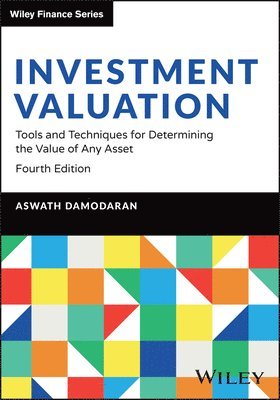
    Investment Valuation

    Tools and Techniques for Determining the Value of Any Asset

    AvAswath Damodaran

    Inbunden, Engelska, 2025

    Del i serien Wiley Finance

    1 443 kr

    Beställningsvara. Skickas inom 5-8 vardagar. Fri frakt över 249 kr.

    Fler format och utgåvor

    E-bok

    1 219 kr

    E-bok

    1 219 kr

    E-bok

    1 015 kr

    E-bok

    1 015 kr

    E-bok

    1 772 kr

    E-bok

    1 772 kr

    Inbunden

    Tillf. slut

    Häftad

    Tillf. slut

    Beskrivning

    Updated edition of the definitive guide to investment valuation tools and techniques Investment Valuation: Tools and Techniques for Determining the Value of Any Asset delves into valuation techniques for a variety of different asset classes, including real options, start-up firms, unconventional assets, distressed companies and private equity, real estate, and many more, and explains how to choose the right model for any given asset valuation scenario. The models are presented with real-world examples so as to capture some of the problems inherent in applying these models, with discussion of differences and common elements between the models to provide readers with a holistic understanding of the subject matter. Written by a professor of finance who is widely regarded as one of the best educators and thinkers on the topic of investment valuation, this newly revised and updated Fourth Edition explores topics including: Understanding financial statements, the basics of risk, and tests and evidence for market efficiencyEstimating risk parameters and costs of financing, terminal value, and equity value per shareUsing scenario analysis, decision trees, and simulations for probabilistic approaches in valuationInvestment Valuation: Tools and Techniques for Determining the Value of Any Asset is an essential resource for all investors and students of financial markets seeking an all-in-one guide to expand their valuation knowledge and make better investment decisions.

    Produktinformation

    • Utgivningsdatum:2025-02-13
    • Mått:178 x 244 x 43 mm
    • Vikt:1 725 g
    • Format:Inbunden
    • Språk:Engelska
    • Serie:Wiley Finance
    • Antal sidor:1 136
    • Upplaga:4
    • Förlag:John Wiley & Sons Inc
    • ISBN:9781394254606

    Utforska kategorier

    • Finansiering inom Ekonomi och Ledarskap

    Mer om författaren

    ASWATH DAMODARAN is Professor of Finance at New York University’s Leonard N. Stern School of Business. He teaches corporate finance and valuation at leading investment banks. He has been the recipient of numerous awards for outstanding teaching, including the NYU Distinguished Teaching Award, and was named one of the nation’s top business school teachers by BusinessWeek. His publications include Damodaran on Valuation, Applied Corporate Finance, The Little Book of Valuation, Investment Philosophies, and The Dark Side of Valuation.

    Innehållsförteckning

    • Preface xvChapter 1 Introduction to Valuation 1A Philosophical Basis for Valuation 1Pricing versus Valuation 2The Bermuda Triangle of Valuation 2Market Efficiency 6The Role of Valuation 7Conclusion 10Questions and Short Problems 10Chapter 2 Approaches to Valuation 13Intrinsic Valuation 13Pricing or Relative Valuation 21Contingent Claim Valuation 25Conclusion 27Questions and Short Problems 27Chapter 3 Understanding Financial Statements 29The Basic Accounting Statements 29Asset Measurement and Valuation 31Measuring Financing mix 38Measuring Earnings and Profitability 44Measuring Risk 50Other Issues in Analyzing Financial Statements 56Conclusion 57Questions and Short Problems 58Chapter 4 The Basics of Risk 61What Is Risk? 61Equity Risk and Expected Return 62Alternative Models for Equity Risk 74A Comparative Analysis of Equity Risk Models 80Models of Default Risk 81Conclusion 85Questions and Short Problems 85Chapter 5 Option Pricing Theory and Models 91Basics of Option Pricing 91Option Pricing Models 94Extensions of Option Pricing 109Conclusion 110Questions and Short Problems 111Chapter 6 Market Efficiency—Definition, Tests, and Evidence 113Market Efficiency and Investment Valuation 113What Is an Efficient Market? 114Testing Market Efficiency 118Cardinal Sins in Testing Market Efficiency 123Some Lesser Sins That Can Be a Problem 124Evidence on Market Efficiency 125Time Series Properties of Price Changes 125Market Reaction to Information Events 133Market Anomalies 137Evidence on Insiders and Investment Professionals 146Conclusion 152Questions and Short Problems 153Chapter 7 Riskless Rates and Risk Premiums 157The Risk-Free Rate 157Equity Risk Premium 162Default Spreads on Bonds 182Conclusion 185Questions and Short Problems 186Chapter 8 Estimating Risk Parameters and Costs of Financing 189The Cost of Equity and Capital 189Cost of Equity 190From Cost of Equity to Cost of Capital 221Best Practices at Firms 233Conclusion 234Questions and Short Problems 234Chapter 9 Measuring Earnings 241The Lead-in: From Accounting Data to Financial Information 241Adjusting Earnings 243Measuring Earnings Power: Clean Up and Time Differences 256Conclusion 266Questions and Short Problems 267Chapter 10 From Earnings To Cash Flows 269The Tax Effect 269Reinvestment Needs 279Conclusion 291Questions and Short Problems 292Chapter 11 Estimating Growth 295The Importance of Growth 295Historical Growth 296Outsourcing Growth 307Fundamental Determinants of Growth 311Top-Down Growth: From Revenue Growth to Free Cash Flows 324Qualitative Aspects of Growth 336Conclusion 337Questions and Short Problems 338Chapter 12 Closure in Valuation: Estimating Terminal Value 341Closure in Valuation 341The Survival Issue 357Closing Thoughts on Terminal Value 360Conclusion 361Questions and Short Problems 361Chapter 13 Narrative and Numbers – Story to Value 363Valuation as a Bridge 363The Importance of Storytelling 364The Dangers in Storytelling 366From Story to Numbers: The Process 368Narrative and Numbers Across the Life Cycle 380Story Resets, Changes, and Breaks 382Conclusion 384Questions and Short Problems 385Chapter 14 Equity Intrinsic Value Models 387Equity Valuation 387The Dividend Discount Model 388The Augmented Dividend Discount Model 404Potential Dividend or FCFE Models 408FCFE Valuation Versus Dividend Discount Model Valuation 428Conclusion 430Questions and Short Problems 431Chapter 15 Firm Valuation: Cost of Capital and Adjusted Present Value Approaches 437Free Cash Flow to the Firm 437Firm Valuation: The Cost of Capital Approach 440Firm Valuation: The Adjusted Present Value Approach 453Firm Valuation: Sum of the Parts 458Effect of Leverage on Firm Value 468Conclusion 477Questions and Short Problems 477Chapter 16 Estimating Equity Value per Share 481Value of Nonoperating Assets 481Firm Value and Equity Value 500Stock-based Compensation 501Value Per Share When Voting Rights Vary 510Conclusion 512Questions and Short Problems 512Chapter 17 Fundamental Principles of Relative Valuation 515Use of Relative Valuation 515Standardized Values and Multiples 516Four Basic Steps to Using Multiples 518Reconciling Relative and Discounted Cash Flow Valuations 530Conclusion 530Questions and Short Problems 531Chapter 18 Earnings Multiples 533Price-Earnings Ratio 533The PEG Ratio 555Other Variants on the PE Ratio 565Enterprise Value to EBITDA Multiple 569Conclusion 577Questions and Short Problems 578Chapter 19 Book Value Multiples 581Price-to-Book Equity 581Value-to-Book Ratios 603Tobin’S Q: Market Value/Replacement Cost 608Conclusion 610Questions and Short Problems 610Chapter 20 Revenue Multiples and Sector-Specific Multiples 613Revenue Multiples 613Sector-Specific Multiples 644Conclusion 653Questions and Short Problems 653Chapter 21 Valuing Financial Service Firms 657Categories of Financial Service Firms 657What Is Unique About Financial Service Firms? 658General Framework for Valuation 659Discounted Cash Flow Valuation 660Relative Valuation 675The Crisis Effect 680Nonbank Financial Service Firms 688Conclusion 691Questions and Short Problems 692Chapter 22 Valuing Money-Losing Firms 695Negative Earnings: Consequences and Causes 695Valuing Money-Losing Firms 700Conclusion 728Questions and Short Problems 728Chapter 23 Valuing Young or Start-Up Firms 733Information Constraints 733General Framework for Analysis 738Value Drivers 750Estimation Noise 751The Expectations Game 753Conclusion 755Questions and Short Problems 756Chapter 24 Valuing Private Firms 757What Makes Private Firms Different? 757Estimating Valuation Inputs at Private Firms 758Valuation Motives and Value Estimates 781Valuing Venture Capital and Private Equity Stakes 786Pricing Private Businesses 789Conclusion 793Questions and Short Problems 793Chapter 25 Acquisitions and Takeovers 795Background on Acquisitions 795Steps in an Acquisition 799Takeover Valuation: Biases and Common Errors 818Structuring the Acquisition 820Improving the Odds 825Analyzing Management and Leveraged Buyouts 828Conclusion 832Questions and Short Problems 833Chapter 26 Valuing Real Estate 837Real Versus Financial Assets 837Real Estate: The Underfollowed Investment Class 838Intrinsic Valuation of Real Estate 843Comparable/Relative Valuation 860Valuing Real Estate Businesses 862Conclusion 864Questions and Short Problems 865Chapter 27 Valuing Other Assets 867Investment classification 867Cash-Flow–Producing Assets 869Collectibles 883Trophy Assets 897Conclusion 904Questions and Short Problems 904Chapter 28 The Option to Delay and Valuation Implications 907Real Options: Promise and Pitfalls 907The Option to Delay a Project 910Valuing a Patent 918Natural Resource Options 925Other Applications 931Conclusion 932Questions and Short Problems 932Chapter 29 The Options to Expand and to Abandon: Valuation Implications 935The Option to Expand 935When Are Expansion Options Valuable? 942Valuing a Firm with the Option to Expand 945Valuing the Optionality in Users and Data 947Value of Financial Flexibility 950The Option to Abandon 953Reconciling Net Present Value and Real Option Valuations 956Conclusion 956Questions and Short Problems 957Chapter 30 Valuing Equity in Distressed Firms 959Equity in Highly Levered Distressed Firms 959Optionality in Valuation: A Corporate Life Cycle Perspective 961Implications of Viewing Equity as an Option 963Estimating the Value of Equity as an Option 966Distressed Equity as an Option: Consequences for Decision-Making 972Conclusion 975Questions and Short Problems 975Chapter 31 Value Enhancement: A Discounted Cash Flow Valuation Framework 977Value-Creating and Value-Neutral Actions 977Ways of Increasing Value 978Value Enhancement Chain 996Closing Thoughts on Value Enhancement 1001Conclusion 1002Questions and Short Problems 1003Chapter 32 Value Enhancement: Economic Value Added, Cash Flow Return on Investment, and Other Tools 1007Economic Value Added 1008Cash Flow Return on Investment 1023A Postscript on Value Enhancement 1028Conclusion 1029Questions and Short Problems 1030Chapter 33 Probabilistic Approaches in Valuation: Scenario Analysis, Decision Trees, and Simulations 1033Scenario Analysis 1033Decision Trees 1038Simulations 1047An Overall Assessment of Probabilistic Risk-Assessment Approaches 1058Conclusion 1060Questions and Short Problems 1061Chapter 34 Overview and Conclusion 1065Choices in Valuation Models 1065Which Approach Should You Use? 1066Choosing the Right Intrinsic Valuation Model 1069Choosing the Right Pricing Model 1074When Should You Use the Option Pricing Models? 1076Conclusion 1078References 1079Index 1091